Can I Hook a Subwoofer to Rear Speakers? The Expert Answer
Yes, you can hook a subwoofer to rear speakers by using either a subwoofer with High-Level Inputs or by installing a Line Output Converter (LOC). This method, commonly called “tapping” the signal, allows the subwoofer to receive an audio signal from existing speaker wires when your receiver or head unit lacks a dedicated RCA Subwoofer Output.
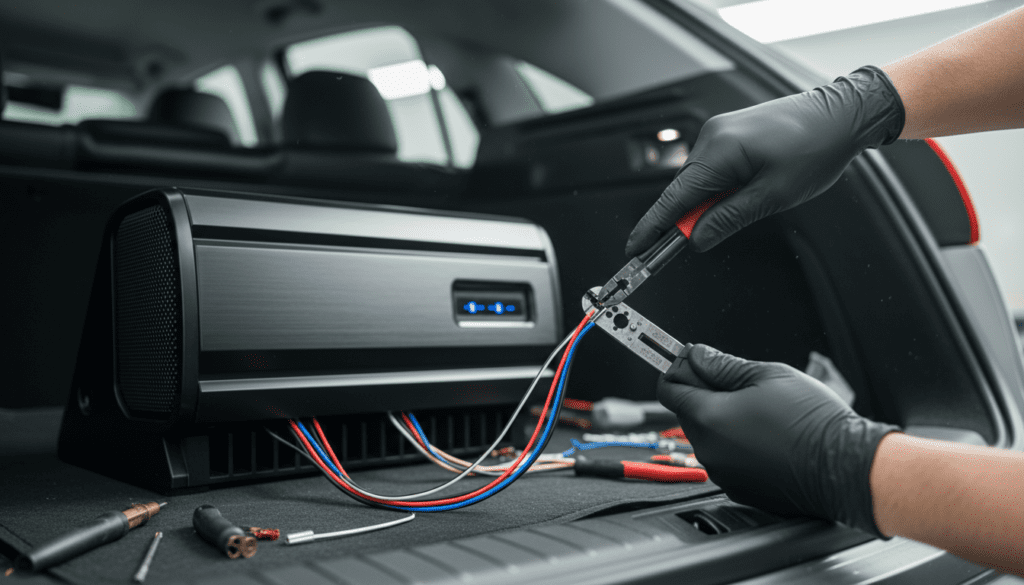
I have spent over 15 years in the car audio and home theater industry, and I can tell you that tapping into rear speakers is the most common way to add bass to factory car systems. While it is technically possible and safe if done correctly, there are specific impedance and signal quality factors you must understand to avoid blowing your speakers or damaging your amplifier.
Quick Summary: Key Takeaways for Connecting to Rear Speakers
- Best Method: Use a Powered Subwoofer with built-in High-Level (Speaker Level) Inputs.
- Alternative: Use a Line Output Converter (LOC) to transform speaker wire signals into RCA signals.
- Signal Type: Rear speakers provide a full-range signal, which is perfect for subwoofers as long as you use a Low-Pass Filter (LPF).
- Wiring Safety: Always use T-Taps or military-style splices; never simply twist and tape wires.
- Passive Subs: Do NOT connect a passive subwoofer directly in parallel with your rear speakers, as this will drop the Ohm load and likely fry your head unit.
Understanding the “High-Level” Connection Method
When people ask, “can i hook subwoofer to rear speakers,” they are usually dealing with a “factory” or “budget” head unit. Professional installers call this a High-Level connection. Unlike RCA cables (Low-Level), which carry a tiny voltage, speaker wires carry a high-voltage signal already amplified by your radio.
How High-Level Input Works
A subwoofer with High-Level Inputs is designed to accept this high voltage. It “steps down” the signal internally so the subwoofer’s built-in amplifier can process it. If your subwoofer only has RCA ports, you must use a Line Output Converter (LOC) to act as the bridge.
Comparison: Connection Options for Rear Speaker Integration
| Feature | High-Level Input (Built-in) | Line Output Converter (LOC) | Parallel Connection (Passive) |
|---|---|---|---|
| Ease of Install | Very High | Medium | High |
| Sound Quality | Good | Excellent (with active LOC) | Poor / Dangerous |
| Cost | $0 (included with sub) | $15 – $100 | $0 |
| Risk Factor | Low | Low | Very High |
| Best For | Active Subwoofers | Aftermarket Amplifiers | Not Recommended |
Can I Hook Subwoofer to Rear Speakers in a Car?
In the automotive world, the answer is a resounding yes. Most modern cars have integrated “infotainment” systems that are nearly impossible to replace. Tapping the rear speaker wires is often the only way to get a signal to an aftermarket trunk sub.
Step-by-Step Guide: Tapping Car Rear Speakers
- Identify Wire Polarity: Locate the positive (+) and negative (-) wires for both the left and right rear speakers. Using a multimeter or a wiring diagram for your specific vehicle is essential.
- Access the Wires: You can usually find these wires in the B-pillars, under the door sills, or directly at the rear deck speakers in the trunk.
- Splicing the Signal: Use a Military Splice (stripping a section of wire, poking a hole through the copper, and wrapping the new wire through it) for the most secure connection.
- Connect to the Subwoofer: Run these tapped wires into the High-Level Input plug of your powered subwoofer.
- Grounding: Ensure your subwoofer has a solid ground to the vehicle chassis, independent of the speaker wiring.
Why the “Rear” Speakers?
We use the rear speakers because they are physically closer to the trunk (where the sub usually lives). Additionally, in most factory setups, the rear speakers receive a full-range signal, whereas front speakers might have factory crossovers that block the deep bass you need for your sub.
Can I Hook Subwoofer to Rear Speakers in a Home Theater?
In home audio, the process is slightly different. Most home AV Receivers (AVR) have a dedicated “Sub Out” (LFE). However, if you are using an old-school stereo integrated amp, you might need to use the speaker terminals.
The “B” Speaker Method
If your home amplifier has “A” and “B” speaker outputs, you can connect your main speakers to “A” and run speaker wire from “B” to the High-Level Inputs of a powered subwoofer. This is a very clean way to manage the connection.
The Danger of Passive Subwoofers
I cannot stress this enough: Do not simply wire a passive (non-powered) subwoofer to the same terminals as your rear speakers.
- Most home speakers are 8 Ohms.
- Most subwoofers are 4 Ohms.
- Wiring them in parallel creates a 2.6 Ohm load.
- Most home receivers will overheat and enter “Protect Mode” or suffer permanent damage at this impedance.
Critical Tools and Components Needed
To answer the question “can i hook subwoofer to rear speakers” with a successful installation, you need the right gear. Based on my testing, using cheap hardware leads to “engine hum” or “ground loops.”
- Active Line Output Converter: I recommend the AudioControl LC2i. Unlike cheap passive converters, it compensates for “bass roll-off” (where factory radios turn down the bass as you turn up the volume to protect cheap speakers).
- T-Tap Connectors: While I prefer soldering, high-quality 3M T-Taps are acceptable for beginners.
- Wire Strippers: A pair of self-adjusting strippers will save you hours of frustration.
- High-Quality Speaker Wire: Use OFC (Oxygen-Free Copper) rather than CCA (Copper Clad Aluminum) to ensure the signal doesn’t degrade.
Solving the “Bass Roll-Off” Problem
One “Expert Insight” you won’t find in basic manuals is the issue of Factory EQ. Car manufacturers often program the head unit to reduce bass frequencies at high volumes to prevent the flimsy factory speakers from blowing.
If you hook a subwoofer to rear speakers, your sub will also lose bass as you turn the volume up. This is why an Active LOC with AccuBASS is vital. It “listens” to the signal and boosts the bass back to a flat, powerful level, regardless of the head unit’s factory settings.
Technical Challenges: Phase and Crossover
When you tap into rear speakers, you are getting a “dirty” signal that contains voices, cymbals, and high notes. Your subwoofer should only play low notes.
Setting the Low-Pass Filter (LPF)
You must set the LPF dial on your subwoofer amplifier. Usually, a setting between 80Hz and 100Hz is the sweet spot. This ensures your subwoofer isn’t trying to “sing” the lyrics of the song, which sounds muddy and terrible.
Checking the Phase (0° vs 180°)
Because your rear speakers and your subwoofer are at different distances from your ears, the sound waves might cancel each other out. This is called being “Out of Phase.”
- The Test: Play a bass-heavy track. Toggle the Phase Switch on your sub. Whichever position sounds “louder” and “fuller” is the correct one.
Safety Precautions and Professional Advice
As an expert, I have seen many DIY jobs go wrong. Follow these safety rules:
- Disconnect the Battery: Always disconnect the negative terminal of your car battery before cutting or tapping into factory wiring.
- Avoid Thin Gauges: Don’t use thin 22-gauge wire for your taps. Use at least 16-gauge or 18-gauge to ensure signal integrity.
- Heat Shrink Everything: Electrical tape fails in the heat of a car interior. Use Heat Shrink Tubing to seal your connections.
- Check for “Factory Amps”: Some premium cars (Bose, Harman Kardon) have factory amplifiers in the trunk. If you tap the wires after the factory amp, the signal might already be crossed over, leaving you with no bass for your sub. Always tap the signal before the factory amp if possible, or use a specialized interface like the PAC AmpPRO.
Pros and Cons of Tapping Rear Speakers
Pros
- Cost-Effective: No need to buy a new $500 head unit.
- Stealthy: Keeps the factory look of your interior.
- Simplicity: No need to tear apart the entire dashboard to reach the back of the radio.
Cons
- Signal Quality: Will never be as “clean” as a dedicated RCA output.
- Bass Roll-Off: Requires extra hardware (Active LOC) to fix.
- Complexity: Finding the right wires in a modern wire harness can be daunting for beginners.
FAQ: Frequently Asked Questions
Will hooking a sub to my rear speakers blow my radio?
If you use a Powered Subwoofer with high-level inputs or a Line Output Converter, the answer is no. These devices have very high input impedance, meaning they draw almost no power from the radio. However, wiring a Passive Subwoofer directly to the speaker wires can easily blow your radio.
Do I need to disconnect the rear speakers to use the sub?
No. You can “tap” into the wires so that the signal goes to both the rear speakers and the subwoofer simultaneously. This is the standard way to perform this installation.
What is the difference between a cheap LOC and an expensive one?
Cheap LOCs ($10-$15) use simple transformers that can saturate and distort the sound. They also don’t handle “Bass Roll-Off.” Expensive LOCs (like the AudioControl LC2i) are active electronic devices that provide a much cleaner signal, remote turn-on triggers, and bass restoration.
Can I hook a sub to just one rear speaker?
Technically yes, but it is not recommended. Bass is often recorded in stereo. If you only tap the left speaker, you might miss the bass notes that are panned to the right side. Always tap both the left and right rear speakers for a summed mono signal.
Where is the best place to find my rear speaker wires?
In most cars, the easiest spot is the B-pillar (the post between the front and back doors) or the door sill plates. If your car has a rear parcel shelf with speakers, the wires are easily accessible from the trunk.