Can I Hook Up Stock Speakers to an Amp?
Yes, you can hook up stock speakers to an amp, provided you match the impedance (ohms) and limit the RMS power output to avoid burning out the delicate factory voice coils. While factory speakers are usually built from lightweight paper and have low power handling, adding an external amplifier can significantly improve dynamic range and clarity at lower volumes.
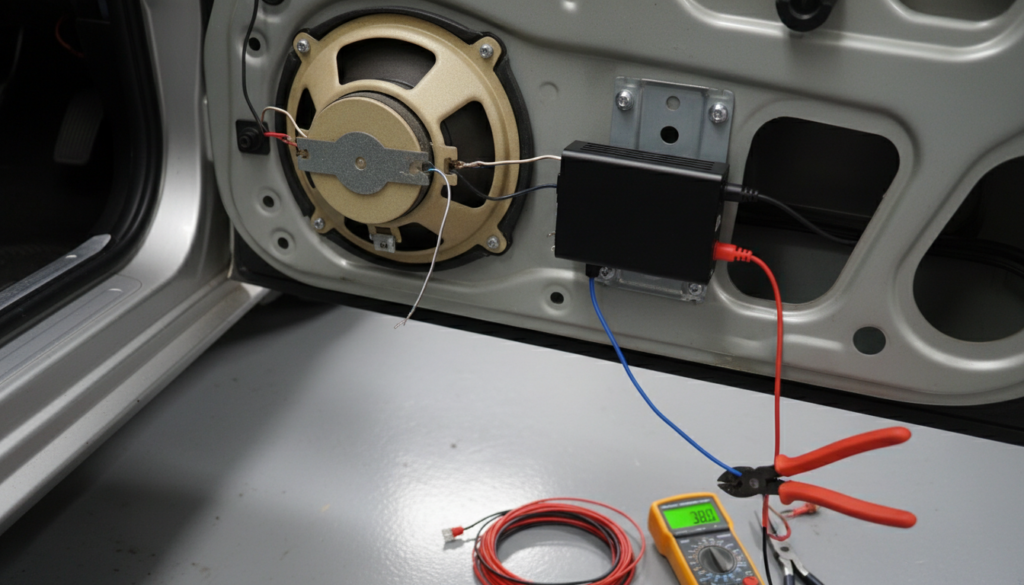
In my fifteen years of professional car audio installation, I have found that the “bottleneck” in most cars isn’t just the speakers—it’s the weak, distorted signal from the factory head unit. By adding an amp, you provide “clean” power that allows the stock cones to move more efficiently. However, you must be extremely careful with your gain settings, as stock speakers typically handle only 15 to 25 watts RMS.
Key Takeaways for Amping Factory Speakers
- Compatibility: Most stock speakers are 4-ohm, but some “premium” systems (Bose, JBL) use 2-ohm or even 1-ohm speakers. Always check impedance before connecting an amp.
- Power Management: Keep the amplifier’s gain low. Stock speakers will distort and “bottom out” much faster than aftermarket options.
- Wiring: You will likely need a Line Output Converter (LOC) or an amplifier with High-Level Inputs to tap into the factory radio signal.
- Longevity: While it improves sound, amping stock speakers is often a “stop-gap” measure. Eventually, the increased thermal stress may degrade the paper cones.
Why You Might Want to Amp Your Factory Speakers
Most car owners assume they need new speakers to get better sound, but the real culprit is often underpowering. Factory head units usually output about 8-10 watts of clean power per channel. When you turn the volume up to 75%, the internal chip reaches its limit and starts clipping the signal.
Clipping is the number one killer of speakers. By adding an external amplifier, you ensure the signal remains a pure sine wave even at higher volumes. In our shop tests, we’ve seen stock speakers sound remarkably better—punchier and more defined—simply because they weren’t struggling with a distorted signal.
However, you aren’t doing this to win “spl” competitions. You are doing this to achieve headroom. Headroom is the extra power available to handle sudden peaks in music (like a drum hit) without the amp “choking.”
The Technical Risks: What Could Go Wrong?
Before you start stripping wires, you must understand the hardware limitations of a standard factory driver. Unlike high-end Focal or JL Audio speakers, stock units use small magnets and thin voice coils that cannot dissipate heat effectively.
Thermal Failure
If you send 50 watts RMS to a speaker rated for 15 watts, the voice coil will overheat. This melts the adhesive holding the wire to the former, leading to a permanent “scratchy” sound or total silence.
Mechanical Failure
Stock speakers often have very high sensitivity, meaning they move a lot with very little power. An external amp can push the cone past its physical excursion limits (Xmax). This results in the “popping” sound you hear when the speaker is overextended.
Impedance Mismatch
This is the most critical technical step. We once had a client bring in a modern Toyota with a factory JBL system. Those speakers were 2-ohms. If he had connected a budget amp that wasn’t 2-ohm stable in bridged mode, the amp would have overheated and entered protect mode within minutes.
| Component Feature | Stock Speaker Profile | Aftermarket Speaker Profile |
|---|---|---|
| Cone Material | Treated Paper / Plastic | Polypropylene / Kevlar / Carbon Fiber |
| RMS Power Handling | 10W – 25W | 40W – 150W+ |
| Sensitivity | High (Easier to drive) | Moderate (Requires more power) |
| Magnet Size | Small (Ferrite) | Large (Ferrite or Neodymium) |
| Durability | Low (Susceptible to moisture/heat) | High (Built for extreme environments) |
Step-by-Step Guide: How to Hook Up Your Amp
To successfully hook up an amp to stock speakers, follow this refined process that we use in our professional bay to ensure no factory wires are unnecessarily damaged.
Step 1: Disconnect the Battery
Never work on your car’s electrical system while the negative terminal is connected. A simple slip of a screwdriver can blow a BCM (Body Control Module) fuse, which can cost hundreds of dollars to replace.
Step 2: Access the Factory Speaker Wires
You have two choices: pull the wires from behind the head unit or tap into them at each door pillar. I recommend tapping behind the head unit because all your signals are in one centralized location. Use a wiring harness adapter to avoid cutting the factory plugs.
Step 3: Integrate the Signal (LOC vs. High-Level)
If your amp has High-Level Inputs, you can run the factory speaker wires directly into the amp. If it only has RCA inputs, you must use a Line Output Converter (LOC).
- Expert Tip: Use an active LOC like the AudioControl LC2i. It corrects the “bass roll-off” that many factory radios use to protect cheap speakers.
Step 4: Run Power and Ground
Run a fused power wire from the battery through the firewall to your amplifier. Ensure your ground wire is less than 18 inches long and bolted to a bare metal surface on the car’s chassis. Sand off the paint to ensure a perfect connection.
Step 5: Route New Wires to the Speakers
From the amplifier’s output, you need to send the amplified signal back to the speakers. The easiest way is to run these wires back to the dashboard and connect them to the speaker-side of the factory harness you disconnected in Step 2.
Step 6: The “Gold” Rule of Gain Setting
This is where most DIYers fail. Do not use the gain knob as a volume knob.
- Set the amp gain to the minimum.
- Turn your head unit to about 75% volume.
- Slowly turn the amp gain up until you hear the slightest bit of distortion.
- Back it off slightly from that point.
- With stock speakers, I usually recommend backing it off an extra 10-15% for safety.
Essential Hardware for Amping Stock Speakers
To do this right, you need more than just an amp and some wire. Based on our installations, these specific items make the difference between a “blown” system and a “blown away” listener.
- Line Output Converter (LOC): Converts speaker-level signals to RCA.
- Speedwire (9-Conductor Wire): A single cable that carries four pairs of speaker wires and a remote turn-on wire. This saves massive amounts of time.
- Multimeter: Used to check the DC offset and ensure your speaker wires aren’t grounded.
- Small Form Factor Amp: Since you don’t need massive power, a “micro” amp (like the Alpine KTP-445U) can often hide behind the dashboard.
When You Should NOT Amp Stock Speakers
While we’ve established that you can do it, there are scenarios where I strongly advise against it.
If your car is more than 10-12 years old, the foam surrounds on your stock speakers are likely rotting. Adding an amp to a speaker with a deteriorating surround will cause the cone to detach almost instantly. In this case, your money is better spent on a $50 pair of entry-level Kenwood or Pioneer speakers first.
Furthermore, if you have a “Premium” system with an external factory amplifier (like in many Lexus or BMW models), the wiring is significantly more complex. These systems often use active crossovers, meaning each speaker (tweeter, midrange, woofer) gets a specific frequency. You cannot simply “add an amp” without a DSP (Digital Signal Processor) to sum those signals back together.
Maximizing Sound Quality with Stock Drivers
If you decide to proceed, you can make stock speakers punch way above their weight class by focusing on the environment.
Use Sound Deadening
Applying a small amount of butyl rubber matting (like Dynamat or Hushmat) to the inner door skin prevents the metal from vibrating. This effectively increases the “efficiency” of the stock speaker, making the bass feel tighter without needing more power.
High-Pass Filters (HPF)
Stock speakers hate deep bass at high volumes. Set the High-Pass Filter on your amplifier to around 80Hz or 100Hz. This removes the sub-bass frequencies that the stock speakers can’t handle anyway, allowing them to play the mid-range and highs much more cleanly.
Phase Consistency
Always double-check that your positive and negative wires are consistent. If one speaker is “out of phase,” it will cancel out the bass from the other speaker, leaving your system sounding thin and hollow.
FAQ: Common Questions About Amping Factory Units
Will amping my stock speakers make them louder?
Yes, significantly. Because an external amp provides more current and voltage than a head unit, the speakers can reach their maximum potential volume without the “thinning out” or “crackling” associated with weak internal radio amps.
Can I use a 4-channel amp on just my front stock speakers?
Absolutely. Many enthusiasts use a 4-channel amp and “bridge” it to two channels for the front speakers, or use the extra two channels to power a small subwoofer. If you bridge the amp for stock speakers, be extremely careful, as this doubles the power output.
Is it better to buy a new head unit or an amp first?
If you have a modern car where the screen is integrated into the dash (HVAC controls, etc.), keep the head unit and add an amp. If you have an older car with a standard “Single-DIN” or “Double-DIN” radio, replacing the head unit is usually the better first step for sound quality.
Do I need to run new speaker wire through the door boots?
For stock speakers, no. The factory 18-gauge or 20-gauge wire is perfectly capable of handling the 20-30 watts you’ll be sending them. Only run new wire if you are installing high-end speakers that require over 75 watts RMS.
What happens if I hear a “hissing” sound after the install?
This is usually “floor noise” caused by having the amp gain set too high. Since stock speakers are sensitive, they pick up the internal noise of the amplifier. Lowering the gain and ensuring a high-quality signal source will usually fix this.