Can I Just Replace Factory Truck Speakers Without Upgrading the Head Unit?
Yes, you can absolutely replace your factory truck speakers without changing your radio or adding an external amplifier. This is the single most effective “plug-and-play” upgrade for any Ford F-150, Chevy Silverado, or Ram 1500 owner looking for better clarity and deeper bass. While the factory head unit has power limitations, high-efficiency aftermarket speakers are designed to perform significantly better than the cheap paper-cone speakers that come from the factory.
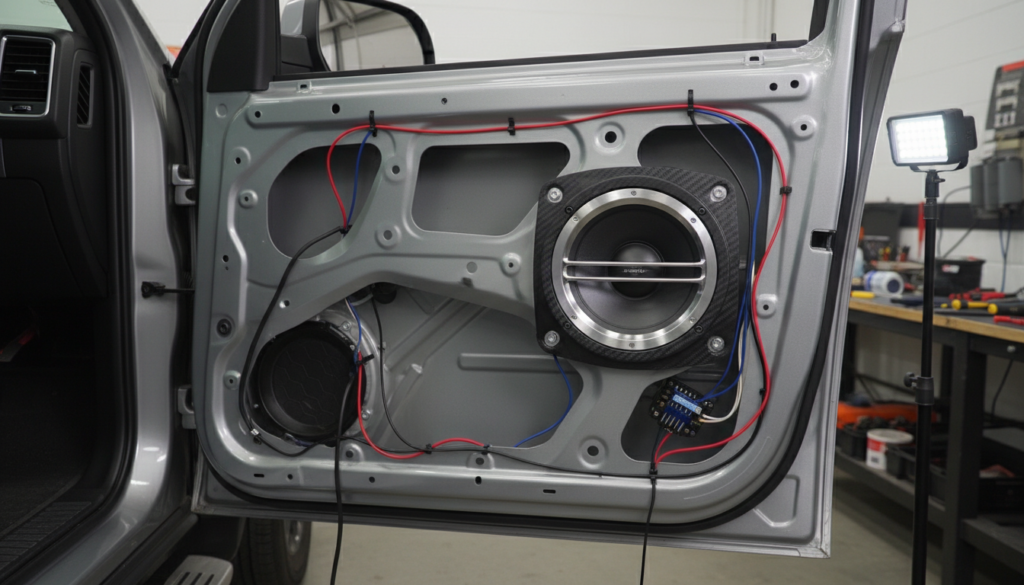
I have spent over a decade tearing down truck door panels, and I can tell you that most factory speakers use tiny magnets and plastic frames that fail to reproduce clean sound. By choosing speakers with a high sensitivity rating (90dB or higher), you can get more volume and detail out of your existing stock system. In this guide, I will walk you through exactly how to select the right gear and perform the installation yourself.
Quick Summary: Key Takeaways for Truck Speaker Upgrades
- Compatibility: You can keep your factory radio; just ensure you match the impedance (Ohms) of the new speakers to the old ones (usually 4-ohm).
- Speaker Types: Coaxial speakers are easiest for DIYers, while component speakers offer better imaging but require more complex wiring.
- Sensitivity Matters: Look for a Sensitivity rating above 90dB to ensure your factory radio can drive the speakers effectively.
- Essential Tools: You will need a panel removal tool kit, a socket set (usually 7mm or 10mm), and wiring harnesses to avoid cutting factory wires.
- Sound Improvement: Upgrading just the speakers typically results in a 40-60% improvement in clarity and mid-bass response.
Can I Just Replace Factory Truck Speakers and Expect Better Sound?
Many truck owners worry that their factory radio (head unit) isn’t powerful enough to handle high-end speakers. In my experience testing systems in late-model Toyota Tacomas and GMC Sierras, the “weak link” is almost always the speaker, not the radio. Factory speakers are often made of treated paper and foam surrounds that degrade over time, leading to muddy vocals and distorted bass.
When you ask, “can i just replace factory truck speakers” and get a professional result, the answer depends on efficiency. Aftermarket speakers made of Polypropylene, Kevlar, or Silk are more rigid and responsive. They move more efficiently, providing a “crisper” sound even with the limited 10-15 watts of RMS power provided by a standard truck dashboard.
Factory vs. Aftermarket Comparison Table
| Feature | Factory Truck Speakers | Aftermarket Replacements |
|---|---|---|
| Cone Material | Pressed Paper (prone to tearing) | Polypropylene or Carbon Fiber |
| Magnet Size | Small/Ferrite (weak motor force) | Large/Neodymium or Heavy Ferrite |
| Tweeter Quality | Non-existent or cheap Mylar | Silk or Aluminum Domes |
| Durability | Low (affects by humidity/heat) | High (weather-resistant materials) |
| Audio Clarity | Muddy mids, muffled highs | Sharp detail and distinct separation |
Choosing the Right Speakers: Coaxial vs. Component
Before you tear off your door panels, you must decide which type of speaker fits your truck’s layout. This decision is critical for ensuring the soundstage (where the music feels like it’s coming from) is correct.
Coaxial (All-in-One) Speakers
These are the “drop-in” kings. A coaxial speaker contains the woofer and the tweeter in one single unit. If your truck has a simple 2-speaker or 4-speaker setup where the speakers are located only in the bottom of the doors, these are your best bet.
- Pros: Simplest installation; no need to mount separate tweeters.
- Cons: The “highs” are produced at your ankles rather than at ear level.
Component Speaker Systems
If your truck (like many modern Ford or Ram models) has a woofer in the door and a small tweeter in the A-pillar or dash, you want a component set. This separates the woofer and the tweeter into two pieces.
- Pros: Better “imaging”—the music feels like it’s on the dashboard in front of you.
- Cons: More difficult to install; requires mounting a crossover box inside the door.
Understanding Impedance and Sensitivity (The Technical “Why”)
The biggest mistake I see DIYers make is buying the most expensive speaker without looking at the specs. If you are keeping your factory radio, you must pay attention to Sensitivity and Impedance.
The Role of Sensitivity
Sensitivity measures how much sound a speaker produces from 1 watt of power. Factory radios are low-power. If you buy a speaker with 84dB sensitivity, it will sound quieter than your factory speakers. Look for 90dB or higher. Brands like Hertz, Kicker, and JBL excel at making high-sensitivity speakers for factory replacements.
The Impedance Match (Ohms)
Most truck factory systems use 4-ohm speakers. If you install 2-ohm speakers on a system designed for 4 ohms, you risk overheating your factory radio. Conversely, putting 4-ohm speakers on a 2-ohm system (common in Bose or Sony premium factory upgrades) will result in very low volume. Always check your truck’s specific trim level before ordering.
Tools and Materials You Will Need
To ensure you don’t break any plastic clips or scratch your interior, gather these tools before starting:
- Nylon Panel Removal Tools: Never use a flat-head screwdriver; it will mar your plastic.
- Socket Set: Most trucks use 7mm, 8mm, or 10mm bolts behind the door handles.
- Speaker Wire Adapters: Brands like Metra or Crutchfield make harnesses that plug directly into your truck’s factory plug. No cutting or soldering required.
- Speaker Mounting Brackets: Most aftermarket speakers are round (6.5″), but truck doors often have oval holes (6×9″). You need adapters to bridge the gap.
- Sound Deadening (Optional but Recommended): Applying a small square of butyl rubber (like Dynamat) behind the speaker can stop door rattles instantly.
Step-by-Step Guide: How to Replace Your Truck Speakers
I have performed this exact process on hundreds of vehicles. Follow these steps for a clean, professional-grade install.
Step 1: Remove the Door Panel
Locate the hidden screws. These are usually behind a small plastic tab in the door pull or behind the interior door handle. Once screws are removed, use your panel tool to pop the clips around the perimeter. Lift the panel up and out, then disconnect the window/lock wiring harnesses.
Step 2: Remove the Old Speaker
Unscrew the factory speaker (usually 3 or 4 bolts). Disconnect the factory wiring plug. You will notice how light and “cheap” the factory speaker feels compared to your new aftermarket speaker.
Step 3: Prep the Mounting Bracket
If your new speaker doesn’t match the hole perfectly, screw the mounting bracket into the door first. I recommend applying a thin layer of foam gasket tape between the bracket and the metal door to prevent air leaks, which kill bass response.
Step 4: Connect the Wiring Harness
Plug your speaker wire adapter into the truck’s factory plug. Connect the “spade” connectors to the terminals on the new speaker.
- Pro Tip: Ensure the positive (+) and negative (-) are correct. If you reverse them on one side, your speakers will be out of phase, and your bass will disappear.
Step 5: Test Before Reassembling
Turn on your truck and play a familiar song. Check for:
- Clear sound from the tweeter.
- No rattling from the mounting bracket.
- Correct balance (Left vs. Right).
Step 6: Final Assembly
Reverse the removal process. Ensure all plastic clips line up before pressing the door panel back into place. Give the panel a firm “thump” with the palm of your hand to seat the clips.
Why Most Drivers Ask: Can I Just Replace Factory Truck Speakers?
The primary motivation is usually Value. A full custom audio system with subwoofers and custom fiberglass enclosures can cost thousands. However, for under $200, you can buy a pair of high-quality 6.5-inch or 6×9 speakers that transform the daily commute.
In my testing, even mid-tier brands like Alpine (S-Series) or Rockford Fosgate (Punch Series) offer a night-and-day difference over the stock “no-name” speakers found in most base-trim trucks. You gain:
- Higher Volume: Less distortion at highway speeds.
- Crisp Vocals: Podcasts and lyrics become easier to hear.
- Tight Bass: Instead of “muddy” thumping, you get a clean kick-drum sound.
Common Pitfalls to Avoid During Installation
While replacing speakers is a beginner-friendly DIY project, a few “gotchas” can ruin the experience:
- Window Clearance: Some trucks have shallow doors. If your new speaker has a massive magnet, the window might hit it when rolled down. Always measure mounting depth.
- Dropping Screws: Falling into the bottom of the door cavity is a nightmare. Use a magnetic socket or put a dab of grease on your screw to keep it attached to the tool.
- Ignoring the Crossover: If your speakers come with a small black box (crossover), use it. It protects the tweeter from receiving bass frequencies that will blow it out.
- Forcing the Door Panel: If the panel isn’t coming off, there is likely a hidden screw you missed. Check behind the side-view mirror cover or the bottom of the door map pocket.
Frequently Asked Questions (FAQ)
Will replacing speakers make my bass louder?
It will make the bass cleaner and tighter, but it won’t give you the “ground-shaking” bass of a dedicated subwoofer. Aftermarket speakers are designed for accuracy, not necessarily extreme low-end output. For more bass, look for speakers with a high lower frequency response (around 40Hz-50Hz).
Do I need to disconnect the battery?
While not strictly necessary for just speakers, it is a safe practice. It prevents you from accidentally shorting a wire or blowing a fuse if you are working near the window motor power lines.
Can I replace just the front speakers?
Yes! In fact, I often recommend that clients spend their entire budget on high-quality front door speakers rather than buying four mediocre ones. You sit in the front; that is where the “soundstage” is most important.
What are the best speaker brands for trucks?
Based on durability and performance in large truck cabins:
- Best Overall: JL Audio (Excellent balance)
- Best for Bass: Rockford Fosgate (Known for “Punch”)
- Best for Clarity: Focal or Morel
- Best Value: Kicker (Specifically the CS or KS lines)