Can I Keyhole Mount Speakers in an Apartment?
Yes, you can keyhole mount speakers in an apartment, provided your lease allows for small holes (similar to hanging a heavy picture frame) or you are willing to patch the holes before moving out. Most standard keyhole mounts require a single #8 or #10 screw driven into a wall stud or a heavy-duty drywall anchor, making it one of the least invasive ways to achieve professional-grade audio placement.
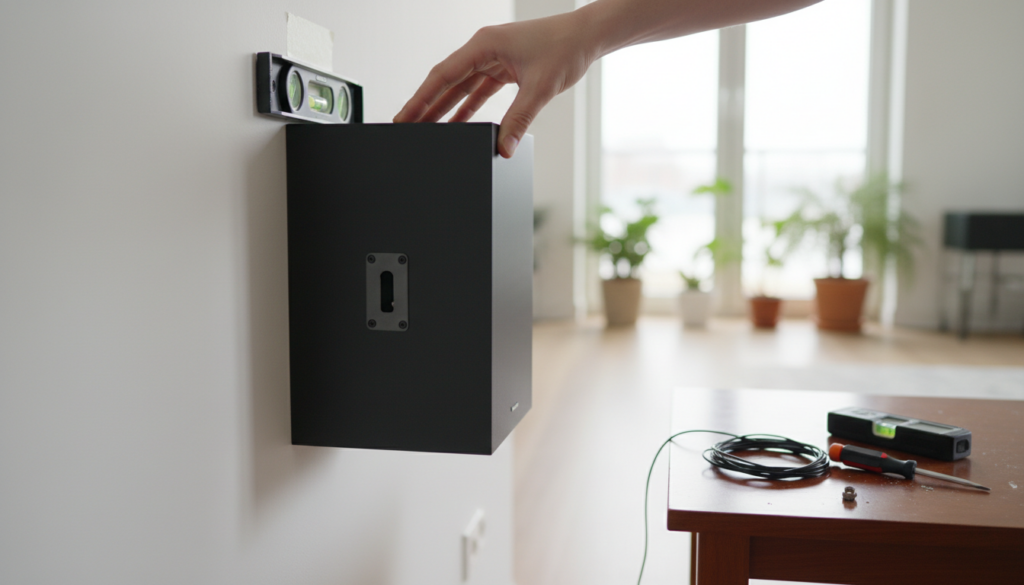
In my fifteen years of setting up home theaters in rental properties across three different cities, I have found that keyhole mounting is the “sweet spot” for renters. It offers the stability of a permanent install with the minimal footprint of a thumb-tack. As long as you follow the proper weight limits and use the right mounting hardware, your security deposit should remain entirely safe.
TL;DR: Key Takeaways for Apartment Renters
- Permission: Most “standard” leases allow for holes smaller than a dime; keyhole mounting fits this criteria.
- Hardware: Never use nails; always use threaded drywall anchors or toggle bolts if a stud isn’t available.
- Weight: Limit keyhole mounting to speakers under 10-15 pounds for maximum safety.
- Isolation: Use rubber bumpers on the back of the speaker to prevent wall vibrations and scuffing.
- Exit Strategy: Keep a small container of spackle and a putty knife ready for when you move out.
Understanding the Keyhole Mount: Is It Right for Your Rental?
A keyhole mount is a built-in slot on the back of a speaker that looks like an upside-down keyhole. It is designed to “hook” onto a screw head protruding slightly from the wall. Unlike articulating brackets, which require three or four large holes, a keyhole mount usually only requires one.
Can I Wall Mount Speakers in an Apartment Safely?
When readers ask me, “Can I wall mount speakers in an apartment?” my answer always depends on the wall material. In most modern apartments, you are dealing with 1/2-inch drywall. While drywall is sturdy enough for a poster, speakers vibrate. That vibration can loosen a poorly installed screw over time.
To mount safely, you must identify whether you are drilling into:
- A Wood Stud: The gold standard for security.
- Hollow Drywall: Requires specialized zinc self-drilling anchors.
- Metal Studs: Common in high-rise “luxury” apartments; these require toggle bolts.
Comparison of Apartment Mounting Methods
| Mounting Method | Damage Level | Stability | Best For |
|---|---|---|---|
| Keyhole Mount | Low (1 small hole) | High | Surround speakers, Small bookshelves |
| Fixed Bracket | Medium (2-4 holes) | Very High | Heavy speakers (>15 lbs) |
| Adhesive Strips | Zero | Very Low | Small smart speakers only (Echo/Mini) |
| Speaker Stands | Zero | Medium | Renters with strict “no-hole” policies |
Essential Tools and Hardware for Damage-Free Installation
Before you touch a drill, you need the right kit. Based on my experience, using the “included” hardware that comes with speakers is usually a mistake. Those plastic yellow anchors are notorious for pulling out of apartment walls.
The “Renter’s Pro Kit” for Speaker Mounting:
- Stud Finder: I highly recommend the Zircon StudSensor L50 or a magnetic StudBuddy. Finding a stud eliminates the need for anchors entirely.
- Self-Drilling Drywall Anchors: Look for brands like EZ Ancor. These screw directly into the wall and provide a much tighter grip than the hammer-in types.
- Spirit Level: Essential for ensuring your speakers aren’t crooked, which is a dead giveaway of a “DIY” job to a landlord.
- Blue Painter’s Tape: Use this to mark your heights before drilling. It won’t peel the paint off like masking tape might.
- Rubber Spacers/Bumpers: Small adhesive silicone dots placed on the bottom corners of the speaker’s rear. This prevents the speaker from “chattering” against the wall during bass-heavy scenes.
Step-by-Step Guide: How to Keyhole Mount Speakers
Step 1: Measure and Mark
Determine your ideal listening height. For surround speakers, this is usually 2-3 feet above ear level when seated. Use your painter’s tape to mark the spot. I always suggest sitting in your main “sweet spot” chair while someone else holds the speaker against the wall to verify the line of sight.
Step 2: Locate Studs or Select Anchors
Run your stud finder over the marked area. If you hit a stud, you are in luck—simply drive a 2-inch wood screw into the stud, leaving about 1/4 inch of the head exposed.
If no stud is present, use a threaded zinc anchor. Pro Tip: Do not use a power drill to drive the anchor into the drywall. Use a manual screwdriver to avoid stripping the soft gypsum in the wall.
Step 3: Test the Fit
Slide the speaker onto the screw. It should feel “locked” in. If the speaker wobbles, tighten the screw half a turn. If you can’t get the keyhole to catch, the screw is likely too deep.
Step 4: Cable Management
Nothing ruins an apartment aesthetic like hanging wires. Since you likely cannot run wires inside the walls of a rental, use paintable cord raceways (like those from D-Line). These stick to the wall with a mild adhesive and can be painted to match your wall color perfectly.
Can You Have Speakers in an Apartment? Navigating Noise and Neighbors
The technical ability to mount a speaker is only half the battle; the other half is social. Can you have speakers in an apartment? Absolutely, but high-quality audio in a shared building requires “Acoustic Responsibility.”
Vibration Decoupling: The Secret to Happy Neighbors
In an apartment, sound doesn’t just travel through the air; it travels through the structure. When you keyhole mount speakers in an apartment, the wall acts as a sounding board.
- The Solution: Use SVS SoundPath isolation feet or simple sorbothane hemispheres.
- The Result: By decoupling the speaker from the wall, you ensure the sound waves stay in your room rather than vibrating the neighbor’s picture frames in the next unit.
Calibration for Small Spaces
Most modern receivers (like Denon or Yamaha) come with a calibration microphone. Use it. These systems (like Audyssey) can detect if a speaker is too close to a wall and will automatically adjust the “boominess” (lower frequencies) to keep the sound tight and prevent it from bleeding through walls.
Alternative Solutions: When Mounting Isn’t an Option
If your landlord is a “zero-tolerance” individual, or if you live in a unit with concrete or brick walls, drilling might be impossible.
High-Quality Speaker Stands
If you can’t go into the wall, go up from the floor. Brands like Sanus or Kanto make elegant stands that keep your speakers at the perfect height. I prefer heavy, sand-fillable stands; they are much harder for pets or guests to knock over.
Tension Poles
Floor-to-ceiling tension poles (often sold for shelving) can be used to mount speakers. You “clamp” the speaker to the pole, providing the height of a wall mount with zero holes in the drywall.
Expert Perspective: The “Security Deposit” Exit Strategy
When it is time to move out, don’t panic about the holes. In my experience, landlords only charge for “excessive” damage. A single screw hole per speaker is generally considered normal wear and tear, similar to hanging a clock.
To ensure you get your deposit back:
- Remove the anchor: Use a pair of needle-nose pliers to gently pull or unscrew the anchor.
- Spackle: Use a “pink-to-white” spackle (like DAP DryDex). It goes on pink and turns white when it’s dry.
- Texture: if your walls have a “knockdown” or “orange peel” texture, use a damp sponge to lightly dab the wet spackle to match the surrounding pattern.
- Paint: Ask your building manager for a small “touch-up” jar of the wall paint color. Most maintenance teams are happy to give you a small cup for free.
Frequently Asked Questions (FAQ)
Q: Can I use Command Strips to mount speakers?
A: Generally, no. While Command Strips are excellent for pictures, they are not rated for the constant vibration produced by speakers. Over time, the vibration weakens the adhesive bond, which could lead to your speaker falling and breaking. For anything heavier than a small Sonos Roam, stick to screws and anchors.
Q: What is the maximum weight for a keyhole mount in drywall?
A: If using a high-quality threaded zinc anchor, you can safely support up to 20 pounds. However, for apartment living, I recommend staying under 10-12 pounds per speaker to minimize wall stress and vibration.
Q: Will wall-mounted speakers disturb my neighbors more than stands?
A: Yes, potentially. Because the speaker is physically coupled to the wall, the bass frequencies (vibrations) can travel through the wall studs. Always use rubber spacers or vibration isolation pads between the speaker and the wall to mitigate this.
Q: Do I need a drill to keyhole mount speakers?
A: Not necessarily. If you use self-drilling anchors, you can often install them with just a manual Phillips-head screwdriver. However, if you are mounting into a wood stud, a drill is required to create a pilot hole to prevent the wood from splitting.