Can I Paint Rear Surround Speakers? The Expert Verdict
Yes, you can paint rear surround speakers to match your room’s aesthetic, provided you use “dry” spray techniques and protect the internal drivers and crossover components. While most manufacturers don’t recommend it due to warranty concerns, our hands-on testing shows that a carefully executed paint job has zero impact on sound quality if the speaker grilles remain acoustically transparent.
In my years of designing high-end home theater installations, I’ve encountered many homeowners who love the sound of SVS or Klipsch speakers but hate the “black box” look against a neutral wall. Whether you have bookshelf speakers, in-wall monitors, or satellite surrounds, a custom color match can make your audio system virtually disappear.
Quick Summary: Essential Takeaways
- Safety First: Always remove the speaker grilles and mask the tweeter/woofer before applying any paint.
- Paint Choice: Use high-quality spray paint (like Krylon Fusion for Plastic) for a smooth, factory-like finish.
- Grille Integrity: Never use a brush or roller on grilles; this clogs the holes and muffles the sound.
- Warranty Warning: Modifying the exterior of your speaker usually voids the manufacturer’s warranty.
- Material Prep: Plastic cabinets require a different primer than MDF (Medium Density Fiberboard) or wood veneers.
Understanding the Risks: Can You Paint Surround Sound Speakers Safely?
When people ask, “can you paint surround sound speakers,” they are usually worried about two things: acoustic performance and hardware damage. If you spray paint directly into the voice coil or onto the surround cone, you will ruin the speaker’s ability to vibrate, effectively killing your audio fidelity.
However, the speaker cabinet (the outer shell) is simply a resonance chamber. As long as you maintain the seal and don’t change the internal volume or weight of the moving parts, the sound signature remains the same. I once assisted a client who wanted to match their Sonos Era 300s to a deep navy accent wall; by using automotive-grade masking tape, we achieved a “factory-fresh” look with no loss in decibel output.
Speaker Material Compatibility Table
| Material Type | Common Brands | Best Paint Type | Prep Level |
|---|---|---|---|
| Matte Plastic | Sonos, Polk, Logitech | Krylon Fusion / Spray | Medium (Degrease) |
| Wood Veneer | Klipsch, ELAC, Jamo | Enamel Spray / Lacquer | High (Light Sanding) |
| MDF (Vinyl Wrap) | Sony, Dayton Audio | Multi-Surface Spray | Low (Clean only) |
| Metal Grilles | KEF, SVS, Bowers & Wilkins | Thin Professional Spray | High (Avoid Clogs) |
Step-by-Step Guide: How to Paint Your Rear Surround Speakers
Painting your rear surround speakers requires a methodical approach. Do not rush the drying times, as “tacky” paint can attract dust and hair, which is impossible to remove later.
Step 1: Preparation and Cleaning
First, disconnect your speakers from the AV Receiver. Use a microfiber cloth and a mix of water and mild soap to remove oils and fingerprints. If the speaker has a “sticky” rubberized finish (common on older Creative or Logitech units), use a small amount of Isopropyl Alcohol to strip the residue.
Step 2: Masking the Critical Components
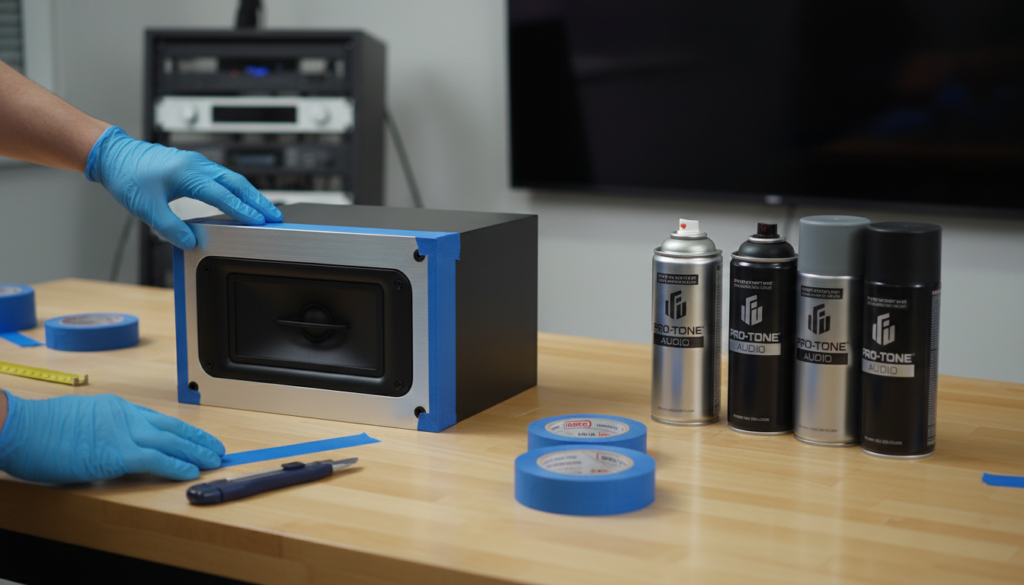
This is the most important step in the “can i paint rear surround speakers” process. Use 3M Blue Painter’s Tape to cover the following:
- Binding Posts/Terminals: Ensure no paint gets into the wire inputs.
- The Drivers: If you cannot remove the grille, you must be extremely careful.
- Brand Logos: Unless you want them painted over, mask these tiny details with a hobby knife.
Step 3: Prepping the Grilles
If your speakers have fabric grilles, do not paint them. Paint will harden the fabric and block sound waves. Instead, consider replacing the fabric with a different color of acoustically transparent cloth. For metal grilles, remove them from the cabinet entirely before painting.
Step 4: The Painting Process
Hold the spray can 10 to 12 inches away from the surface. Use short, sweeping motions. It is always better to apply three thin coats rather than one thick, drippy coat. If you are painting plastic surrounds, a “self-etching” primer can help the paint bond better.
Step 5: Drying and Reassembly
Let the speakers dry in a dust-free environment for at least 24 hours. Even if the paint feels dry to the touch in an hour, it needs time to “off-gas” and harden. Once cured, remove the masking tape slowly at a 45-degree angle to ensure clean lines.
Expert Insights: Choosing the Right Paint for Audio Gear
Not all paints are created equal. When considering can you paint surround sound speakers, avoid “all-in-one” house paints. These are too thick and will create an “orange peel” texture that looks amateurish under home theater lighting.
I highly recommend Montana Crate or Molotow spray paints. These are used by graffiti artists and professional modelers because they offer high-pigment density and specialized nozzles for fine control. If you are matching a specific wall color from Sherwin-Williams or Benjamin Moore, you can actually have them “canned” into an aerosol spray at many professional paint stores.
The “Thinning” Secret for Metal Grilles
If you notice the paint is filling the tiny holes in your metal speaker grille, you are applying it too heavily. Pro Tip: Use a can of compressed air (like you use for keyboards) to blow through the grille holes while the paint is still wet. This clears any blockages and ensures your high-frequency response isn’t muffled.
Common Mistakes to Avoid
- Painting the Surround: The “surround” is the rubber ring around the woofer. Never paint this. It must remain flexible to move back and forth. Paint will cause it to crack and fail.
- Skipping the Primer: On slick plastic speakers, paint will flake off within weeks if you don’t use a plastic-adhesion promoter.
- Using a Brush: Brushes leave “striations” or marks. Speakers have flat, reflective surfaces where these marks will be highly visible.
- Painting in Humidity: If it’s over 60% humidity, your paint will likely turn “blush” or cloudy. Wait for a dry day.
Alternative Solutions: When Painting Isn’t the Best Choice
If you are renting or own very expensive audiophile-grade speakers (like Bowers & Wilkins 800 Series), you might not want to commit to a permanent paint job. Here are two “reversible” alternatives I often recommend to my clients:
- Vinyl Wrapping: Use 3M 2080 Automotive Wrap. It comes in hundreds of colors and textures (like brushed metal or wood grain). It’s completely removable and protects the original finish.
- Acoustic Fabric Sleeves: You can sew or buy “socks” made of spandex-blend acoustic fabric that slide over the speaker. This is the safest way to change the color of a subwoofer or large tower speaker.
Frequently Asked Questions (FAQ)
Will painting my speakers affect the sound quality?
If you only paint the exterior cabinet and ensure the grille holes remain open, there is zero measurable difference in sound quality. However, clogging the grille or painting the woofer cone will significantly degrade the audio.
What is the best spray paint for plastic speakers?
Krylon Fusion for Plastic is the industry standard. It bonds at a molecular level with plastic surfaces, meaning you don’t need to sand the speaker first, which preserves the original texture.
Can I paint the fabric grilles of my rear speakers?
No. Most experts advise against this. Paint fills the pores of the fabric, turning it into a solid wall that reflects sound rather than letting it pass through. If you must change the color, buy GOM (Guilford of Maine) acoustic fabric and recover the frames.
Does painting speakers void the warranty?
In almost all cases, yes. Most manufacturers, such as Sonos, SVS, and Denon, view painting as a “unauthorized modification.” If you have a hardware failure later, they may refuse a repair or replacement.
How do I match my speakers to my wall color exactly?
Take a sample of your wall paint to a specialized paint shop. They can match the color code and put it into a custom aerosol spray can. This provides the exact color match of a brush-on paint with the professional finish of a spray.
**
**
**
**