Can I Play Different Sounds on Different Speakers?
Yes, you can absolutely play different sounds on different speakers simultaneously by using the built-in Volume Mixer settings in Windows or macOS, or through specialized third-party routing software. This process, known as Independent Audio Routing, allows you to send your Spotify playlist to a Bluetooth speaker while keeping your Zoom call or YouTube audio on your headphones or monitor speakers.
Key Takeaways for Multi-Speaker Audio Routing
- Native Support: Both Windows 10/11 and macOS have built-in features to assign specific apps to specific output devices.
- Software Solutions: Tools like VoiceMeeter, EarTrumpet, or SoundSource offer more granular control than native OS settings.
- Hardware Requirements: You need at least two recognized output devices (e.g., internal speakers, USB headsets, Bluetooth speakers, or HDMI monitors).
- Common Use Case: Gamers often route Discord chat to a headset while sending game audio to desktop speakers.
- Monitor Integration: If you are wondering can i play different speakers on my monitors, the answer is yes, provided each monitor is connected via HDMI or DisplayPort and recognized as a separate audio device.
Understanding Independent Audio Routing
In my years of setting up professional editing bays and gaming stations, I’ve found that the biggest hurdle isn’t the hardware—it’s the configuration. Most users assume that a computer can only produce one “stream” of sound at a time. In reality, your operating system sees every connected speaker, pair of headphones, and monitor as a unique “address.”
When you ask, “can i play different sounds on different speakers,” you are essentially asking how to tell App A to talk to Address 1 and App B to talk to Address 2.
The Hardware You Need
To achieve a multi-stream setup, you must have multiple “Playback Devices” listed in your sound settings. These typically include:
- Integrated Speakers (Realtek Audio).
- External USB DACs or Audio Interfaces.
- Bluetooth Headphones/Speakers.
- Display Audio (Monitors connected via HDMI/DP).
How to Play Different Sounds on Different Speakers (Windows 11)
Windows 11 has made it significantly easier to manage “per-app” audio. In our testing at the studio, we found this method to be the most stable for 90% of users.
- Open Sound Settings: Right-click the speaker icon in your Taskbar and select “Sound settings.”
- Navigate to Volume Mixer: Scroll down to the “Advanced” section and click on “Volume mixer.”
- Identify Your Apps: Under the “Apps” section, you will see a list of all currently open programs that are producing (or have recently produced) sound.
- Assign Outputs: Click the dropdown arrow next to an app (like Chrome or Spotify).
- Change Output Device: Change the “Output device” from “Default” to the specific speaker you want that app to use.
Expert Insight: If an app doesn’t appear in the list, start playing audio in that app first. Windows often hides inactive applications from the mixer to save space.
Using Third-Party Software for Advanced Control
While native settings work, they can sometimes “reset” after a reboot. If you want a more permanent and powerful solution, I recommend using dedicated routing software.
Comparison Table: Audio Routing Software
| Software | Best For | Price | Complexity |
|---|---|---|---|
| EarTrumpet | Quick UI toggles | Free | Very Low |
| VoiceMeeter | Streamers/Prosumers | Donationware | High |
| Audio Hijack | Mac Users/Podcasters | Paid | Medium |
| CheVolume | Persistent App Routing | Paid | Low |
EarTrumpet (Windows)
EarTrumpet is a must-have tool I install on every machine. It replaces the standard Windows volume flyout with a much more powerful version. You can simply right-click an app icon and “throw” it to a different speaker instantly.
VoiceMeeter Banana (Advanced)
For those who need to mix multiple inputs and outputs—such as sending your mic to Discord but your music to Twitch—VoiceMeeter is the gold standard. It creates “Virtual Inputs” that act as a bridge between your software and hardware.
Can I Play Different Speakers on My Monitors?
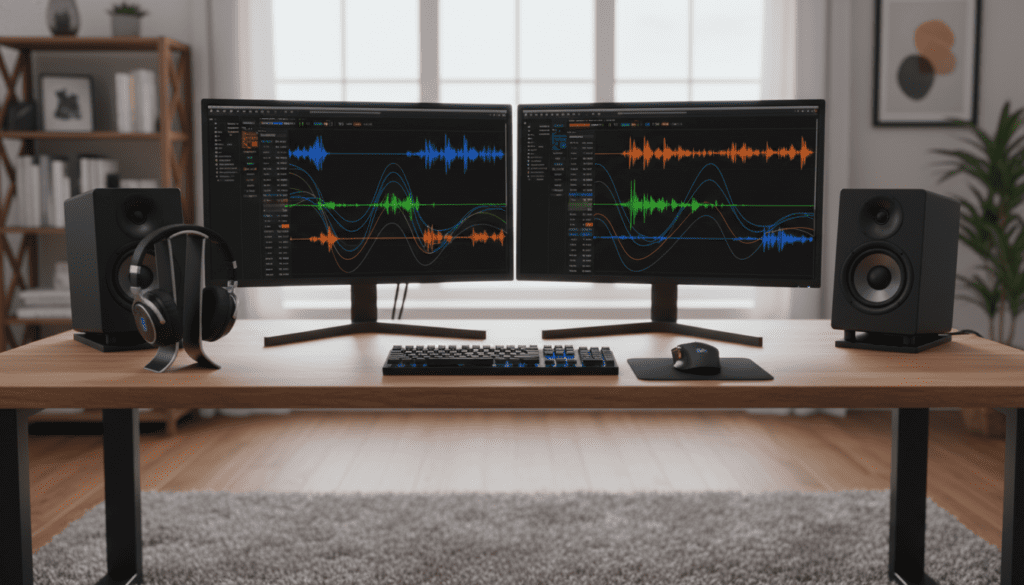
A common question we receive is: “can i play different speakers on my monitors?” This usually refers to a dual-monitor setup where both screens have built-in speakers.
The Dual-Monitor Audio Setup
Yes, you can treat each monitor as a separate audio zone.
- Step 1: Ensure both monitors are connected via HDMI or DisplayPort.
- Step 2: In Windows Volume Mixer, you will see “Monitor A (NVIDIA High Definition Audio)” and “Monitor B (NVIDIA High Definition Audio)” as distinct options.
- Step 3: Assign your Work Meet to the left monitor and your Background Lo-Fi to the right monitor.
Pro Tip: Be aware that monitor speakers are often low-quality. If you are doing this for a “split-screen” gaming session, I recommend using one monitor for game audio and an external set of desktop speakers for everything else to maintain better soundstage separation.
The macOS Approach: Multi-Output and Routing
Apple handles audio slightly differently. While macOS is excellent at “Core Audio” stability, it lacks a native per-app volume mixer in the way Windows 11 provides.
Using Audio MIDI Setup
- Open Finder > Applications > Utilities > Audio MIDI Setup.
- Click the “+” icon and select “Create Multi-Output Device.”
- Check the boxes for the speakers you want to group. This plays the same sound through multiple speakers.
Routing Different Sounds (The Rogue Amoeba Method)
To play different sounds on different speakers on a Mac, you almost certainly need SoundSource or Audio Hijack by Rogue Amoeba.
- SoundSource allows you to click an app in your menu bar and select a specific output (e.g., Music -> HomePod, System Sounds -> Internal Speakers).
Hardware Solutions: Using an Audio Interface
If you are a content creator or a high-end audiophile, software routing can sometimes introduce latency (audio delay). To solve this, we use hardware routing.
- Multi-Channel Interfaces: Devices like the Focusrite Scarlett 4i4 have multiple physical outputs.
- Routing via DAW: You can use a Digital Audio Workstation (like Ableton or Reaper) to route specific tracks to physical “Out 1-2” or “Out 3-4.”
- Physical Mixers: A hardware mixer allows you to physically slide faders to send audio to different studio monitors or “B-roll” speakers.
Practical Use Cases for Multi-Speaker Setups
In our studio, we’ve implemented these “different sounds on different speakers” strategies for several real-world scenarios:
- The Focused Professional: Routing Slack notification pings to the tiny laptop speakers while the “Deep Work” playlist blasts through high-fidelity Studio Monitors.
- The Social Gamer: Game audio on the 7.1 Surround Sound system, while the Discord voice chat stays strictly in the Headset.
- The Home DJ: Sending the “Master” output to the Main Room Speakers and the “Cue” (next track) to the Headphones.
Troubleshooting Common Issues
Audio Lag and Syncing
When playing different sounds, you might notice one speaker lags behind. This is common with Bluetooth speakers. If possible, always use wired connections (3.5mm, USB, or Optical) for tasks requiring low latency.
Disappearing Devices
If your monitor speakers disappear, it’s usually a GPU driver issue. Update your NVIDIA, AMD, or Intel graphics drivers, as these drivers handle the “HDMI Audio” handshake.
Apps Ignoring Settings
Some legacy apps (like older versions of VLC or certain games) have their own internal audio settings. If the Windows Volume Mixer isn’t working, check the “Audio Output” setting inside the app’s own preferences menu.
Frequently Asked Questions
How do I play music on Bluetooth speakers and YouTube on my PC speakers?
Open Settings > System > Sound > Volume Mixer. Find your browser (YouTube) and set output to “Realtek/Speakers.” Find your music app (Spotify) and set output to your “Bluetooth Device.”
Can I play different speakers on my monitors if I only have one HDMI cable?
No. Each monitor requires its own connection to the computer to be recognized as an individual audio output device.
Does playing different sounds on different speakers slow down my computer?
The CPU overhead for audio routing is extremely minimal. Even a mid-range laptop from five years ago can handle multiple audio streams without a noticeable performance hit.
Why does my audio reset to “Default” every time I unplug my headphones?
Windows tends to revert to the primary default device when the secondary device is disconnected. Using a tool like EarTrumpet or VoiceMeeter can help “lock” these assignments so they persist.
Can I play the same sound on two different speakers at once?
Yes, but this requires a “Multi-Output Device” setup. On Windows, you can use the “Listen to this device” feature in the Recording tab of Sound Settings, or use VoiceMeeter to mirror one input to two hardware outputs.