Can I Point the Main PA Speakers for Better Sound?
Yes, you can and should point your main PA speakers directly toward the audience’s ear level to maximize clarity and minimize room reflections. When asking can i point the main pa speakers, the goal is “toe-in”—aiming the cabinets slightly inward and downward—to ensure the sound energy hits the listeners rather than bouncing off the back wall or ceiling.
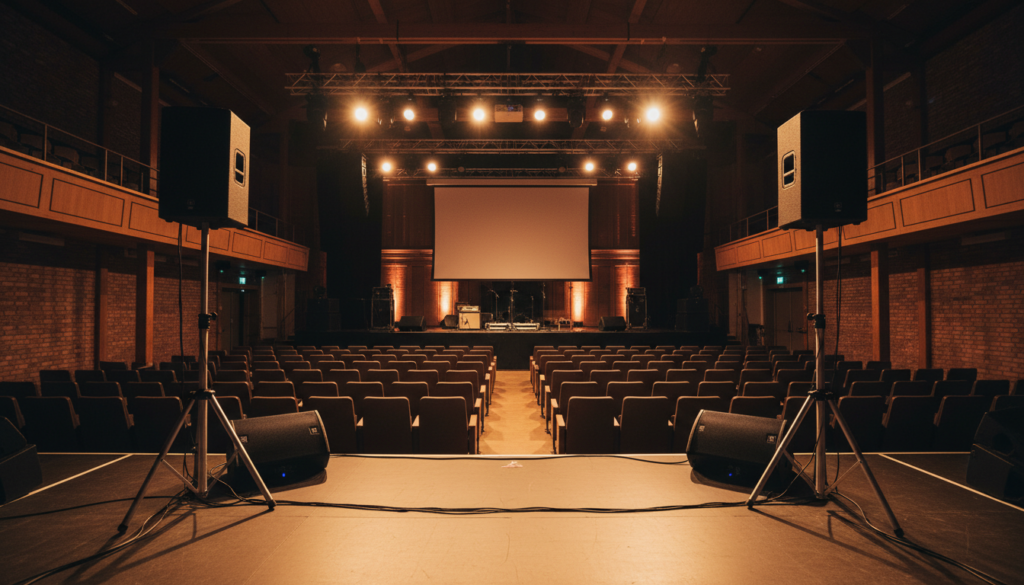
Setting up a Professional Audio (PA) system involves more than just plugging in cables and turning up the volume. In my 15 years of live sound engineering, I have seen even the most expensive QSC or JBL speakers sound amateur because of poor positioning. Proper “aiming” ensures that high frequencies, which are highly directional, reach every person in the room without creating “dead zones.”
Key Takeaways for PA Setup
- Point the “horns” (high-frequency drivers) at the back row of the audience for the most even coverage.
- Angle speakers inward (toe-in) to focus the stereo image and reduce side-wall reflections.
- Elevate your speakers at least 2-3 feet above the heads of the audience to prevent the front row from absorbing all the sound.
- Avoid parallel walls by slightly angling the cabinets to prevent “standing waves” and acoustic flutter.
- Always place speakers in front of the microphones to prevent the dreaded feedback loop.
The Physics of Sound: Why You Must Point Your Speakers
When people ask can i point the main pa speakers, they are often worried about “missing” parts of the room. However, sound—especially high-frequency sound—behaves much like a flashlight beam. If you point it at a wall, the light bounces back; if you point it at the audience, they “see” the sound clearly.
Understanding Dispersion Patterns
Every PA Speaker has a specific dispersion pattern, usually measured in degrees (e.g., 90° x 60°). The first number represents the horizontal spread, while the second represents the vertical spread. If you point your speakers straight ahead in a narrow room, 30% of your sound is likely hitting the side walls, creating muddy reflections that destroy vocal intelligibility.
The Inverse Square Law
In my experience touring small clubs, many beginners forget that sound drops by 6 decibels (dB) every time the distance from the speaker doubles. By pointing the speakers toward the back of the room, you compensate for this loss. This ensures the person at the bar hears the same mix as the person at the front of the stage.
| Component | Purpose | Ideal Placement |
|---|---|---|
| High-Frequency Horn | Clarity and Vocals | Aimed at ear level of the furthest listener. |
| Woofer | Punch and Mid-range | Elevated to clear the front-row “bodies.” |
| Subwoofer | Low-end “Thump” | On the floor, ideally centered or coupled together. |
| Stage Monitors | Artist Reference | Pointed up at the performer from the floor. |
Step-by-Step Guide: How to Point and Position Your PA
Follow this workflow to ensure your Live Sound Setup is optimized for any venue. I have used this exact method for everything from backyard weddings to 500-capacity corporate events.
Establish the “Speaker Line”
Place your speakers at the very front edge of the stage. Ensure they are several feet ahead of any Vocal Microphones like the Shure SM58. This physical separation is your first line of defense against feedback.
Set the Height
Mount your speakers on high-quality Speaker Stands (like Ultimate Support or On-Stage Stands). The bottom of the speaker cabinet should be roughly at head height (6 feet). If the speaker is too low, the front row acts as a “meat muffler,” absorbing all the high-end frequencies.
Apply the “Toe-In” Angle
This is where we address the question: can i point the main pa speakers inward? Angle each speaker about 15 to 30 degrees toward the center of the back wall. This focuses the “sweet spot” on the audience area and prevents sound from “slapping” off the side walls.
Use the Vertical Tilt
If your speaker stands have a tilt-mount adapter, use it. Angling the speaker downward by 5-10 degrees focuses the energy onto the floor where the people are. This prevents sound from reflecting off the ceiling, which is often the biggest cause of “reverberant mud” in gyms or halls.
Determining Where to Point Main PA Speakers in Different Venues
Not every room is created equal. Your strategy for can i point the main pa speakers will change based on the architecture of the space.
Long and Narrow Rooms
In a “shoe-box” style venue, side-wall reflections are your worst enemy. Keep the speakers close to the side walls but angle them sharply toward the center-back. This creates a “cross-fire” pattern that keeps the sound away from the walls and focused on the listeners.
Wide and Shallow Rooms
For a wide room, you may need a “center fill” or to spread the speakers wider apart. In this scenario, pointing the main pa speakers straight ahead might actually be better to ensure the far left and far right seats get enough coverage. However, a slight 5-degree inward tilt still helps with stereo imaging.
Outdoor Environments
Outdoors, you have no walls to worry about, but you have no “room gain” to help the bass. Point your speakers directly at the furthest point where people will be gathered. Since there is no ceiling, you don’t need to worry as much about vertical tilt, but height remains critical to clear the crowd.
Expert Tips for E-E-A-T: Improving Your Live Mix
I’ve spent hundreds of hours behind Behringer X32 and Allen & Heath consoles. Here are the “pro secrets” I’ve learned about speaker placement and pointing:
- The “Flashlight” Test: Imagine a high-powered flashlight is mounted inside the speaker horn. If you turned it on, would it illuminate the audience’s faces? If it’s hitting the ceiling or the side wall, you need to re-aim.
- Check for Phase Cancellation: If you point two speakers directly at each other, certain frequencies will cancel out. Always ensure they are angled toward the audience, not toward each other.
- The Subwoofer “Power Alley”: If you place two subwoofers on the sides, you create a “Power Alley” in the middle and “dead zones” elsewhere. Try “coupling” your subs in the center for a 3dB to 6dB increase in bass efficiency.
- Use Gaff Tape: Once you find the perfect spot, mark the floor with Gaffers Tape. This saves you 20 minutes of troubleshooting during your next setup.
Common Mistakes When Pointing PA Speakers
Avoid these pitfalls to ensure you don’t waste the power of your Active PA Speakers.
Pointing Speakers at the Wall
Many performers think that placing speakers flush against a wall looks “cleaner.” In reality, this causes “boundary interference,” which makes your bass sound boomy and inconsistent. Always keep at least 2-3 feet of space between the speaker and the back wall if possible.
Forgetting the “Center Fill”
In very large setups, if you point your main speakers too far outward, the people right in front of the stage won’t hear anything. We call this the “hole in the middle.” If you encounter this, consider a small 10-inch active speaker placed on the floor in the center of the stage as a “front fill.”
Mixing Mono vs. Stereo
In live sound, stereo is often a trap. If you have a wide stereo spread and point the main pa speakers wide, the left side of the audience misses the guitar panned to the right. For most small to medium venues, running your PA in Mono ensures everyone hears the full mix.
FAQ: Frequently Asked Questions About PA Setup
Can I point the main PA speakers slightly down?
Yes, tilting your speakers downward (usually 5-10 degrees) is highly recommended. This directs the sound energy toward the audience’s ears and reduces reflections from the ceiling, leading to a much clearer and more intimate sound.
How high should my PA speakers be?
The bottom of the speaker should be at least 6 feet high, or just above the heads of the standing audience. If the speakers are at shoulder height, the sound will be blocked by the people in the front, leaving the back of the room with muffled audio.
Should PA speakers be angled inward?
Yes, a technique called “toe-in” involves angling the speakers toward the center-back of the room. This improves the stereo image for the center of the audience and prevents sound from bouncing off the side walls, which causes echo and muddiness.
How far apart should my PA speakers be?
Ideally, your speakers should be placed at a distance apart that is roughly 60% to 80% of the depth of the room. However, the most important rule is to ensure they are placed wide enough to provide coverage for the entire front row without creating a “dead zone” in the center.
Can I use PA speakers on the floor?
You should only use PA speakers on the floor if they are specifically designed as “wedge monitors” for the performers. For the main audience (FOH), speakers must be elevated on stands to ensure the sound can travel over the heads of the crowd to the back of the room.