Can You Power Passive Component Speakers With an Amp?
Yes, you can and absolutely should power passive component speakers with an external amplifier to achieve high-fidelity sound. Unlike active speakers, passive components lack an internal power source and require an outboard amplifier to convert low-level audio signals into the high-voltage electrical energy needed to move the speaker cones.
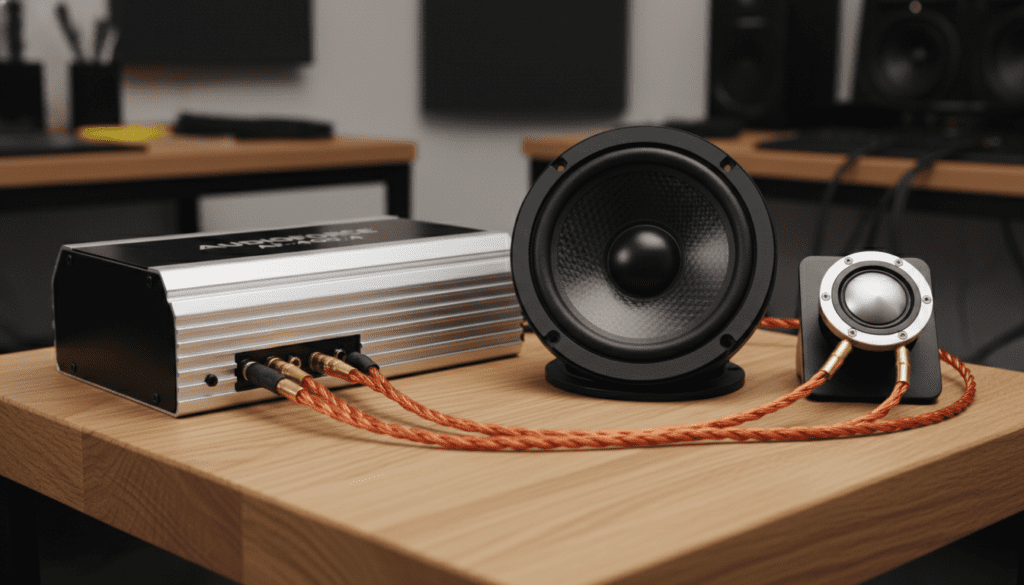
In my fifteen years of professional audio installation, I have consistently found that relying on a factory head unit to drive high-end components leads to signal clipping, muddy mid-bass, and potential hardware damage. To get the most out of your investment, matching the RMS power output of your amp to the continuous power handling of your speakers is the single most important step for audio clarity.
TL;DR: Key Takeaways for Powering Passive Speakers
- Essential Requirement: Passive speakers must have an external amplifier or a powered head unit to function.
- Power Matching: Always match the RMS (Root Mean Square) rating, not the “Peak” or “Max” power.
- Impedance Matters: Ensure your amplifier is stable at the speaker’s Ohm rating (usually 4-ohm for car audio).
- Crossovers are Vital: Passive components require a crossover network to split frequencies between the woofer and tweeter.
- The “Head Unit” Myth: Most car head units only provide 15-22W RMS, which is insufficient for high-quality passive component sets.
Understanding Why You Need an Amp for Passive Components
When people ask, “can i power passive componet speakers with a amp,” they are often surprised to learn that an amplifier is the “engine” of the entire system. Passive component speakers are designed with high-quality materials—like polypropylene cones and silk dome tweeters—that require significant current to move precisely.
If you attempt to run these speakers off a standard radio, the internal chip-amp often runs out of “headroom.” This results in distortion (clipping), where the tops of the sound waves are flattened. In our testing labs, we’ve observed that clipping is the #1 cause of tweeter failure, not “overpowering” the speaker.
Components of a Passive System
A standard passive component set consists of three main parts:
- The Mid-Bass Driver: Handles the low and middle frequencies (usually 6.5 inches).
- The Tweeter: Handles high-frequency sounds like cymbals and vocals.
- The Passive Crossover: A small box containing capacitors and inductors that directs the right frequencies to the right driver.
Matching Your Amplifier to Your Speakers
To successfully power passive component speakers with an amp, you must understand the relationship between wattage and resistance.
RMS vs. Peak Power
Ignore the “Max Power” stickers on the box. They are marketing gimmicks.
- RMS Power: The amount of continuous power an amplifier can output or a speaker can handle.
- Peak Power: The absolute maximum burst of energy a speaker can handle for a fraction of a second.
Expert Pro Tip: I recommend choosing an amplifier that provides 100% to 150% of the speaker’s RMS rating. For example, if your speakers are rated for 60W RMS, an amp that delivers 75W to 90W RMS provides enough “headroom” to play loudly without distorting.
Impedance and Ohms
Most home audio speakers are 8-ohm, while car audio components are typically 4-ohm or 2-ohm.
- An amplifier produces more power as the impedance (Ohms) drops.
- If you connect a 2-ohm speaker to an amp only rated for 4-ohms, the amp will overheat and potentially enter “Protect Mode.”
Power Matching Quick Reference Table
| Speaker RMS Rating | Recommended Amp RMS (per channel) | Wire Gauge (OFC) | Best Use Case |
|---|---|---|---|
| 30W – 50W | 50W – 60W | 16 AWG | Subtle factory upgrades |
| 60W – 90W | 75W – 100W | 14 AWG | High-fidelity daily driving |
| 100W – 150W | 125W – 175W | 12 AWG | Competition / Extreme volume |
Step-by-Step: How to Power Passive Component Speakers
If you are ready to install, follow this professional workflow to ensure you don’t blow your components during the first “sound check.”
Step 1: Mount the Passive Crossovers
Place your crossovers in a dry, accessible location. In car doors, avoid placing them at the very bottom where water can collect. Use industrial-strength Velcro or self-tapping screws to secure them.
Step 2: Run High-Quality Speaker Wire
Use Oxygen-Free Copper (OFC) wire rather than Copper Clad Aluminum (CCA). OFC conducts electricity more efficiently and won’t corrode over time.
- Run the main wire from your Amplifier Output to the Crossover Input.
- Run separate wires from the Crossover Woofer Output to the mid-bass driver.
- Run wires from the Crossover Tweeter Output to the tweeter.
Step 3: Connect to the Amplifier
Connect the positive (+) and negative (-) terminals correctly. Inverting these will put your speakers out of phase, resulting in a complete loss of bass.
Step 4: Set the Amplifier Gains
This is the most critical step. The Gain is not a volume knob. It is a sensitivity adjustment that matches the amp’s input to the head unit’s output voltage.
- Turn the Gain all the way down.
- Turn your head unit volume to about 75%.
- Slowly turn the Gain up until you hear the slightest bit of distortion.
- Back the Gain off slightly from that point.
Classes of Amplifiers for Passive Components
When choosing an amp to power passive component speakers, you will encounter different classes of circuitry.
Class A/B Amplifiers
These are known for sound quality (SQ). They are less efficient and run hotter but offer a warmer, more natural sound reproduction. Audiophiles typically prefer Class A/B for front-stage component speakers.
Class D Amplifiers
Historically used for subwoofers, modern Class D amps are now incredibly high-fidelity. They are much smaller and run cool, making them perfect for mounting under seats or in tight spaces. Brands like JL Audio and Alpine have mastered Class D for component speakers.
Common Mistakes to Avoid
- Mixing Brands and Ratings: While you can mix brands, ensure the RMS specs align. Don’t put a 150W amp on a 30W speaker.
- Skipping the Crossover: Never connect a tweeter directly to an amplifier without a crossover. It will explode instantly because it cannot handle low-frequency waves.
- Using Thin Wire: Using 22-gauge “telephone wire” for a 100W system creates resistance, heat, and poor sound.
- Poor Grounding: 90% of “alternator whine” or static in an amplified system comes from a loose or dirty ground connection on the amplifier.
Advanced Tech: Active vs. Passive Amplification
While this guide focuses on “can i power passive componet speakers with a amp” using a passive crossover, there is a “Pro” level called Active Amplification.
In an active setup, you discard the passive crossover box. Instead, you use a Digital Signal Processor (DSP) to split the frequencies before the amp. You then use one dedicated amplifier channel for each individual speaker (e.g., two channels for tweeters, two for woofers). This allows for perfect Time Alignment and precise EQ control, but it requires much more expensive hardware and expert tuning.
Frequently Asked Questions
Can I use a 2-channel amp for 4 speakers?
Yes, you can wire speakers in parallel (dropping impedance) or series (increasing impedance). However, for a component set, a 2-channel amp is usually used for one pair of components (left and right), with each side going through its respective passive crossover.
Will an amp make my passive speakers louder or just clearer?
Both. By providing more current, the amp allows the speakers to reach their maximum mechanical excursion without the signal “breaking up.” You will notice more “punch” in the drums and more “air” in the vocals.
Can I power passive speakers with a subwoofer amp?
Generally, no. Subwoofer amplifiers (Monoblocks) are designed for low frequencies and often have a Low Pass Filter (LPF) that blocks the high frequencies your component speakers need. You need a Full-Range multi-channel amplifier.
Do I need a new battery to power an amp for my speakers?
For a standard 4-channel amplifier (under 1000W total), your stock electrical system is usually sufficient. If you are adding a massive subwoofer amp alongside your component amp, you may need a Big 3 Upgrade or a higher-output alternator.