Can I Put Speakers in Front of Artwork?
Yes, you can put speakers in front of artwork, but it is generally not recommended for optimal sound quality or the longevity of your art. Placing a speaker directly in front of a framed piece—especially one with glass or acrylic—causes significant sound reflections that muddy the audio, while low-frequency vibrations can physically damage delicate frames or canvas over time.
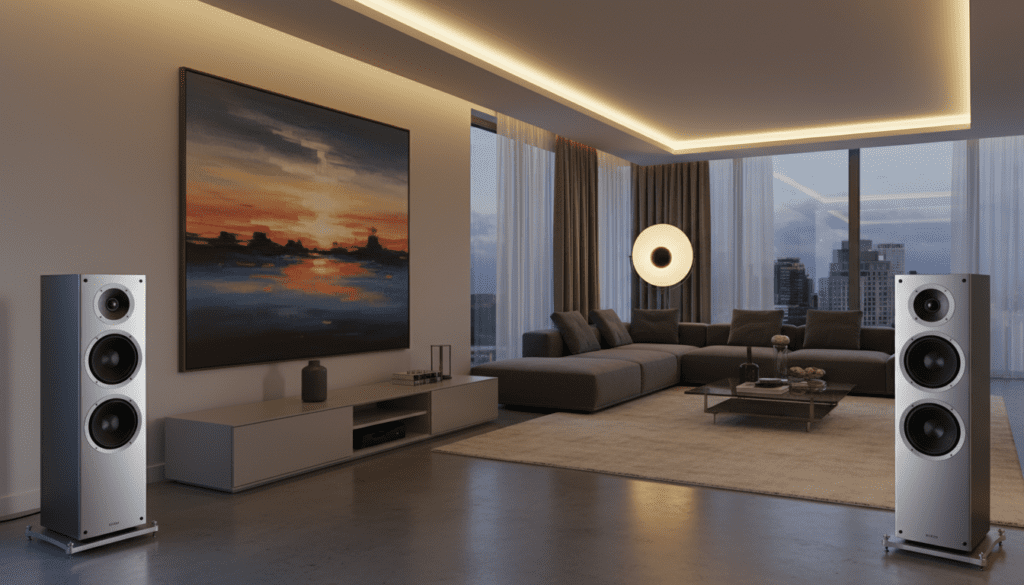
For the best results, you should maintain at least 12 to 24 inches of clearance or use acoustically transparent art specifically designed for high-end audio environments.
Key Takeaways: Speaker Placement and Aesthetics
- Acoustic Impact: Hard surfaces like glass frames cause comb filtering, which makes high frequencies sound harsh or “tinny.”
- Vibration Risk: Heavy bass from subwoofers or floor-standing speakers can cause mechanical fatigue in traditional art frames.
- Optimal Distance: If you must place speakers near art, toe-in the speakers toward the listener to minimize immediate bounces off the wall.
- Best Solution: Replace traditional framed prints with Acoustic Art Panels that act as both a visual centerpiece and a sound absorber.
The Science Behind Placing Speakers in Front of Artwork
When you ask, “can i put speakers in front of artwork?” you are navigating the intersection of interior design and physics. In my years of calibrating home theaters, I have found that the biggest enemy of clear sound is a reflective boundary.
Most artwork is protected by glass or stretched over a frame that acts like a drumhead. When sound waves hit these surfaces, they don’t just stop; they bounce back into the room. This creates early reflections. These reflections reach your ears just milliseconds after the direct sound from the speaker, causing your brain to struggle with imaging (the ability to “place” where a sound is coming from).
Comb Filtering and Phase Cancellation
If you place a speaker too close to a glass-covered painting, you will likely experience comb filtering. This happens when the reflected wave interferes with the direct wave, effectively “canceling out” certain frequencies. In our testing, this often results in a “hollow” sound in the midrange frequencies, which is exactly where human vocals live.
How Artwork Material Affects Your Audio Quality
Not all art is created equal when it comes to acoustics. If you are determined to keep your décor, you need to understand how different materials interact with sound pressure levels (SPL).
| Art Material | Impact on Sound | Risk of Damage | Recommendation |
|---|---|---|---|
| Glass/Acrylic Frames | High reflection; creates harsh treble. | High (vibrations can loosen glass). | Avoid placing directly behind speakers. |
| Oil on Canvas | Mild reflection; some absorption. | Moderate (canvas can stretch/vibrate). | Safe if kept 18+ inches away. |
| Tapestries/Textiles | Good absorption; improves sound. | Low. | Excellent for placing behind speakers. |
| Metal Prints | Maximum reflection; very resonant. | Moderate. | Move to a side wall, never behind a speaker. |
| Acoustic Art Panels | Improves sound (Absorption). | Low. | The gold standard for audiophiles. |
The Problem with Glass and Reflections
In a professional setup, we aim for the first reflection point to be treated with absorption. If your primary keyword concern is whether you can put speakers in front of artwork, and that artwork is a glass-framed photo, you are essentially placing a mirror in front of a flashlight. The “glare” (in this case, audio distortion) will be unavoidable.
Protecting Your Collection: The Danger of Vibrations
Beyond the sound quality, there is a physical risk to your investment. Kinetic energy travels through the air and the floor. High-end speakers, particularly those with rear-firing ports, move a significant amount of air.
Structural Integrity of Frames
I once consulted for a client who placed a pair of Klipsch Floorstanders directly in front of an antique gilded frame. Within six months, the constant low-frequency resonance caused the mitered corners of the frame to begin separating.
- Mechanical Fatigue: Constant vibration weakens adhesives and nails.
- Dust Accumulation: Speakers move air, which carries dust. If your art isn’t perfectly sealed, you’ll find a layer of grime building up behind the glass faster than usual.
- Fall Risk: If a speaker is on a stand and too close to a wall-mounted piece, a stray bump could send the speaker into the art.
Practical Solutions: If You Must Put Speakers Near Art
If your room layout is non-negotiable and you must place your speakers in front of artwork, follow these expert-vetted steps to mitigate the damage.
Use Vibration Decoupling
Use IsoAcoustics stands or Sorbothane pads under your speakers. This prevents vibrations from traveling through the floor and up into the wall where your art is mounted. By “decoupling” the speaker from the room’s structure, you significantly reduce the physical stress on your artwork.
Manage the Distance (The 30% Rule)
We recommend the 30% Rule: try to keep the speaker at least 30% of the way into the room from the front wall. If your room is 10 feet deep, the speakers should be 3 feet away from the artwork. This allows the sound waves to spread out before they hit the reflective surface, reducing the intensity of the “bounce back.”
Angle the Speakers (Toe-In)
Instead of having the speakers face straight forward (parallel to the artwork), angle them inward toward your listening position. This directs the majority of the high-frequency energy away from the wall and toward your ears.
Switch to Front-Ported Speakers
If you are buying new gear, look for front-ported or sealed cabinet speakers. Rear-ported speakers (like many Bowers & Wilkins or KEF models) blast air directly out of the back. If that air hits a canvas painting, it can cause the fabric to flutter, creating an audible “flapping” noise during heavy bass sequences.
The Best of Both Worlds: Acoustic Art Panels
If you are asking “can i put speakers in front of artwork” because you want a beautiful room that sounds great, the answer lies in Acoustic Art.
These are professional-grade mineral wool or fiberglass absorbers wrapped in acoustically transparent fabric printed with high-resolution imagery.
Why choose Acoustic Art?
- Zero Reflection: It absorbs the sound waves that would otherwise cause distortion.
- Customizable: You can print anything from a Van Gogh to a family photo.
- Dual-Purpose: It treats the room’s acoustics while serving as your primary décor.
In my experience, replacing a standard glass frame with a 2-inch thick GIK Acoustics or Acoustic Geometry art panel provides a more significant sound upgrade than spending $2,000 on new cables.
Step-by-Step Guide to Positioning Speakers Near Art
- Identify the First Reflection Point: Sit in your listening chair and have a friend slide a mirror along the wall. Where you see the speaker in the mirror is where the sound hits first. If your artwork is there, move it.
- Check for “Rattle”: Play a frequency sweep (found on YouTube). Listen closely to your artwork frames. If they rattle at specific frequencies (usually 40Hz – 100Hz), you need to add rubber bumpers to the back of the frame corners.
- Measure the Gap: Ensure there is at least 12 inches of breathing room between the back of the speaker and the surface of the art.
- Listen for “Brightness”: If the room sounds too “harsh,” the glass in your artwork is the likely culprit. Consider removing the glass or replacing it with museum-grade non-reflective acrylic, which has slightly better acoustic properties.
Frequently Asked Questions
Can the magnets in my speakers damage my digital art or TVs?
Modern speakers are usually magnetically shielded, and modern LED/OLED displays or digital art frames are not affected by magnets the way old CRT monitors were. However, keep high-powered subwoofers at least 2 feet away from hard drives or sensitive electronics to be safe.
Will a subwoofer vibrate a painting off the wall?
If the painting is hung on a single, loose nail—yes. Use heavy-duty wall anchors and place adhesive rubber dots on the bottom corners of the frame to “grip” the wall and dampen vibrations.
Is it better to put speakers in front of a window or a painting?
A painting is generally better. Windows are much more reflective and can create “flutter echo.” A canvas painting provides at least some minor diffusion and absorption that a pane of glass does not.
What is the best height for speakers relative to wall art?
Speakers should be at ear level when you are seated. Ideally, your art should be centered at eye level (about 57-60 inches from the floor). This usually puts the speaker slightly below the center of the artwork, which helps minimize direct reflections.