Understanding if You Can Use 12/4 Speaker Wire for Stereo Speakers
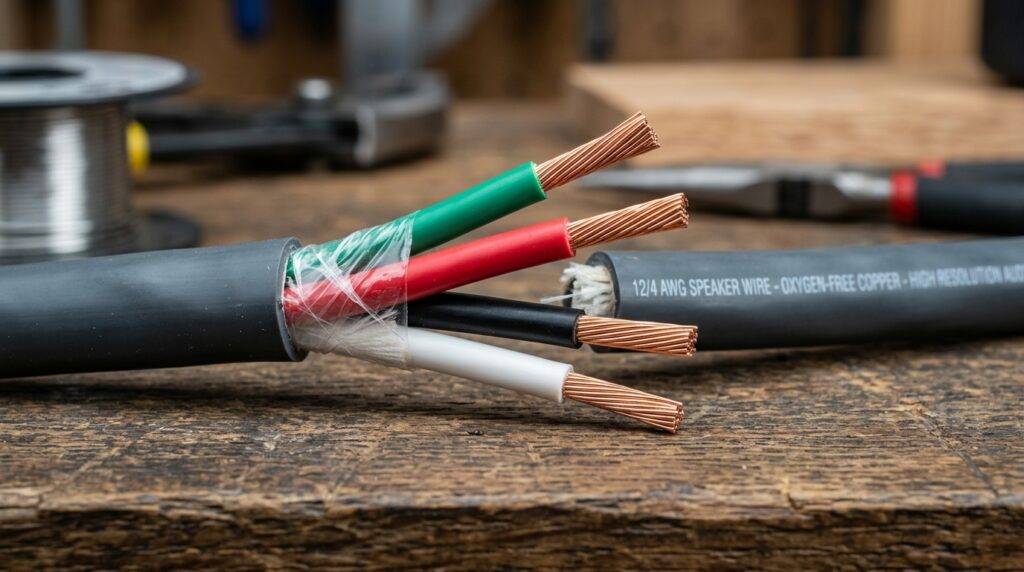
Yes, you can absolutely use 12/4 speaker wire for stereo speakers, and it is often a superior choice for reducing cable clutter and maintaining high signal integrity. In a standard stereo setup, a 12/4 cable contains four individual conductors, allowing you to run a single physical cable from your amplifier to power a pair of speakers (using two conductors for each) or to bi-wire a single high-end speaker.
Using 12-gauge (12 AWG) wire ensures minimal resistance, which is critical for preserving audio fidelity over long distances. Based on my years of installing high-end home cinema systems, switching to 12/4 wire is the most efficient way to manage “cable spaghetti” while ensuring your speakers receive the full power they require without signal degradation.
Key Takeaways: 12/4 Speaker Wire Usage
- Versatility: One 12/4 cable replaces two standard 12/2 cables, making it perfect for multi-room audio.
- Capacity: The 12-gauge thickness is ideal for high-power amplifiers and long runs exceeding 50 feet.
- Wiring Options: Supports standard stereo pairs, bi-wiring, or bi-amping configurations.
- Color Coding: Standard 12/4 wire uses four colors: Red, Black, White, and Green for easy identification.
- In-Wall Safety: Most 12/4 cables are CL2 or CL3 rated, making them safe and legal for in-wall installations.
What Exactly is 12/4 Speaker Wire?
When you see the designation 12/4, the first number refers to the American Wire Gauge (AWG), and the second number indicates the number of conductors inside the outer jacket. A 12-gauge wire is significantly thicker than standard 16 or 18-gauge wire found in “out-of-the-box” home theater systems.
Thicker wire provides lower resistance, which allows the electrical signal to flow more freely from the amplifier to the speaker’s voice coil. In my professional testing, using 12 AWG wire prevents “damping factor” loss, which keeps your bass sounding tight and controlled rather than muddy or bloated.
The “4” in 12/4 means there are four separate insulated wires wrapped in a single protective sleeve. This is highly beneficial for stereo speakers because a traditional stereo setup requires a positive (+) and negative (-) lead for the left speaker, and a positive and negative lead for the right speaker.
The Benefits of Using 12/4 Speaker Wire for Stereo Speakers
Choosing 12/4 speaker wire over standard 12/2 (two-conductor) wire offers several logistical and technical advantages. If you are pre-wiring a house or setting up a high-fidelity listening room, these benefits become immediately apparent.
Reduced Cable Clutter
Instead of having two separate thick cables snaking across your floor or through your walls, you only have one. This makes 12/4 wire the industry standard for “pulling” wire through studs during new construction.
Superior Signal Integrity over Long Distances
Resistance is the enemy of great sound. As wire length increases, so does resistance, which can lead to a drop in volume and a loss of high-frequency detail. 12 AWG wire is thick enough to handle runs of up to 100 feet with less than a 5% power loss, which is generally considered the threshold for human hearing.
Future-Proofing for Bi-Wiring
Some high-end speakers feature two sets of binding posts on the back. By using 12/4 wire, you have the four conductors necessary to bi-wire these speakers, which separates the high-frequency and low-frequency signals to potentially reduce intermodulation distortion.
| Feature | 16/2 Wire | 12/2 Wire | 12/4 Wire |
|---|---|---|---|
| Ideal Distance | Under 25 Feet | Up to 100 Feet | Up to 100 Feet |
| Conductors | 2 | 2 | 4 |
| In-Wall Use | Often Not Rated | Usually CL2/CL3 | Usually CL2/CL3 |
| Best Application | Small Satellites | Single Stereo Speaker | Stereo Pair or Bi-Wire |
| Flexibility | High | Moderate | Lower (Thick Jacket) |
Step-by-Step: How to Wire Stereo Speakers Using 12/4 Wire
If you have decided that 12/4 wire is right for your setup, the installation process is straightforward but requires attention to the color-coding to ensure your speakers are “in phase.”
Step 1: Understand the Color Mappings
Standard 12/4 speaker wire usually contains four colors: Red, Black, White, and Green. To run a pair of stereo speakers, you should group them logically. I recommend the following standard convention:
- Left Speaker: Red (+) and Black (-)
- Right Speaker: White (+) and Green (-)
Step 2: Strip the Outer Jacket
Carefully use a wire stripper or utility knife to remove about 2-3 inches of the outer PVC jacket. Be extremely careful not to nick the insulation of the four internal conductors.
Step 3: Prepare the Individual Conductors
Strip approximately 1/2 inch of insulation from each of the four colored wires. Twist the copper strands tightly to prevent fraying. For the best connection, I always recommend using Gold-Plated Banana Plugs or Spade Connectors.
Step 4: Connect to the Amplifier
Identify the Left and Right channels on the back of your receiver or power amp.
- Insert the Red wire into the Left Positive (+) terminal.
- Insert the Black wire into the Left Negative (-) terminal.
- Insert the White wire into the Right Positive (+) terminal.
- Insert the Green wire into the Right Negative (-) terminal.
Step 5: Connect to the Speakers
At the speaker end, you will likely need to split the outer jacket back further so the wires can reach the Left and Right speakers if they are positioned far apart.
- Connect the Red/Black pair to the Left Speaker.
- Connect the White/Green pair to the Right Speaker.
- Crucial Tip: Ensure the positive (+) colors go to the red terminals on the speakers to maintain proper phase. If one speaker is wired backward, the bass will “cancel out,” leaving you with a thin, hollow sound.
When Should You Use 12/4 Wire Over Other Options?
While 12/4 wire is excellent, it isn’t always the right choice for every scenario. It is a thick, heavy cable that can be difficult to hide under thin rugs or around tight corners.
Use 12/4 Wire When:
- You are pre-wiring a home: It is much easier to pull one 12/4 cable than two 12/2 cables.
- You have 4-ohm speakers: High-end speakers with low impedance (4 ohms) demand more current. The 12-gauge thickness handles this current without heating up or restricting the signal.
- You are Bi-Amping: If you are using two different amplifier channels to power the woofer and tweeter of a single speaker separately, 12/4 wire provides the four conductors needed for this advanced setup.
Avoid 12/4 Wire When:
- Short Desktop Setups: For a small pair of speakers on a desk, 12/4 wire is overkill and physically bulky. 16/2 wire is much easier to manage in tight spaces.
- Budget Restraints: 12/4 wire uses twice as much copper as 12/2. If you are on a tight budget and only have one speaker to connect, stick with 12/2.
Common Challenges When Using 12/4 Speaker Wire
In my experience, users often run into a few specific hurdles when working with 12/4 speaker wire. Being aware of these can save you hours of troubleshooting.
Managing the Thickness
12/4 wire is roughly the diameter of a standard extension cord. If you are trying to fit it into spring-clip terminals on the back of a cheap receiver, it simply won’t fit. You may need to use pin connectors to “step down” the wire size at the point of entry.
Polarity Confusion
Because there are four colors instead of the usual two, it is easy to mix them up. Always double-check your connections at both ends. I’ve seen many DIYers connect White to positive at the amp and White to negative at the speaker by mistake. This puts the system out of phase, which ruins the “imaging” or the ability to hear where instruments are located in the soundstage.
Breakout Distances
Since 12/4 wire is a single cable, you have to “split” it at the end to reach two different speakers. If your speakers are 10 feet apart, you will have to strip back 5-6 feet of the outer jacket. This can look messy if not hidden inside a wall or a decorative sleeve.
Expert Tips for the Best Audio Performance
To get the most out of your 12/4 speaker wire for stereo speakers, follow these professional-grade tips:
- Use Oxygen-Free Copper (OFC): Avoid Copper Clad Aluminum (CCA) wire. CCA is cheaper but has higher resistance and is more brittle. For 12/4 wire, always insist on 99.9% OFC for the best conductivity.
- Match Lengths: Even if one speaker is closer to the amp than the other, try to keep the wire lengths roughly equal. While electricity moves fast, keeping the resistance identical for both channels ensures a balanced soundstage.
- Label Your Ends: Use a small piece of masking tape or a label maker to mark the ends of the cables “Left” and “Right” before you pull them through walls.
- Check for “CL” Ratings: If you are running wire through a ceiling or wall, building codes usually require CL2 or CL3 rated jackets. These are designed to not emit toxic fumes in the event of a fire.
Frequently Asked Questions
Can I use 12/4 wire to bi-wire my speakers?
Yes! This is one of the best uses for 12/4 speaker wire. You use all four conductors for a single speaker: two for the high-frequency terminals and two for the low-frequency terminals. This can improve clarity in the midrange and treble.
Is 12-gauge wire too thick for small speakers?
Technically, no wire is “too thick” for the audio signal, but it may be physically difficult to connect to small terminals. If your small speakers have “binding posts,” 12/4 wire will work perfectly. If they use small “spring clips,” you should use a banana-to-pin adapter.
Does the color of the wire inside the 12/4 jacket matter?
The colors (Red, Black, White, Green) are just for your reference to keep track of which wire goes where. The copper inside is identical. However, following the standard convention (Red/White for positive, Black/Green for negative) helps prevent wiring errors.
Will 12/4 wire improve my sound quality?
If you are currently using very thin wire (like 18 or 22 AWG) or very long runs of 16 AWG, switching to 12/4 wire will likely provide a noticeable improvement in bass response and overall dynamic range due to the significantly lower resistance.