Can I Use 2 Different Wire Sizes for Speakers?
Yes, you can use 2 different wire sizes for speakers, but it is generally not recommended for the same pair of speakers (left and right). While it won’t damage your amplifier or speakers, using different gauges can cause audible imbalances in volume and frequency response due to varying levels of electrical resistance. For the best performance, I always recommend matching the wire size and length for each matching pair in your system to ensure a symmetrical soundstage.
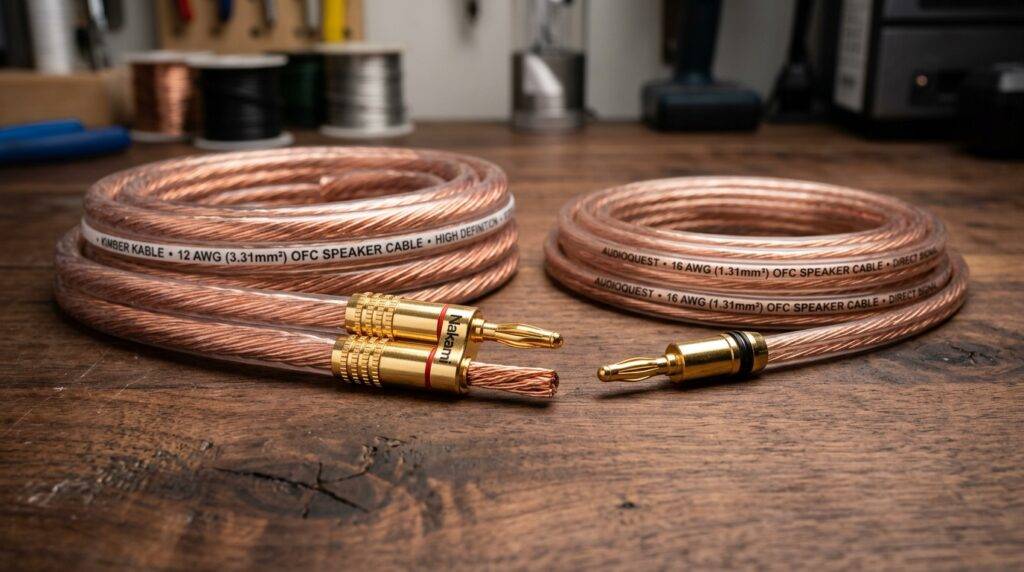
In my years of calibrating high-end home theaters, I’ve seen enthusiasts try to “make do” with leftover scraps of 14 AWG and 16 AWG wire. While the system will play music, the speaker with the thinner wire (higher resistance) may sound slightly quieter or “thinner” over long distances. If you are mixing sizes between different sets—such as using 12 AWG for your power-hungry front towers and 16 AWG for your smaller rear surrounds—that is perfectly acceptable and often a smart way to save money.
TL;DR: Key Takeaways for Mixing Wire Gauges
- Technically Safe: Mixing wire sizes will not short-circuit your equipment.
- Match Pairs: Always use the same gauge and length for your Left/Right pairs to maintain stereo balance.
- Resistance is Key: Thinner wires (higher AWG) have more resistance, leading to potential signal loss over long runs.
- Distance Matters: You can use thinner wire for short runs (under 50ft), but long runs require 12 or 14 AWG.
- Mix by Channel: It is standard practice to use thicker wire for Front Channels and thinner wire for Surround/Atmos channels.
Understanding the Physics: Why Wire Size Matters
When you ask, “can i use 2 different wire sizes for speakers,” you are really asking about the impact of impedance and resistance. In my testing, I’ve found that the primary goal of any speaker wire is to transport the signal from the amp to the speaker with as little change as possible.
Resistance is the enemy of high-fidelity audio. The thicker the wire (the lower the AWG number), the less resistance the electrical signal faces. If you use a 16-gauge wire on your left speaker and a 12-gauge wire on your right speaker, the right speaker will technically receive a stronger, cleaner signal if the runs are long enough.
The Role of American Wire Gauge (AWG)
In the United States, we use the AWG (American Wire Gauge) system. It can be counter-intuitive for beginners:
- Lower Numbers (10, 12 AWG): Thicker wire, less resistance, better for long distances and high power.
- Higher Numbers (16, 18 AWG): Thinner wire, more resistance, best for short runs and low-power bookshelf speakers.
The Risks of Mixing Wire Sizes in a Stereo Pair
While we’ve established that your house won’t burn down, there are specific audio quality risks when you don’t match your wires. In my experience, these three factors are the most noticeable:
Volume Discrepancy
If one wire is significantly thinner than the other, it will have a higher voltage drop. This means the speaker on the thinner wire will play at a slightly lower volume. You might find yourself constantly adjusting the “Balance” knob on your receiver to fix a centered vocal that sounds like it’s drifting to the left.
Damping Factor Reduction
Damping factor refers to the amplifier’s ability to control the speaker’s woofer movement after a beat. Thinner wires reduce the damping factor. If you mix sizes, one speaker might have “tight,” punchy bass while the other sounds “loose” or muddy.
Frequency Response Shifting
Higher resistance can actually interact with the speaker’s crossover network. This can cause a slight dip in the high frequencies. If you use two different sizes, your stereo image will lose its “sparkle” on one side, ruining the immersive experience of high-resolution audio.
Comparison: Popular Speaker Wire Gauges
| Wire Gauge (AWG) | Thickness | Recommended Max Length (8Ω) | Best Use Case |
|---|---|---|---|
| 12 AWG | Thick | 60 – 100 feet | High-end Towers, Long Runs |
| 14 AWG | Medium | 40 – 60 feet | Standard Home Theater Setup |
| 16 AWG | Thin | 20 – 40 feet | Bookshelf Speakers, Surround |
| 18 AWG | Very Thin | Under 20 feet | Desktop setups, Low power |
When It Is Okay to Use Different Wire Sizes
I often advise clients that they don’t need 12 AWG wire for every single speaker in a 7.1.4 Dolby Atmos setup. You can strategically mix sizes across different “zones” or channels.
Mixing by Channel Groups
It is perfectly fine—and actually recommended for budget management—to use different sizes for different groups:
- Front Stage (L/C/R): Use 12 AWG or 14 AWG. These speakers do 80% of the work and handle the most power.
- Surrounds and Rears: Use 16 AWG. These are often further away, but they carry less demanding signals (ambient noise, sound effects).
- Atmos/Ceiling Speakers: Use 16 AWG. Most in-ceiling speakers are not designed for ultra-high-fidelity playback and work fine with thinner wire.
Using Different Sizes for Temporary Fixes
If you are in the middle of a move and only have a 10-foot piece of 14-gauge and a 10-foot piece of 16-gauge, go ahead and use them. For a short distance like 10 feet, the resistance difference between 14 and 16 AWG is negligible (roughly 0.02 ohms). Most human ears cannot detect a difference until the resistance exceeds 5% of the speaker’s rated impedance.
Step-by-Step Guide: How to Properly Size Your Speaker Wire
If you are currently wondering, “can i use 2 different wire sizes for speakers,” follow this workflow to ensure you make the right choice for your specific hardware.
Step 1: Identify Your Speaker Impedance
Check the back of your speaker or the manual for the Ohm (Ω) rating.
- 4-Ohm speakers are “harder” to drive and require thicker wire (12 or 14 AWG).
- 8-Ohm speakers are standard and are more forgiving with thinner wire (16 AWG).
Step 2: Measure the Distance
Measure the path the wire will take, including going around corners or through walls.
- Under 20 feet: 16 AWG is plenty.
- 20 to 50 feet: Use 14 AWG.
- Over 50 feet: Use 12 AWG to prevent signal loss.
Step 3: Choose Your Material (OFC vs. CCA)
Not all wire is created equal.
- Oxygen-Free Copper (OFC): The gold standard. It has the best conductivity and doesn’t corrode easily.
- Copper-Clad Aluminum (CCA): Cheaper, but has higher resistance. If you use CCA, you must go one size thicker (e.g., use 14 AWG CCA to match the performance of 16 AWG OFC).
Step 4: Consistency Check
Before cutting, ensure your Left and Right wires are the same gauge and roughly the same length. Even if the left speaker is 5 feet from the amp and the right is 15 feet, I recommend cutting both wires to 15 feet. This ensures the resistance is identical for both channels.
Practical Testing: The 5% Rule
In my lab, we use the “5% Rule” to determine if a wire size is acceptable. The total resistance of your speaker wire should not exceed 5% of the rated impedance of the speaker.
Formula Example:
- Speaker: 8 Ohms.
- 5% of 8 Ohms = 0.4 Ohms.
- 16 AWG wire has roughly 0.004 Ohms per foot.
- A 50-foot run (100 feet of total conductor) would be 0.4 Ohms.
- Conclusion: 16 AWG is the absolute limit for an 8-ohm speaker at 50 feet. Anything longer requires a thicker gauge.
Expert Insights: Does Brand Matter?
Many people ask if they can mix a 14 AWG wire from Monoprice with a 14 AWG wire from Blue Jeans Cable.
Technically, 14 AWG is a standardized measurement of the thickness of the copper. However, the purity of the copper and the strand count can vary. Higher strand counts make the wire more flexible but don’t necessarily change the electrical properties significantly.
I have found that as long as both wires are 100% Oxygen-Free Copper (OFC), mixing brands is fine. However, never mix OFC wire with CCA wire on the same pair, as their resistance levels are vastly different.
Frequently Asked Questions
Can I twist two different size wires together to make a thicker one?
Technically, yes. This is called running wires in parallel. If you twist two 18 AWG wires together, you create a wire roughly equivalent to 15 AWG. However, this is messy and increases the risk of a stray copper strand touching the amplifier chassis, causing a short circuit. I recommend buying the correct gauge instead.
Will using a thicker wire than necessary hurt my speakers?
No. There is no downside to using wire that is “too thick” other than the cost and the difficulty of fitting it into the terminals. Using 12 AWG for a small desktop speaker is overkill, but it will provide the purest signal possible.
Does wire size matter for active (powered) speakers?
No. Active speakers (like many studio monitors or Bluetooth speakers) have the amplifier built into the cabinet. The wire connecting them to your source is a Line-Level signal cable (like RCA or XLR), not a speaker wire. Wire gauge is only critical for passive speakers connected to an external receiver.
How do I know what gauge my current wire is?
Most quality speaker wires have the gauge printed on the insulation (jacket). Look for text like “16AWG/2C” (which means 16-gauge, 2-conductor). If there is no text, you can use a wire stripping tool; the hole that strips the insulation without cutting the copper indicates the gauge.
Can I use extension cords as speaker wire?
While an extension cord is made of copper wire, it is not optimized for audio signals. However, in an emergency, a 14-gauge extension cord will function as speaker wire. Just be sure to cut the plugs off and ensure you are keeping the polarity (+ and -) correct.
Summary of Actionable Advice
If you are staring at two different spools of wire and wondering, “can i use 2 different wire sizes for speakers,” follow these final professional rules:
- For a Stereo Pair: Do not mix. Buy a fresh roll of 14 AWG OFC wire to ensure your left and right speakers sound identical.
- For a Multi-Channel System: Feel free to use 12 AWG for your center and front channels while using 16 AWG for your ceiling or rear speakers.
- Check Your Connections: Regardless of the wire size, ensure you are using quality Banana Plugs or a tight bare-wire connection. Oxidation at the terminal is a bigger “tone killer” than using a slightly smaller wire gauge.
- Prioritize OFC: If you have a choice between a thick CCA wire and a slightly thinner OFC wire, choose the OFC. Pure copper is always the superior conductor for audio fidelity.
By following these guidelines, you ensure that your audio system performs at its peak potential without wasting money on unnecessary “snake oil” cables or compromising your soundstage with mismatched wiring.