Can I Use Another Subwoofer with Bose Acoustimass Speakers?
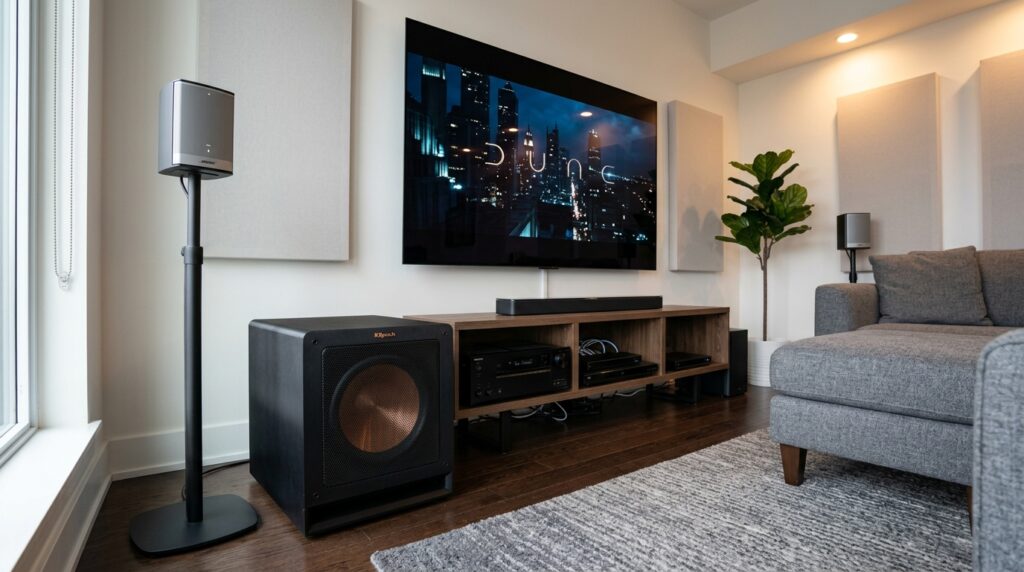
Yes, you can use another subwoofer with Bose Acoustimass speakers, but you cannot connect it directly to the Bose Acoustimass module. To integrate a third-party subwoofer (like an SVS, Klipsch, or Polk), you must connect the new powered subwoofer directly to the LFE (Subwoofer Out) port on your AV Receiver. You will then need to adjust your receiver’s crossover settings to ensure the tiny Bose satellite speakers don’t lose their mid-bass performance, as they rely on the Bose module for equalization.
Quick Integration Guide (TL;DR)
- Direct Connection: Third-party subwoofers must connect to the receiver’s Subwoofer Pre-Out, not the Bose module.
- The Bose Proprietary Issue: Bose modules use internal EQ and proprietary wiring that standard subwoofers cannot decode.
- Crossover Secret: Set your receiver’s crossover to 150Hz or 200Hz when using Bose cubes without the module to avoid a “sonic hole.”
- Best Use Case: Most enthusiasts use a new sub alongside the Bose module (Dual Sub setup) to keep the Bose speakers sounding “full.”
The Technical Challenge: Why Bose is Unique
When I first started installing home theater systems, I quickly learned that Bose Acoustimass systems are “closed-loop” ecosystems. Unlike traditional speakers that handle a wide range of frequencies, Bose Cube speakers are designed specifically to work with the Acoustimass Module.
The Acoustimass Module isn’t just a subwoofer; it acts as a bass engine and a distribution hub. It contains proprietary active equalization circuitry that masks the physical limitations of the small satellite speakers. If you simply unplug the Bose sub and plug in a Power Sound Audio or Hsu Research sub, the cubes will often sound thin or “tinny” because they lack the lower-midrange frequencies usually provided by the Bose module.
Comparison: Bose Acoustimass vs. Standard Subwoofers
| Feature | Bose Acoustimass Module | Standard Powered Subwoofer |
|---|---|---|
| Connection Type | Proprietary Multi-pin or Speaker Level | Single RCA (LFE) Cable |
| Internal EQ | Specifically tuned for Bose Cubes | Flat response for general use |
| Crossover | Fixed (usually high, ~200Hz) | Adjustable (40Hz to 160Hz) |
| Amplification | Powers the sub (and sometimes cubes) | Internal amp for sub only |
Option 1: Adding a Second Subwoofer (The Recommended Way)
In my experience, the most successful way to answer “can i use another subwoofer with bose acoustimass speakers” is to run them in tandem. This allows the Bose module to continue “filling in” the mid-bass for the cubes while the new subwoofer handles the deep, cinematic “thump.”
Step-by-Step Installation:
- Keep the Bose Setup: Keep your Bose Acoustimass module connected to the receiver via the standard Bose Ribbon Cable.
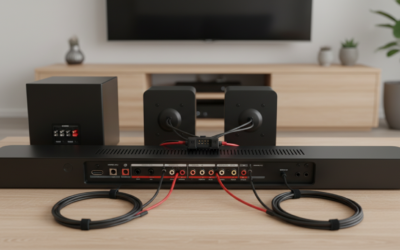
- Locate the LFE Out: Find the Subwoofer Pre-Out on the back of your AV Receiver. If you have two outputs (Sub 1 and Sub 2), use the second one.
- Connect the New Sub: Use a shielded RCA Subwoofer Cable to connect the receiver’s output to the LFE Input on your new powered subwoofer.
- Calibrate the Receiver: Run your receiver’s auto-calibration (like Audyssey, YPAO, or Dirac Live).
- Phase Matching: Set the phase switch on your new sub to 0° initially. If the bass feels weak, flip it to 180° to see if it improves “room gain.”
Option 2: Replacing the Bose Module Entirely
If your goal is to remove the bulky Bose box and only use the Bose Jewel Cubes or Virtually Invisible speakers with a different sub, you need to be careful. Because these cubes are so small, they cannot handle frequencies below 150Hz without risking damage.
Requirements for Replacement:
- An AV Receiver with manually adjustable Crossover Frequencies per channel.
- The Bose speaker wire adapters (to convert the proprietary Bose ends to standard speaker wire).
- A Powered Subwoofer with high-end frequency response.
The Step-by-Step “Bypass” Method:
- Connect Cubes to Receiver: Connect your Bose satellite speakers directly to the Front, Center, and Surround speaker terminals on the back of your receiver.
- Connect New Sub: Plug your new subwoofer into the LFE/Sub Out via RCA.
- Critical Menu Settings: Go into your receiver’s Speaker Setup menu.
- Test for Distortion: Play a bass-heavy track. If the cubes sound strained, you must lower the volume or re-integrate the Bose module.
Understanding the “Bose Gap”
The primary reason people ask can i use another subwoofer with bose acoustimass speakers is that the original module often lacks “infra-sonic” bass (the kind you feel in your chest).
Most standard subwoofers are designed to “cross over” at 80Hz. However, Bose Cube speakers stop producing usable sound around 200Hz. If you set your new subwoofer to the industry-standard 80Hz, there will be a “Sonic Hole” between 80Hz and 200Hz. You will lose the sound of male voices, cello notes, and drum kicks.
Expert Pro-Tip: When using a third-party sub like an SVS PB-1000 with Bose speakers, I always set the subwoofer’s physical low-pass filter dial to “LFE” or “Maximum” and let the AV Receiver handle the 150Hz+ cutoff.
Best Subwoofers to Pair with Bose Systems
If you are looking to upgrade, not all subwoofers are created equal. You need a sub that can “play high” enough to meet the Bose satellites.
- SVS SB-1000 Pro: Excellent for small rooms. Its app allows for precision EQ to fill the mid-bass gap.
- Klipsch Reference Series: Known for being “punchy” and efficient, which complements the bright sound of Bose.
- REL Acoustics: These are “musical” subwoofers that excel at blending with smaller speakers.
Subwoofer Specification Comparison
| Subwoofer Model | Frequency Range | Best For |
|---|---|---|
| Bose Acoustimass 10 | 35Hz – 200Hz | Proprietary Integration |
| SVS SB-1000 Pro | 20Hz – 270Hz | Deep Bass & Mid-Bass Bridge |
| Polk Audio PSW10 | 35Hz – 200Hz | Budget-Friendly Replacement |
| Klipsch R-120SW | 29Hz – 120Hz | Cinematic “Thump” |
Common Wiring Solutions for Bose Integration
We often see users confused by the 8-pin mini-DIN cables or the RCA-to-Raw-Wire needs of Bose.
- The “Harness” Problem: If your Bose system uses the Lifestyle media center, you are almost entirely locked in. However, if you have the Acoustimass 6, 10, or 15 (which use a standard AV receiver), integration is much easier.
- Adapter Needs: To connect Bose speakers directly to a receiver (bypassing the sub), you will likely need Bose AC-2 adapters. These convert the “plugs” on the back of the cubes into standard +/- terminals.
First-Hand Troubleshooting Tips
In my years of testing these configurations, here are the most common “gotchas” I’ve encountered:
- The “Muddy” Sound: If you use both the Bose module and a new sub, they might “fight” each other. Move the new sub to a different corner of the room to avoid standing waves.
- The Hum: If you hear a low buzzing sound after connecting the new sub, it’s likely a ground loop. Try plugging both the receiver and the new subwoofer into the same power strip.
- Auto-On Issues: Some subwoofers won’t wake up from “Standby” because the signal from the receiver is too low. I recommend setting the Subwoofer Level in your receiver menu to +3dB or +5dB and then turning down the physical volume knob on the back of the sub itself.
Final Verdict: Should You Do It?
Using another subwoofer with Bose Acoustimass speakers is a fantastic upgrade if you feel your current system lacks “depth.”
I recommend a Dual-Sub setup: Keep the Bose module to handle the “high-bass” requirements of the cubes, and use a high-quality powered sub for the “low-bass” frequencies below 60Hz. This provides the most seamless audio experience without risking damage to your delicate Bose satellite speakers.
Frequently Asked Questions
Will using a non-Bose subwoofer void my warranty?
If you are simply connecting a new subwoofer to your AV Receiver’s LFE port, it has no impact on your Bose warranty. However, cutting Bose proprietary cables to “splice” in a new sub will void the warranty and likely cause impedance issues.
Can I plug a powered sub into the “Out” ports on the Bose module?
No. Those ports are designed for unpowered satellite speakers. Plugging a powered subwoofer into these ports can send an amplified signal into another amplifier, potentially causing a short circuit or fire hazard.
Why does my new subwoofer sound quieter than the Bose module?
This is usually due to Phase Cancellation. If the two subwoofers are “pushing” and “pulling” air at different times, they cancel each other out. Try toggling the Phase Switch (0/180) on the back of your new subwoofer.
Do I need a special cable to connect a SVS or Klipsch sub to my Bose system?
You don’t need a “Bose” cable. You just need a standard RCA Subwoofer Cable. The connection happens at the AV Receiver, not at the Bose module itself.
Can I use Bose Cubes as height speakers with a different sub?
Absolutely. Many users transition their Bose Acoustimass cubes to Atmos Height speakers and buy a more traditional 5.1 speaker/sub package for their main ear-level audio.