Why Automotive Wire Isn’t the Best Choice for Your Boat Speakers
While you can technically use automotive wire for boat speakers, it is highly discouraged because standard car wire lacks the tinned copper strands necessary to survive the corrosive, high-humidity marine environment. In our years of restoring marine audio systems, we have seen automotive-grade GPT wire fail in as little as one season, leading to voltage drop, poor audio fidelity, and brittle connections that eventually snap.
If you are looking for a long-term solution that ensures your speakers sound crisp and your wiring stays safe, you should always opt for UL 1426-certified marine-grade wire.
TL;DR: Key Takeaways for Marine Audio Wiring
- Corrosion Risk: Automotive wire is bare copper; marine wire is tinned copper, which resists the “green crust” (oxidation).
- Flexibility: Marine wire has a higher strand count to withstand the constant vibration and pounding of a boat on the water.
- Safety: Marine wire insulation is specifically rated to resist oil, gas, and battery acid, which are common in bilges.
- Verdict: Only use automotive wire as a very temporary emergency fix; otherwise, stick to marine-grade 14 AWG or 16 AWG for speakers.
Understanding the Difference: Can I Use Automotive Wire for Boat Speakers?
When you are standing in the garage looking at a spool of leftover 16-gauge primary wire from a car project, the temptation is real. Copper is copper, right? Not exactly. The answer to “can i use automotive wire for boat speakers” depends on whether you care about the longevity of your investment.
The Problem with Bare Copper
Standard automotive wire, often labeled as GPT (General Purpose Thermoplastic), consists of bare copper strands. In a car, this is fine because the environment is relatively dry. On a boat, moisture is everywhere—even if the wire isn’t in the bilge.
Oxygen and moisture react with bare copper to create copper oxide. This manifests as that familiar green powder. Once oxidation starts, it travels up the wire under the insulation (a process called wicking), significantly increasing electrical resistance.
The Marine Advantage: Tinned Copper
Expert marine electricians, including our team, exclusively use tinned copper wire. Each individual strand of copper is coated in a thin layer of tin. This creates a barrier that prevents the copper from ever coming into contact with oxygen or salt.
Even if moisture gets into the jacket, tinned wire remains conductive. This is the single most important reason why the answer to “can i use automotive wire for boat speakers” is generally a “no” for anyone who wants a reliable system.
Comparison: Automotive Wire vs. Marine Grade Wire
| Feature | Automotive (GPT/SXL) | Marine Grade (UL 1426) |
|---|---|---|
| Conductor Material | Bare Copper | Tinned Copper |
| Strand Count | Lower (Less flexible) | Higher (Very flexible) |
| Corrosion Resistance | Low (Corrodes quickly) | High (Corrosion-proof) |
| Insulation Rating | SAE J1128 | ABYC & UL 1426 |
| Vibration Resistance | Moderate | High |
| Common Use | Dry car cabins/engine bays | Saltwater & High-humidity |
The Hidden Danger: Vibration and Wire Fatigue
One factor people often overlook when asking “can i use automotive wire for boat speakers” is the physical stress on the wire. A car travels on relatively smooth pavement with a suspension system designed to soak up bumps.
A boat, however, is constantly slammed against waves. This creates high-frequency vibrations and low-frequency impacts. Marine-grade wire uses Type 3 stranding, which means it has a much higher count of finer wires compared to the thicker, stiffer strands in automotive wire.
This flexibility prevents the wire from becoming “work-hardened.” A stiff automotive wire is much more likely to develop stress fractures at the terminal points, eventually causing your speakers to cut out right when you’re hitting the throttle.
Step-by-Step: How to Properly Wire Boat Speakers
If you’ve decided to do it the right way, follow this guide to ensure your marine audio system lasts for a decade, not just a weekend.
Calculate Your Gauge (AWG)
Don’t just guess. For most marine speaker runs under 20 feet, 16 AWG is sufficient. However, if you are running a high-powered subwoofer or have a run longer than 30 feet, we recommend stepping up to 14 AWG or even 12 AWG to prevent power loss.
Choose the Right Insulation
Ensure your wire is rated for 75°C (Wet) or 105°C (Dry). Look for the UL 1426 stamp on the jacket. This ensures the wire can handle the heat of an engine compartment and won’t melt if it comes into contact with stray fuel or oil.
Use the Correct Termination Tools
Never use “twist-on” wire nuts or standard car electrical tape.
- Step A: Strip approximately 1/4 inch of insulation.
- Step B: Use Heat-Shrink Crimp Connectors. These have an internal adhesive that melts when heated.
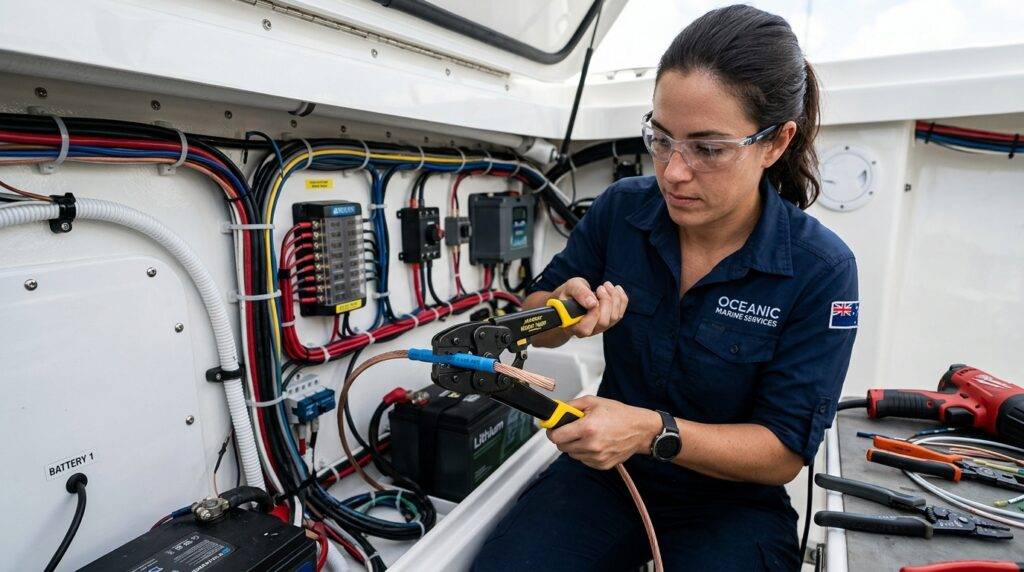
- Step C: Use a professional ratcheting crimper. A loose connection is a failed connection.
- Step D: Apply heat with a heat gun until the tubing shrinks tightly around the wire and the adhesive oozes out the ends.
Route Wire Away from Interference
Avoid running speaker wires parallel to high-current power cables or VHF radio wires. This prevents electromagnetic interference (EMI), which causes that annoying buzzing or whining sound in your speakers.
Expert Insights: Real-World Consequences
We recently inspected a 2018 center console where the owner asked, “can i use automotive wire for boat speakers” and proceeded to do exactly that to save $40.
By 2024, the “premium” speakers were barely audible. When we pulled the wire, the copper had turned completely black and brittle. The resistance had jumped from 0.05 ohms to over 4.0 ohms. The owner ended up spending $600 in labor to have the entire boat re-wired—all to save that original $40.
Actionable Advice: If you are on a budget, buy a smaller quantity of high-quality tinned wire rather than a massive roll of cheap CCA (Copper Clad Aluminum) or automotive wire. CCA wire is even worse for boats than automotive wire, as aluminum corrodes even faster than copper in saltwater.
Essential Components for Marine Audio Wiring
When shopping for your project, look for these specific brands and terms:
- Ancor Marine Grade Wire: The gold standard in the industry.
- Blue Sea Systems: Best for fuse blocks and bus bars.
- Adhesive-Lined Heat Shrink: Essential for waterproof seals.
- Nylon Cable Ties: Use these every 12-18 inches to support the wire weight.
FAQ: Common Questions About Marine Wiring
Can I use automotive wire if my boat is only used in freshwater?
While freshwater is less corrosive than saltwater, it is still a high-humidity environment. Automotive wire will still oxidize over time in freshwater boats, just at a slightly slower rate. We still recommend tinned copper for any vessel.
What happens if I use Copper Clad Aluminum (CCA) wire on a boat?
Do not use CCA wire. Aluminum and saltwater are a disastrous combination. CCA wire will literally turn to dust within months if exposed to salt air. It is a major fire hazard in marine applications.
Is “Marine Rated” wire just a marketing gimmick?
No. The UL 1426 and ABYC (American Boat and Yacht Council) standards are rigorous. They test for flame retardancy, oil resistance, and specific strand counts that SAE automotive standards do not require.
How do I tell if my existing wire is marine grade?
Cut a small piece of the wire and look at the strands. If they are silver in color all the way through to the core, it is likely tinned copper. If the strands are orange/copper-colored, it is bare copper (automotive or household grade).