Can I Use Car Speakers for Boombox? The Direct Answer
Yes, you can absolutely use car speakers to build a powerful DIY boombox. Because car speakers are designed to operate at 4 ohms, they are highly efficient and produce significant volume when paired with the right 12V power source and a Class D amplifier. To make this project successful, you must house the speakers in a custom enclosure to prevent “acoustic short-circuiting” and ensure the bass response is punchy rather than thin.
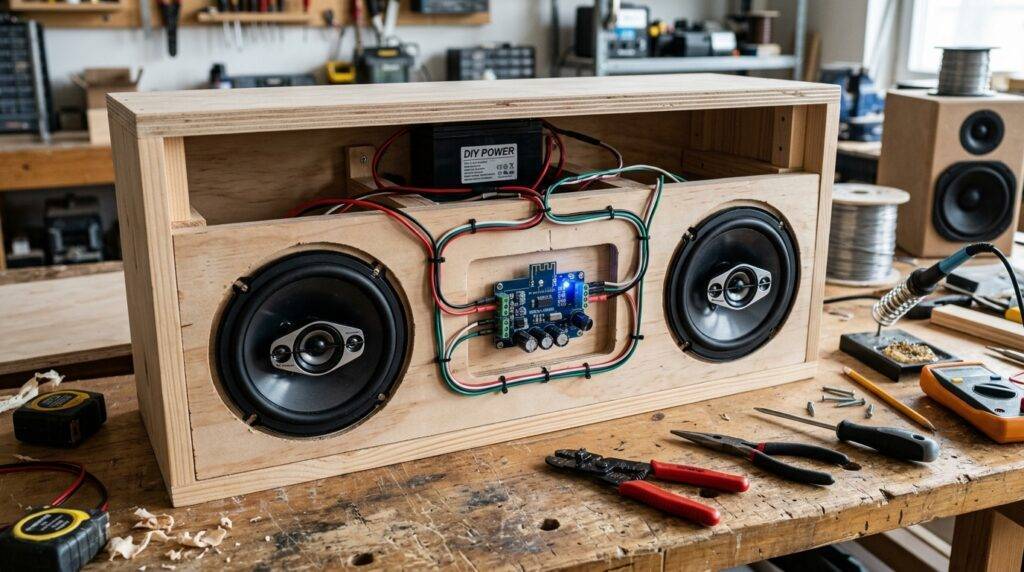
In my years of building custom “ammo-can” speakers and tailgating setups, I’ve found that car speakers are actually superior to many home audio drivers for portable use because they are built to withstand temperature fluctuations and humidity. However, the transition from a car door to a portable box requires specific technical steps regarding impedance matching and power management.
TL;DR: Key Takeaways for Your DIY Build
- Compatibility: Car speakers (usually 4-ohm) work perfectly with modern Bluetooth amplifier boards.
- Power Source: You will need a 12V DC power supply or a Lithium-ion battery pack (3S or 4S configuration).
- Enclosure is King: Without a sealed or ported box, car speakers will have zero bass.
- Best Speaker Type: Coaxial speakers are easiest because the tweeter is built-in, saving space and wiring complexity.
- Avoid Head Units: Unless you want a bulky build, use a small Bluetooth Amp Board instead of a full car stereo head unit.
Why Use Car Speakers for a Boombox Project?
When people ask, “can i use car speakers for boombox builds?” they often worry about the power requirements. In reality, car speakers are some of the most versatile components for DIY audio. Unlike home speakers that usually run at 8 ohms, car speakers run at 4 ohms, allowing them to pull more power from low-voltage battery sources.
Advantages of Car Audio Components
- Durability: Car speakers feature treated surrounds and polypropylene cones designed to survive the harsh environment of a vehicle. This makes them perfect for a portable boombox that might see outdoor use.
- Efficiency: They are designed to get loud with minimal wattage. A standard 6.5-inch coaxial speaker can easily fill a backyard with sound.
- Cost-Effectiveness: You can often find high-quality used Pioneer, Kenwood, or JBL speakers for a fraction of the price of dedicated “bookshelf” drivers.
- Integrated Tweeters: Most car speakers are coaxial, meaning the high-frequency tweeter is mounted directly over the woofer. This simplifies your “cut-out” process during the build.
Essential Components for Your Build
To successfully answer the question “can i use car speakers for boombox utility?” you need to look beyond just the speakers. You are essentially building a small, portable car audio system.
| Component | Purpose | Recommendation |
|---|---|---|
| Car Speakers | Audio Output | 5.25″ or 6.5″ Coaxial (4-ohm) |
| Amplifier Board | Powers the Speakers | TPA3116D2 Bluetooth Class D Amp |
| Power Source | Provides Energy | 12V TalentCell Battery or 12V 5A Wall Adapter |
| Enclosure | Resonance & Bass | 1/2″ MDF or 1/4″ Plywood |
| Switches/Ports | User Control | SPST Toggle Switch & DC Power Jack |
| Damping Material | Sound Quality | Poly-fill or craft foam |
Step-by-Step Guide: Building Your Car Speaker Boombox
I have built dozens of these units, from “cooler radios” to vintage suitcase conversions. Follow these steps to ensure your car speakers sound like a high-end system rather than a tinny toy.
Step 1: Selecting Your Speakers
For a boombox, 6.5-inch speakers are the “sweet spot.” They provide enough surface area for decent bass without requiring a massive enclosure. Look for a Sensitivity (dB) rating of 90dB or higher. The higher the sensitivity, the longer your battery will last because the amp doesn’t have to work as hard.
Step 2: Choosing the Amplifier
Don’t use a heavy car head unit unless you absolutely need a CD player or FM radio. Instead, use a Class D Bluetooth Amplifier Board. These boards are the size of a credit card, incredibly efficient, and can be hidden inside the box. I recommend boards based on the TPA3116D2 chip, which can output up to 50W per channel at 12V-24V.
Step 3: Designing the Enclosure
This is where most DIYers fail. If you just mount a car speaker on a flat board, the sound waves from the back cancel out the waves from the front.
- Volume: For a pair of 6.5″ speakers, aim for an internal volume of about 0.5 to 1.0 cubic feet.
- Material: Use MDF (Medium Density Fiberboard) for the best acoustics, or Birch Plywood if you want it to be lightweight.
- Sealing: Use wood glue and silicone caulk on every internal seam. An airtight box is mandatory for car speakers to produce bass.
Step 4: Power Management
Since car speakers are designed for 12V DC, you have two main options:
- Wall Power: Use a 12V 5A DC power brick (like a laptop charger).
- Battery Power: Use a Lithium-ion (Li-ion) or LiFePO4 battery. A 10Ah (Amp-hour) battery will typically give you 8-12 hours of playtime at moderate volumes.
Step 5: Wiring and Assembly
- Cut your speaker holes using a jigsaw or hole saw.
- Mount the Bluetooth Amp inside, ensuring the Bluetooth antenna isn’t blocked by thick metal.
- Wire the speakers in Parallel or Series? For most 2-channel amps, just wire the Left Speaker to the Left Output and the Right Speaker to the Right Output.
- Add a Power Switch between the battery and the amp to prevent “parasitic drain.”
The Technical Side: Impedance and Power Math
Understanding Ohm’s Law is critical when you ask, “can i use car speakers for boombox designs?”
Most home receivers expect an 8-ohm load. If you hook 4-ohm car speakers to a cheap home receiver, you might overheat the receiver. However, DIY Amp Boards are specifically designed to handle 4-ohm loads.
Pro Tip from My Workshop: If your amp feels hot to the touch, you are likely pushing too much current. Ensure your Power Supply Voltage matches your amp’s requirements. While many boards say they “can” handle 24V, running them at 18V or 19V (using an old laptop power supply) often provides the best balance of power and heat management for 4-ohm car speakers.
Pros and Cons of Using Car Speakers for Portable Audio
Pros:
- Weather Resistance: Many car speakers use rubber surrounds instead of foam, which won’t rot when taken to the beach.
- Punchy Mid-Bass: Car speakers are tuned to overcome road noise, giving them a very “forward” and energetic sound.
- Availability: You can find these at any big-box retailer or local junkyard.
Cons:
- Power Hunger: They require more current (Amps) than smaller, dedicated portable drivers.
- Bulk: You cannot make a “pocket-sized” boombox with 6.5″ car speakers; you are committed to a medium-to-large build.
- Tweeter Harshness: Some entry-level car speakers have metal dome tweeters that can sound “bright” or “harsh” when listened to up close. I recommend choosing speakers with silk dome tweeters for a smoother indoor listening experience.
Advanced Tips for Audiophile Quality
If you want your car speaker boombox to rival a JBL Boombox 3 or a UE Hyperboom, follow these expert tweaks:
- Add Poly-fill: Lightly stuff the inside of the box with polyester fiberfill (pillow stuffing). This “tricks” the speaker into thinking it is in a larger box by slowing down the sound waves, resulting in deeper bass.
- Use a Passive Radiator: If your box is small, add a passive radiator. This allows you to get “ported” bass performance without the complexity of calculating port air velocity or dealing with “chuffing” noises.
- Upgrade the Capacitors: If you are using a cheap amp board, soldering a larger electrolytic capacitor (e.g., 4700uF) across the power input can help provide “burst” energy for bass hits.
- Seal the Back of the Speakers: If you are putting two speakers in one box, they should ideally have a divider wall between them. This prevents the pressure from one speaker from interfering with the movement of the other.
Frequently Asked Questions
Can I use a car battery to power my boombox?
While you can, I don’t recommend it. Standard Lead-Acid car batteries are heavy, contain acid, and release gases when charging. Instead, use a Deep Cycle battery or a Lithium-ion pack, which is much lighter and safer for indoor/portable use.
Do I need a crossover for my car speaker boombox?
If you are using coaxial speakers, the crossover is already built-in (usually a small capacitor glued to the back). If you are using component speakers (where the woofer and tweeter are separate), you must use the included crossover box to prevent blowing the tweeter.
How do I add Bluetooth to my DIY boombox?
The easiest way is to buy an amplifier board that has integrated Bluetooth 5.0. If you already have an old amp, you can plug a Bluetooth Receiver Module into the “Aux Input” of the amp.
Can I use 8-ohm home speakers with a car amp?
Yes, but the volume will be lower. A car amp designed for 4 ohms will produce about half its rated power when connected to 8-ohm speakers. This is safe, but not optimal for maximum loudness.
What is the best wood for a car speaker box?
MDF (Medium Density Fiberboard) is the gold standard for sound because it is dense and doesn’t vibrate. However, if the boombox is for outdoor use, use Marine-grade Plywood or apply a waterproof coating like Duratex or truck bed liner.
**
**
**
**