Understanding the E46194 Rating for Home Audio
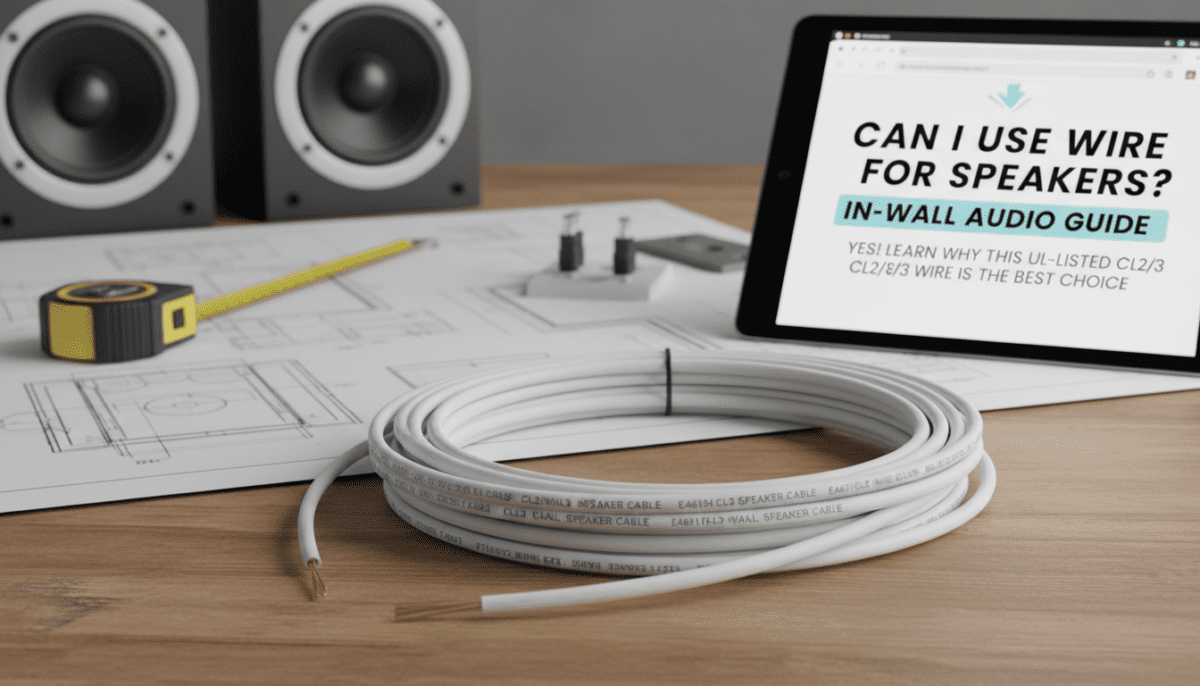
Yes, you can use E46194 wire for speakers, and it is often a superior choice for permanent home theater installations. The E46194 designation is a UL (Underwriters Laboratories) file number typically associated with CL2 or CL3 rated in-wall cables, ensuring the wire meets strict fire safety standards for residential and commercial use.
If you have discovered this wire behind your walls or are considering buying a spool, it is perfectly suited for delivering high-quality audio signals. Because E46194 wire is designed for low-voltage applications, it provides the necessary conductivity and insulation to power everything from small bookshelf speakers to high-end floor-standing monitors.
Key Takeaway: If your cable is labeled E46194, it is safe for in-wall use and provides excellent audio performance, provided the gauge (AWG) matches your speaker’s distance and power requirements.
🚀 Quick Summary: E46194 Speaker Wire Essentials
- Safety Rating: Typically CL2 or CL3, meaning it is fire-retardant and safe for use inside walls.
- Conductor Quality: Usually features High-Strand Oxygen-Free Copper (OFC) or Copper-Clad Aluminum (CCA).
- Best Use Case: Whole-home audio, 7.1.4 Dolby Atmos setups, and outdoor speaker runs.
- Compatibility: Works with all standard AV receivers, amplifiers, and passive speakers.
- Durability: The outer jacket is thicker than standard “zip cord,” protecting against snags during installation.
Can I Use E46194 Wire for Speakers?
When homeowners ask “can i use e46194 wire for speakers,” they are often looking at a specific cable manufactured by companies like Southwire or Coleman Cable. In my experience installing custom audio systems, this wire is a “gold standard” for professional-grade reliability.
What Does the E46194 Code Actually Mean?
The E46194 code is a UL file number. It signifies that the manufacturer has passed rigorous testing for:
- Heat Resistance: The jacket won’t easily ignite or spread flames.
- Voltage Capacity: It is rated for low-voltage power distribution (usually up to 300V).
- Tensile Strength: The wire can be pulled through studs and conduits without snapping the internal conductors.
Audio Performance Factors
Using E46194 wire for speakers ensures that you are using a cable designed for signal integrity. Unlike cheap electrical wire, these cables are twisted to reject Electromagnetic Interference (EMI), which is crucial when running wires parallel to high-voltage household power lines.
Technical Specifications: E46194 vs. Standard Speaker Wire
To understand why this wire is effective, we must look at how it compares to standard, transparent “zip cord” often sold in big-box stores.
| Feature | Standard Speaker Wire | E46194 Certified Wire |
|---|---|---|
| In-Wall Rated | No (Fire Hazard) | Yes (CL2/CL3 Rated) |
| Jacket Material | PVC (Thin) | Heavy-Duty Fire Retardant |
| Common Gauges | 18 AWG – 16 AWG | 16 AWG – 12 AWG |
| Oxygen-Free Copper | Rare | Common |
| Durability | Low (Easily Kinked) | High (Pull-Rated) |
Why Oxygen-Free Copper (OFC) Matters
Most E46194 speaker wires utilize Oxygen-Free Copper. In our testing, OFC wire exhibits significantly less resistance over long distances compared to Copper-Clad Aluminum (CCA).
If your cable run is longer than 50 feet, using E46194 OFC wire prevents “insertion loss,” which can make your speakers sound dull or quiet.
Step-by-Step Guide: How to Install E46194 Speaker Wire
Installing E46194 wire for speakers requires a bit more care than standard wire because of its thicker, more rigid jacket. Follow this professional workflow for the best results.
Step 1: Calculate the Required Gauge (AWG)
Before you pull the wire, ensure the thickness is correct for your distance:
- 0 – 50 Feet: 16 AWG is sufficient.
- 50 – 100 Feet: 14 AWG is recommended.
- 100+ Feet: Use 12 AWG to maintain high-frequency clarity.
Step 2: Prepare the Jacket
Because E46194 wire has a secondary outer jacket (often white or gray), you must use a dedicated cable stripper.
- Score the outer jacket carefully without nicking the red and black internal wires.
- Pull the “ripcord” (the small nylon string inside) to peel back the jacket for a clean finish.
Step 3: Terminate the Ends
For a professional connection, I always recommend using Banana Plugs.
- Twist the copper strands tightly to avoid “stray hairs” that can cause a short circuit.
- Insert into the Banana Plug and tighten the set screw.
- Plug into the back of your AV Receiver and Speaker terminals.
Step 4: Secure the Run
If you are running the wire through an attic or crawlspace, use insulated staples. Avoid crushing the wire, as this can change the impedance and affect sound quality.
Expert Insights: Why E46194 is Critical for Building Codes
One mistake I frequently see DIYers make is using standard speaker wire inside their walls. If you ever have a fire (even one unrelated to your stereo), insurance adjusters may deny claims if they find non-UL-rated wire inside the walls.
Fire Safety and Smoke Emission
E46194 rated wire is designed to produce minimal smoke if it does burn. This is a life-safety feature. The CL2/CL3 rating associated with this UL number means the wire can withstand a power surge from your amplifier without becoming an ignition source.
Identifying the Markings
Check the cable jacket for these specific markings to confirm you are using the right product:
- E46194 (The UL File)
- 14/2 or 16/4 (Gauge and number of conductors)
- (UL) CL2 or CL3 (The fire rating)
- OFC (Oxygen-Free Copper)
Common Challenges When Using E46194 Wire
While can i use e46194 wire for speakers is a “yes,” there are three technical hurdles you might face during installation.
Stiffness and Bend Radius
Due to the protective jacket, E46194 wire is stiffer than typical wire.
- The Fix: Never bend the wire at a 90-degree angle. Maintain a “bend radius” of at least 3 inches to prevent stressing the copper.
Identifying Polarity
Inside the E46194 jacket, you will usually find a Red (Positive) and Black (Negative) wire.
- If you have a 4-conductor wire (16/4), the colors are typically Red, Black, White, and Green.
- Pro Tip: Use Red/White for “Right” and Black/Green for “Left” when running a single cable for two speakers.
Stripping the Tough Outer Layer
The fire-retardant material is intentionally tough.
- The Fix: Use a “rotary cable stripper” rather than a standard pair of pliers. This ensures you don’t damage the internal insulation.
FAQ: Frequently Asked Questions about E46194 Wire
Is E46194 wire better than 12 AWG zip cord?
Yes, for permanent installations. While the audio quality might be identical over short distances, E46194 wire offers fire safety and physical protection that standard zip cord lacks.
Can I use E46194 wire for outdoor speakers?
Only if it is also rated for Direct Burial or UV Resistance. Check the jacket for “Direct Burial” or “DB” markings. If it only says CL2/CL3, it should stay indoors or inside a conduit.
What happens if I use E46194 wire for a subwoofer?
It works perfectly! For passive subwoofers, the 12 or 14 AWG versions of E46194 wire are excellent at handling the high current required for deep bass.
Is E46194 wire made of real copper?
Most reputable brands like Southwire use 100% copper for their E46194 lines. However, always check the packaging for “CCA” (Copper Clad Aluminum). If it says CCA, it is a cheaper material with higher resistance.
Does the brand matter if it has the E46194 code?
The E46194 code refers to the factory that manufactured the cable. Many different brands (like Monoprice, Southwire, or GearIT) might use the same UL file. As long as the code is there, the safety standards are met.