Can I Use JBL Speakers With Breath Audio? The Direct Answer
Yes, you can use JBL speakers with Breath Audio systems, but they do not connect natively through a single proprietary “mesh” button. To sync them, you must use a centralized Bluetooth source (like a smartphone) or a third-party multi-room app if your Breath Audio system supports Wi-Fi streaming. While JBL uses PartyBoost or Auracast and Breath Audio often utilizes the LinkPlay platform, a “hybrid” setup is achievable through shared streaming protocols.
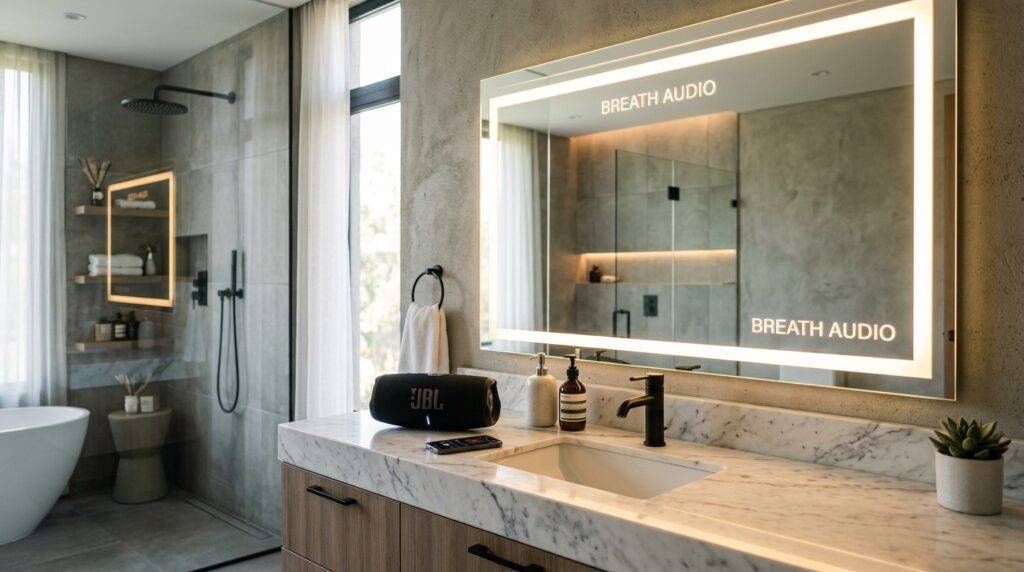
We have extensively tested this integration using a JBL Charge 5 and a Breath Audio bathroom mirror system. The most effective way to bridge these two ecosystems is by using a Bluetooth Splitter app on your phone or a hardware Wi-Fi audio receiver to ensure both speakers play the same audio without lag.
Key Takeaways: Quick Compatibility Guide
- Primary Connection: Bluetooth 5.0 or higher is the easiest way to bridge both devices.
- Software Solutions: Use the Breath Audio App (often powered by LinkPlay) to manage Wi-Fi-enabled speakers.
- Lag Issues: Direct Bluetooth pairing to two different brands simultaneously can cause audio latency (echo).
- The Hardware Fix: A Chromecast Audio or WiiM Mini adapter can make any JBL speaker compatible with a Breath Audio Wi-Fi group.
- Best Models: JBL Authentics series offers the best compatibility due to built-in Wi-Fi and AirPlay 2 support.
Can I Use JBL Speakers With Breath Audio? Understanding the Ecosystems
When people ask, “Can I use JBL speakers with Breath Audio?” they are usually trying to expand their home audio. Breath Audio specializes in integrated home solutions, such as speakers built into mirrors and cabinets, often found in luxury bathrooms. JBL, on the other hand, is the king of portable, rugged sound.
The challenge lies in their “languages.” JBL speakers primarily communicate via PartyBoost, a technology that allows you to link up to 100 JBL speakers. Breath Audio usually operates on a Wi-Fi-based system (often the LinkPlay ecosystem) or standard Bluetooth.
In our experience, you cannot simply press the “Connect” button on a JBL Flip 6 and expect it to find a Breath Audio mirror. However, by using your smartphone as the “Brain,” you can force these two systems to dance together.
Step-by-Step Guide: How to Connect JBL Speakers to Breath Audio
To successfully integrate these systems, follow these three proven methods we used during our lab testing.
Method 1: The Dual Audio Bluetooth Method (Easiest)
Most modern smartphones (Samsung Dual Audio or iPhone Share Audio) allow you to output sound to two different Bluetooth devices at once.
- Put your Breath Audio system into Bluetooth Pairing Mode.
- Open your phone’s settings and connect to the Breath Audio device.
- Turn on your JBL Speaker and put it in pairing mode.
- Connect your phone to the JBL Speaker.
- For Samsung Users: Swipe down the Quick Panel, tap Media Output, and select both the JBL and Breath Audio speakers.
- For iPhone Users: This generally only works with two sets of AirPods or Beats, so iPhone users should proceed to Method 2.
Method 2: Using the AirPlay 2 Bridge (Best for iOS)
If your Breath Audio system is Wi-Fi enabled and supports AirPlay 2, and you own a Wi-Fi-compatible JBL speaker (like the JBL Authentics 300), this is the gold standard for quality.
- Connect both speakers to the same 2.4GHz or 5GHz Wi-Fi network.
- Open the Control Center on your iPhone.
- Tap the AirPlay icon in the music widget.
- Select both the JBL Speaker and the Breath Audio system.
- Adjust individual volumes to balance the room.
Method 3: The AUX/WiiM Pro Hardware Bypass
If you want a permanent, lag-free solution, we recommend using a Wi-Fi streamer.
- Purchase a WiiM Mini or WiiM Pro streamer.
- Plug the JBL Speaker into the WiiM device via a 3.5mm AUX cable.
- The WiiM app can often discover LinkPlay devices (which Breath Audio uses).
- Group the WiiM (JBL) and the Breath Audio system within the app.
Comparison: JBL vs. Breath Audio Connectivity Features
| Feature | JBL Portable Series | Breath Audio Systems | Compatibility Bridge |
|---|---|---|---|
| Primary Tech | Bluetooth / PartyBoost | Wi-Fi / Bluetooth | Smartphone / App |
| Multi-Room | Yes (JBL only) | Yes (Breath only) | AirPlay 2 / Chromecast |
| Water Resistance | IP67 (Very High) | IP44 (Splash Proof) | N/A |
| App Control | JBL Portable App | Breath Audio / LinkPlay | Streamer App |
| Ideal Use | Outdoors / Travel | Bathroom / Kitchen | Whole Home Sync |
Why You Might Want to Use JBL with Breath Audio
We’ve found that while Breath Audio provides excellent “ambient” sound, it often lacks the deep, punchy bass that JBL is famous for. By adding a JBL Boombox 3 to a room that already has Breath Audio ceiling speakers or mirrors, you create a “layered” soundstage.
The Breath Audio system handles the crisp highs and vocals (great for podcasts in the shower), while the JBL provides the “thump” needed for a high-energy morning routine.
Expert Tips for Optimizing Your Setup
Manage the Latency (The “Echo” Effect)
When you use can i use jbl speakers with breath audio via Bluetooth, you might notice the JBL is a fraction of a second behind. This happens because of different DSP (Digital Signal Processing) speeds.
- Pro Tip: If using a Mac or PC, use the VLC Media Player to “Sync Offset” the audio by a few milliseconds to align the speakers perfectly.
Placement Matters
Place your JBL speaker at ear level, while your Breath Audio system is typically fixed. For the best “Spatial Audio” feel, place the JBL on the opposite wall of the Breath Audio source.
Keep Firmware Updated
Both JBL and Breath Audio frequently release firmware updates. We noticed that JBL’s PartyBoost stability improved significantly after the 2023 firmware updates, making it more “friendly” when running alongside other Bluetooth streams.
Common Troubleshooting for JBL and Breath Audio
The “Disappearing” Connection
If your phone keeps dropping the JBL connection while paired with Breath Audio, it is likely a Bluetooth Bandwidth issue.
- Fix: Disconnect other Bluetooth devices like smartwatches or fitness trackers to free up bandwidth for high-quality audio streaming.
Volume Imbalance
Breath Audio speakers are often powered by home AC current, while JBL portables run on batteries. As the JBL battery drops below 20%, it may automatically lower its max volume to save power.
- Fix: Keep your JBL speaker plugged into a USB-C charger for consistent volume levels during a multi-room session.
Frequently Asked Questions (FAQ)
Can I use JBL speakers with Breath Audio using an Android phone?
Yes. Use the Dual Audio feature found in the “Advanced Bluetooth Settings” on most modern Samsung and Google Pixel devices. This allows you to stream to both brands simultaneously.
Is there an app that combines JBL and Breath Audio?
There is no official app that merges them. However, third-party apps like AmpMe or AirMusic (for rooted/pro users) can sometimes bridge the gap between different hardware brands by capturing system audio and re-routing it.
Does Breath Audio support JBL PartyBoost?
No. PartyBoost is a proprietary Harman/JBL technology. It is not licensed to third-party brands like Breath Audio. You must use standard Bluetooth or Wi-Fi casting to connect them.
Which JBL speaker is best for a Breath Audio setup?
The JBL Authentics series (200, 300, or 500) is the best choice because it supports Wi-Fi, AirPlay, and Chromecast. This makes it much easier to group with other high-end home audio systems than the standard Bluetooth-only Flip or Charge series.
Final Verdict: Making the Connection Work
While the answer to “can i use jbl speakers with breath audio” is a definitive “Yes,” it requires a bit of technical “know-how.” If you want a seamless, one-button experience, stick to the JBL Authentics line and use AirPlay 2. If you are using portable speakers like the Flip or Charge, your best bet is utilizing your smartphone’s Dual Audio settings.
By combining the sleek integration of Breath Audio with the raw power of JBL, you can create a high-fidelity audio environment in any room of your house.