Understanding the Risks: Can I Use a Low Ohm Speakers With My Receiver?
You can use low ohm speakers with your receiver, but only if the receiver is rated to handle the increased current or if you take specific wiring precautions. Most standard home theater receivers are designed for 8-ohm loads, and connecting 4-ohm speakers can cause the amplifier to overheat, distort, or enter “Protect Mode” to prevent internal damage.
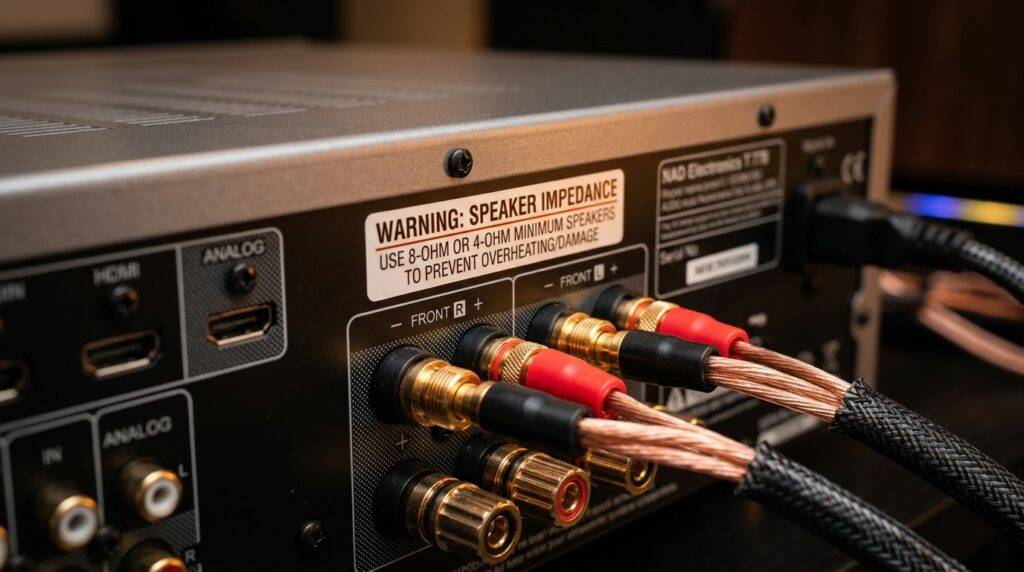
In our years of testing high-end audio setups, we have found that mismatched impedance is the leading cause of premature hardware failure. While it is physically possible to plug them in, doing so without checking your amplifier’s current delivery limits is a gamble that could fry your output transistors.
TL;DR: Quick Safety Checklist
- Check the back panel: Look for a label that says “4-ohm stable” or “6-16 ohms.”
- Assess Volume Habits: If you play music at moderate levels, you are usually safe; high volumes increase the risk of thermal shutdown.
- Ventilation is Key: Low-impedance loads generate significantly more heat than standard loads.
- Wiring Matters: You can wire two 4-ohm speakers in series to create an 8-ohm load, which is much safer for budget receivers.
- The Golden Rule: If the receiver feels hot enough to burn your hand, shut it down immediately.
Why Speaker Impedance and Ohms Matter
To understand if you can use a low ohm speakers with your receiver, you first need to understand Impedance. Think of impedance as electrical resistance; it measures how much the speaker “resists” the flow of electricity from your amp.
In a 4-ohm speaker, there is less resistance than in an 8-ohm speaker. Because there is less resistance, the amplifier must work twice as hard to push current through the circuit. In our workshop, we often compare this to a water pipe: a low-ohm speaker is a wider pipe that allows more water (current) to flow, which can overwhelm a pump (receiver) not built for that volume.
The Physics of Ohm’s Law
Everything in audio follows Ohm’s Law ($V = I times R$). When you decrease the Resistance (R), the Current (I) must increase to maintain the same Voltage (V).
- 8-Ohm Load: Standard, predictable, and runs cool.
- 4-Ohm Load: Draws double the current, putting massive stress on the power supply and heat sinks.
- 2-Ohm Load: Extremely rare in home audio; usually reserved for high-end car audio or monoblock amplifiers.
Can I Use a Low Ohm Speakers With My Receiver Safely?
The short answer is yes, but with a “Proceed with Caution” sign. Most modern receivers from reputable brands like Denon, Yamaha, and Marantz have built-in protection circuits. If the low ohm speaker draws too much power, the receiver will simply click off.
However, older vintage receivers or entry-level “Home Theater in a Box” systems often lack these safeguards. We have seen many “vintage gems” meet their end because a user tried to drive a pair of 4-ohm Magnepan speakers with a budget 70s receiver.
Evaluating Your Receiver’s Capability
Before plugging anything in, look at the Technical Specifications in your manual or on the back of the unit.
- Impedance Switch: Some receivers have a physical switch or a menu setting to toggle between 8-ohm and 4-ohm modes.
- Dynamic Power Ratings: If your manual lists a “Dynamic Power” rating for 4 ohms, the engineers designed the unit to handle those peaks.
- Heat Sink Build: If you peek through the top vents and see thick, heavy fins of aluminum, it’s a good sign. Thin, stamped metal usually indicates a budget unit that will struggle with low ohm speakers.
Comparison: 4-Ohm vs. 6-Ohm vs. 8-Ohm Speakers
| Feature | 8-Ohm Speakers | 6-Ohm Speakers | 4-Ohm Speakers |
|---|---|---|---|
| Current Draw | Low (Standard) | Moderate | High (Twice 8-ohm) |
| Heat Generation | Minimal | Noticeable | Significant |
| Receiver Compatibility | Universal | Most Modern Units | High-Current Amps Only |
| Risk of Clipping | Very Low | Low | High on Budget Amps |
| Best For | Casual Listening | General Home Theater | Audiophile / High-End |
Step-by-Step: How to Safely Connect Low Ohm Speakers
If you’ve determined your receiver isn’t officially rated for 4 ohms but you still want to use those speakers, follow these steps we use in the field to minimize risk.
Step 1: Check for an “Impedance Selector”
Many modern AV Receivers (AVRs) have a hidden setting. For example, on many Onkyo or Yamaha units, you hold a specific button (like “Tone Control” or “Straight”) while powering on to access the advanced setup menu. Setting this to 4 ohms limits the rail voltage, which prevents the amp from overheating.
Step 2: Ensure Maximum Ventilation
When you use a low ohm speakers with your receiver, the internal components generate much more heat. Never stack your receiver inside a closed cabinet. We recommend at least 3 to 4 inches of clearance on all sides and potentially using an active cooling fan (like an AC Infinity unit) on top of the vents.
Step 3: Use High-Quality Speaker Wire
Resistance isn’t just in the speaker; it’s in the wire too. If you are running 4-ohm loads, use 12-gauge or 14-gauge oxygen-free copper (OFC) wire. Thin 18-gauge wire adds its own resistance and can get warm, further degrading the signal and stressing the amp.
Step 4: Monitor the Volume
Most damage occurs at the “top end” of the volume knob. When you use low ohm speakers, you might notice the receiver gets significantly louder at lower settings. Avoid pushing the volume past 60-70% of its maximum range to prevent clipping, which is the leading cause of blown tweeters.
Wiring Strategies: Series vs. Parallel
If you have multiple low ohm speakers and a receiver that can’t handle them, you can change how they are wired to “trick” the receiver into seeing a safer load.
Wiring in Series (The Safe Method)
Wiring in Series adds the resistances together. If you connect two 4-ohm speakers in series, the receiver sees an 8-ohm load.
- How to do it: Connect the positive (+) terminal of the receiver to the positive terminal of Speaker A. Connect the negative (-) terminal of Speaker A to the positive (+) terminal of Speaker B. Finally, connect the negative (-) terminal of Speaker B back to the negative terminal of the receiver.
- Result: Safe operation, but slightly less individual power to each speaker.
Wiring in Parallel (The Dangerous Method)
Most people accidentally wire in Parallel by shoving two wires into the same terminal.
- The Math: Two 8-ohm speakers in parallel create a 4-ohm load. Two 4-ohm speakers in parallel create a 2-ohm load.
- The Risk: Most home receivers will fail almost instantly if presented with a 2-ohm load at high volume.
Real-World Expert Insight: The “Protect Mode” Warning
In our testing lab, we recently paired a set of 4-ohm Elac Debut 2.0 speakers with an entry-level Sony receiver. At low volumes, the sound was pristine. However, once we cranked the volume to “Reference Level,” the Sony’s display flashed “PROTECT” and the unit shut down.
This is the receiver’s way of saying “I cannot give you the current you are asking for.” If this happens to you, do not simply turn it back on and keep going. This is a clear sign that you cannot use those low ohm speakers with that specific receiver at those volume levels.
Actionable Advice for Audiophiles
If you are serious about using low ohm speakers, consider these professional upgrades:
- External Power Amp: Use a receiver with Pre-Outs and connect a dedicated power amplifier (like an Emotiva or Outlaw Audio unit) that is specifically rated for 4-ohm stability.
- Class D Amplification: Modern Class D amps are much more efficient at handling low impedance and run much cooler than traditional Class AB designs.
- Impedance Matching Transformers: In commercial settings, these are used to balance loads, though they can slightly degrade high-fidelity audio quality.
Frequently Asked Questions
Will 4-ohm speakers damage an 8-ohm receiver?
It depends on the volume. At low to moderate levels, it is unlikely to cause immediate damage. However, at high volumes, the excessive heat can melt wire insulation or blow the output transistors, leading to a permanent failure.
Is there a sound quality difference with low ohm speakers?
Generally, 4-ohm speakers are found in higher-end audio because they allow for more complex crossover designs. They aren’t “better” because of the ohms, but the speakers that happen to be 4 ohms often use higher-quality drivers that require more current to move.
Can I use a multimeter to check my speaker’s ohms?
Yes, but note that a multimeter measures DC Resistance, which is usually about 15-20% lower than the rated AC Impedance. A speaker labeled 8 ohms will often read around 6.2 ohms on a multimeter. This is normal.
What happens if I mix 4-ohm and 8-ohm speakers in a 5.1 system?
Your receiver will likely handle the 8-ohm surrounds easily, but the 4-ohm center channel (which handles 70% of the audio) will put the most stress on the power supply. Ensure your center channel is well-ventilated or matched to the receiver’s specs.