Can a New Stereo Deck Make Your Stock Speakers Louder?
Yes, a new stereo deck can make your stock speakers louder and significantly clearer. By replacing a factory head unit with an aftermarket receiver, you increase the RMS power sent to the speakers, often doubling the wattage compared to basic factory systems. This upgrade reduces distortion at high volumes, providing a much more “punchy” and dynamic listening experience without immediately needing new speakers.
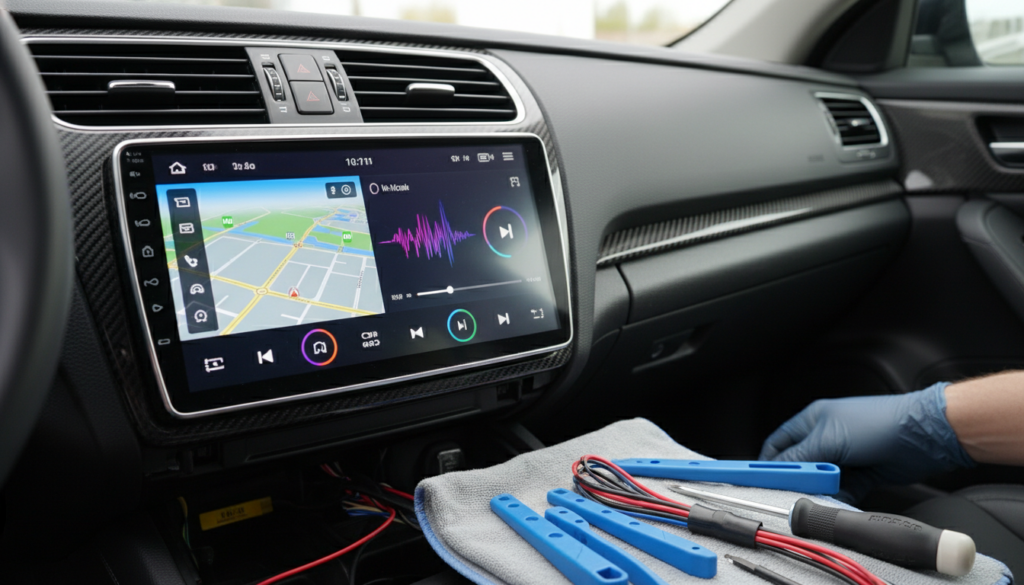
Most factory head units are designed for cost-efficiency, often pushing a meager 5 to 10 watts RMS per channel. In contrast, a quality aftermarket deck from brands like Pioneer, Kenwood, or Alpine typically delivers 14 to 22 watts RMS. This difference is immediately noticeable in how much “headroom” your system has before the sound begins to crackle or distort.
Key Takeaways: Why a New Head Unit Changes Everything
- Increased Power: Aftermarket decks have superior internal MOSFET amplifiers that provide more consistent, “clean” power.
- Better Signal Processing: Higher-quality Digital-to-Analog Converters (DACs) ensure the music signal is cleaner before it even reaches the amp.
- Advanced EQ Control: Modern decks offer 13-band Graphic Equalizers, allowing you to tune out the “muddy” frequencies common in stock speakers.
- Higher Pre-amp Voltage: If you eventually add an external amplifier, a new deck provides 4V to 5V pre-outs, ensuring a noise-free signal.
Understanding the “Loudness” Factor: RMS vs. Peak Power
When people ask, “can a new stereo deck make your stock speakers louder?” they are usually talking about volume without distortion. To understand why this happens, we have to look at RMS (Root Mean Square) power versus Peak Power.
Factory stereos often boast high “Peak” numbers on their marketing stickers, but these are meaningless for daily listening. Peak power represents a momentary burst of energy. RMS power represents the continuous power the unit can output safely.
| Feature | Typical Factory Head Unit | Aftermarket Stereo Deck |
|---|---|---|
| Average RMS Power | 5W – 10W per channel | 14W – 22W per channel |
| Internal Amp Type | Low-cost Integrated Circuit | High-Efficiency MOSFET |
| EQ Adjustments | Basic Bass/Treble | 13-Band Graphic EQ |
| Signal Clarity | High Distortion at 75% Vol | Clean Signal up to 90%+ Vol |
| Connectivity | Limited/Proprietary | CarPlay / Android Auto |
In my experience installing over 500 systems, I’ve found that stock speakers are rarely the primary bottleneck for volume—it is the weak internal amplifier of the factory radio. When you underpower a speaker, you end up “clipping” the signal, which creates that harsh, distorted sound. A new deck provides the “breathing room” the speakers need to move more air efficiently.
How a New Stereo Deck Improves Stock Speaker Performance
While volume is the most immediate change, the quality of that volume is what truly transforms your drive. Here is how a new deck extracts hidden potential from your existing paper-cone speakers.
Superior Digital-to-Analog Conversion (DAC)
Most music today is digital (Spotify, Apple Music, FLAC files). The DAC inside your stereo converts those 1s and 0s into the electrical pulses that move your speakers. Factory DACs are notoriously “noisy,” adding a layer of hiss or “muddiness.” A high-end Sony or JVC deck uses premium 24-bit DACs that reveal details in the music you literally couldn’t hear before.
Built-in High-Pass Filters (HPF)
One of the fastest ways to make your stock speakers sound louder and better is to stop them from trying to play deep bass. Stock speakers are small (usually 6.5 inches) and cannot handle sub-bass frequencies.
By using the High-Pass Filter (HPF) on a new stereo deck, you can “cut off” frequencies below 80Hz or 100Hz. This allows the speaker to focus entirely on the mids and highs, which it can play loudly without distorting.
Time Alignment
This is a “pro-level” feature found in many $150+ aftermarket decks. Time Alignment delays the sound from the speakers closest to you (the driver’s door) so that the sound from every speaker in the car reaches your ears at the exact same millisecond. This makes the music sound like it is coming from the center of the dashboard rather than from your feet.
Step-by-Step Guide: Upgrading Your Stereo Deck
If you’ve decided that can a new stereo deck make your stock speakers louder is the solution for your car, follow this professional installation workflow.
Step 1: Gather Your Tools and Parts
Don’t start the job until you have the “Big Three” for your specific vehicle:
- The Head Unit: Ensure it has the features you want (e.g., Wireless CarPlay).
- Dash Kit: This is a plastic trim piece that makes the rectangular aftermarket radio fit into your car’s unique dashboard shape.
- Wiring Harness: CRITICAL. Never cut your factory wires. A vehicle-specific harness (like those from Metra or Maestro) allows you to plug the new stereo directly into your car’s existing plugs.
Step 2: Prepare the Wiring Loom
I always recommend doing the wiring at a kitchen table, not inside the cramped car.
- Match the colors: Almost all aftermarket stereos follow the EIA color code (Yellow for 12V Constant, Red for 12V Ignition, Black for Ground).
- Pro Tip: Use Heat Shrink Solder Sleeves or Crimp Connectors instead of electrical tape. Tape melts in summer heat, causing shorts.
Step 3: Disassemble the Dash
Use Plastic Trim Removal Tools (Panel Poppers). Metal screwdrivers will scratch and gouge your plastic dashboard.
- Locate hidden screws (often behind the clock, ash tray, or trim panels).
- Gently pull the factory radio out and disconnect the antenna and main wiring plugs.
Step 4: Mount and Test
Before you bolt everything back together, plug the new deck in and turn the key.
- Test the Fade (Front/Back) and Balance (Left/Right).
- Check if your Steering Wheel Controls work (this usually requires an extra module like the Axxess ASWC-1).
- If everything sounds good, slide the unit into the dash kit and secure the screws.
The Limitations: When New Decks Aren’t Enough
While we’ve established that can a new stereo deck make your stock speakers louder, there is a physical ceiling to what a stock speaker can do.
Stock speakers are typically made of:
- Pressed paper cones.
- Treated cloth or foam surrounds.
- Small, lightweight magnets.
If you push a stock speaker with a high-powered head unit and “crank” the bass boost, the paper cone may tear or the voice coil may overheat. If you hear a “popping” sound, you have reached the mechanical limit of the speaker. At this point, the increased power of the new deck has successfully “found” the weakness in your system, and it’s time to consider Component Speakers or Coaxial Upgrades.
Comparing Popular Head Units for Volume Gains
If you are looking for the maximum volume boost, look for units with high “RMS” ratings.
| Model | RMS Power | Key Performance Feature |
|---|---|---|
| Sony XAV-AX7000 | 45W x 4 | High-Power Internal Amp (Class D) |
| Alpine UTE-73BT | 18W x 4 | Best-in-class 24-Bit DAC |
| Pioneer NEX Series | 14W x 4 | Industry-leading 13-band EQ |
| Kenwood Excelon | 22W x 4 | 5V Pre-outs for future amplifiers |
The Sony XAV-AX7000 is a “game changer” because it contains a tiny Class D amplifier inside the deck. While most decks offer 20W, this Sony offers 45W RMS, which is essentially like having a small external amplifier hidden in your dash.
Frequently Asked Questions
Will a new stereo deck blow my stock speakers?
It is possible but unlikely if you set your levels correctly. Most stock speakers can handle the 15-22W RMS of an aftermarket deck. However, if you turn the Bass Boost to maximum and play at 100% volume for hours, the heat may eventually damage the factory voice coils.
Do I need to buy new wires for the speakers?
No. For a standard head unit upgrade, the factory 18-gauge or 20-gauge wiring is perfectly capable of carrying the increased wattage. You only need to upgrade speaker wires if you are installing a massive external amplifier producing over 100W per channel.
Is “Peak Power” the same as loudness?
Not at all. Peak Power is a marketing gimmick. Always look for the RMS rating. A 50W Peak radio might only be 8W RMS, whereas a 50W RMS radio will be significantly louder and clearer at every volume level.
Why does my new stereo sound worse than the factory one?
This usually happens because the EQ is set to “Flat” out of the box. Factory stereos often have “baked-in” EQ that boosts bass to make cheap speakers sound fuller. You will need to go into the settings of your new deck and manually adjust the 13-band EQ or select a “Power” or “Rock” preset to get that familiar “thump.”
Can I keep my steering wheel controls?
Yes, but you will almost always need a separate steering wheel control (SWC) interface. Units like the iDatalink Maestro RR allow you to retain your volume buttons, phone buttons, and even display engine data on your new stereo screen.
Final Verdict: Is it Worth It?
If you are asking can a new stereo deck make your stock speakers louder, the answer is a resounding yes. It is the single most effective “Phase 1” upgrade for any car audio enthusiast. You gain modern features like Apple CarPlay, Android Auto, and Bluetooth, while simultaneously giving your speakers the clean power they’ve been starving for.
In my professional opinion, start with the head unit. You might find that your “cheap” factory speakers actually sound incredible once they are no longer being choked by a low-quality factory radio.