Understanding the Connection: Can Solar Panels Be Wired to Speakers?
No, you cannot safely connect a solar panel directly to speakers because solar panels produce raw, fluctuating Direct Current (DC) that lacks the necessary voltage regulation and signal amplification required for audio equipment. Connecting them directly will almost certainly destroy your speaker’s internal components or voice coils. To power speakers via solar, you must build an intermediary system consisting of a charge controller, a deep-cycle battery, and an inverter (or a DC-to-DC converter). This setup stabilizes the power flow, ensuring your audio system receives a clean, consistent energy source.
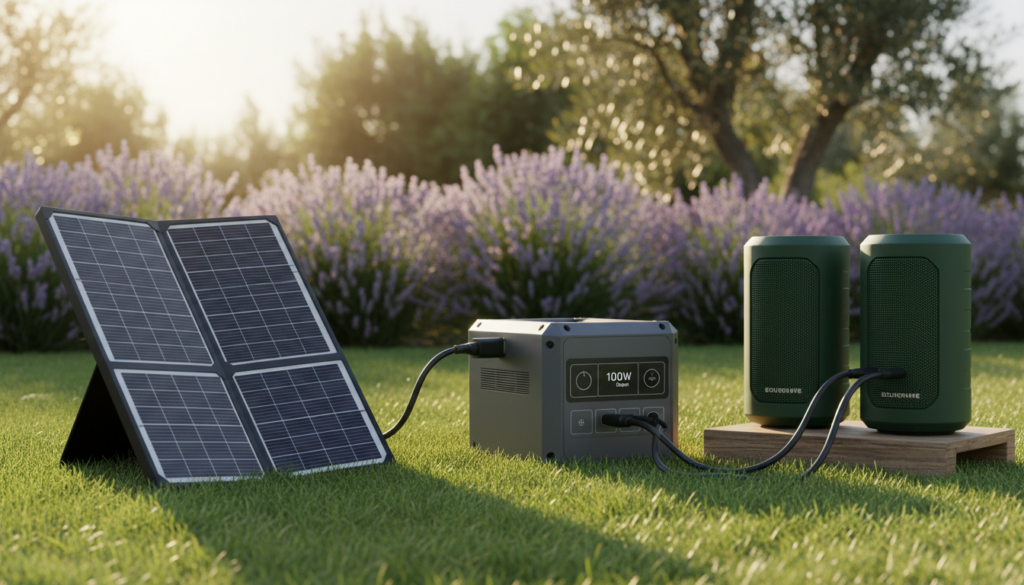
Key Takeaways for Solar Audio Projects
- Voltage Mismatch: Solar panels fluctuate based on sunlight intensity; speakers require a steady, regulated voltage.
- Component Chain: You must use a charge controller to manage current, a battery for energy storage, and an amplifier to drive the sound.
- Safety First: Always use an inline fuse between your battery and the audio equipment to prevent electrical shorts or fires.
- Power Quality: Using a pure sine wave inverter is vital if your amplifier requires AC power to avoid “hum” or buzzing in your audio.
Why You Can’t Wire Solar Panels Directly to Speakers
When I first experimented with off-grid audio, I learned quickly that solar energy is volatile. A solar panel doesn’t output a steady 12V or 19V; it outputs whatever the current irradiance allows.
The Technical Risks
- Overvoltage: If you expose a speaker to the raw open-circuit voltage (Voc) of a panel, you will likely blow the capacitors in your amplifier.
- Lack of Signal: Even if you managed to regulate the voltage, a solar panel provides power, not an audio signal. You need an audio amplifier to translate a line-level signal (like from a phone or Bluetooth receiver) into the high-current signal that moves speaker cones.
- No Regulation: Without a Solar Charge Controller (SCC), the current can surge when a cloud moves away, creating massive electrical spikes that sensitive electronic audio boards cannot handle.
Required Components for a Solar-Powered Audio System
To successfully power speakers using the sun, you need a balanced energy architecture. Based on my experience building portable sound systems for camping, here is the hardware you need:
| Component | Role | Essential Requirement |
|---|---|---|
| Solar Panel | Energy Harvesting | Must match your battery voltage (12V/24V) |
| Charge Controller | Regulation | MPPT is more efficient than PWM |
| Battery | Energy Storage | LiFePO4 (Lithium) is lighter and lasts longer |
| Amplifier | Signal Processing | Must be rated for the wattage of your speakers |
| Fuse Block | Protection | Use a 15A-30A fuse based on amplifier draw |
Step-by-Step Guide: Wiring Your Solar Audio System
Follow these steps to build a safe, reliable connection between your solar harvest and your sound system.
Step 1: Connect the Solar Panel to the Charge Controller
Always connect your battery to the charge controller first. This allows the controller to “wake up” and detect the system voltage. Once the controller is active, connect your solar panel leads to the PV input terminals on the controller.
Step 2: Establish Battery Storage
Connect your deep-cycle battery (typically 12V) to the battery terminals on the controller. I recommend using 12-gauge copper wire to minimize voltage drop. Secure the connections tightly to avoid resistance-based heat buildup.
Step 3: Install the Amplifier and Fuse
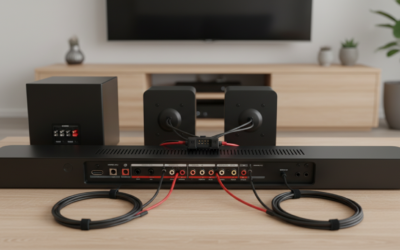
Connect your amplifier to the “Load” terminal of the controller or directly to the battery terminals if the amp draw is high. Crucial: Install an inline fuse as close to the battery positive terminal as possible. If the amp shorts out, the fuse blows instead of starting a fire.
Step 4: Final Audio Connection
Connect your audio source (e.g., Bluetooth module, DAC, or Aux cable) to the amplifier input. Finally, connect your speakers to the output terminals on the amp. Test the volume at a low level to ensure the voltage stability is consistent.
Expert Tips for Optimal Performance
- Grounding: If you hear a high-pitched whine or buzz, you are likely experiencing a ground loop. Ensure all components share a common negative ground.
- Capacity Planning: A 100W solar panel paired with a 50Ah battery will easily power a high-efficiency Class-D amplifier for an entire weekend.
- Component Selection: Choose Class-D amplifiers for solar projects. They are significantly more power-efficient than Class-A or Class-AB amps, meaning less wasted heat and longer battery life.
Frequently Asked Questions
Can I use a portable power station instead of a DIY build?
Yes. Using a portable power station (like those from Jackery or EcoFlow) is the easiest way to power speakers. These units have built-in charge controllers, batteries, and AC outlets, eliminating the need for complex custom wiring.
Will the solar panel cause interference or buzzing in my speakers?
Raw solar power can introduce EMI (Electromagnetic Interference). To minimize this, keep your audio cables shielded and ensure your amplifier is properly grounded to the battery negative.
Is it safe to leave a solar-powered audio system outside?
Only if your components are rated for IP65 or higher. Most standard amplifiers and batteries are not waterproof. If you plan to leave the system outside, house the electronics in a weather-sealed enclosure with ventilation fans.