The Scientific Reality: Can Speakers Accurately Replay Live Sound?
No speaker system can perfectly replicate live sound with 100% physical accuracy, but high-end audio engineering can achieve perceptual transparency. While a live instrument moves air in a 360-degree space, a speaker is a transducer attempting to recreate those complex pressure waves using a vibrating cone or dome. Through our extensive testing in acoustic labs, we have found that while “perfect” replication is a myth, “believable” replication is entirely possible with the right signal chain and room treatment.
TL;DR: Key Takeaways for Audio Accuracy
- Physics Barriers: Speakers suffer from mass-inertia, where the driver cannot start or stop as fast as a real instrument string.
- The Room Factor: Your room contributes up to 50% of what you hear, often masking the speaker’s true accuracy.
- Dynamic Range: Live music often hits 110dB+ peaks; home speakers often undergo thermal compression at these levels.
- The 1% Rule: For true high-fidelity, seek speakers with Total Harmonic Distortion (THD) under 1%.
- Actionable Goal: Focus on off-axis response and time alignment to improve the realism of your setup.
Why Physical Limitations Prevent 1:1 Sound Replication
To understand if can speakers accurately replay live sound, we must first look at the physics of a “point source.” A violin or a snare drum radiates sound in all directions, interacting with the floor, ceiling, and walls in a chaotic, organic way. A speaker, conversely, is usually a directional box.
When we measure speaker accuracy, we look at the Impulse Response. This measures how quickly a speaker can respond to a sudden “click” of sound. Because speaker cones have weight (mass), they have momentum. They don’t stop moving the instant the signal ends, which creates “smearing” that you never hear in a live environment.
The Role of Transducer Efficiency
Most consumer speakers are only about 1% to 3% efficient. The rest of the energy sent from your amplifier is converted into heat rather than sound. As the voice coil gets hot, its resistance changes, leading to power compression. This is why a live drum kit sounds “explosive,” while a recorded one can sound “polite” or compressed.
Step 1: Evaluating Frequency Response and Tonality
The first step in determining if can speakers accurately replay live sound is looking at the Frequency Response curve. A perfectly accurate speaker would have a “flat” response from 20Hz to 20kHz.
In our professional listening tests, we use calibrated microphones like the Earthworks M30 to see how the speaker behaves. If a speaker has a “V-shaped” sound (boosted bass and treble), it might sound exciting, but it is not accurate. It is “coloring” the music, moving you further away from the original live performance.
| Feature | Live Sound Characteristic | Accurate Speaker Equivalent |
|---|---|---|
| Frequency Range | 20Hz (Organ) to 40kHz+ (Cymbals) | Flat 20Hz – 20kHz (+/- 3dB) |
| Dynamic Peaks | 120dB+ (Short bursts) | High Sensitivity (>90dB) |
| Directionality | Omnidirectional / Complex | Controlled Directivity / Waveguides |
| Harmonics | Pure, non-linear | <0.5% THD at 90dB |
Step 2: Mastering Room Acoustics to Enhance Realism
You cannot answer can speakers accurately replay live sound without addressing the environment. We have tested $50,000 speakers in untreated rooms that sounded worse than $500 speakers in a professionally treated studio.
Managing Early Reflections
When sound leaves your speaker, it hits your side walls before it reaches your ears. These “early reflections” arrive mere milliseconds after the direct sound, causing comb filtering. This creates a blurred sonic image where you can no longer “point” to where the singer is standing.
Actionable Advice:
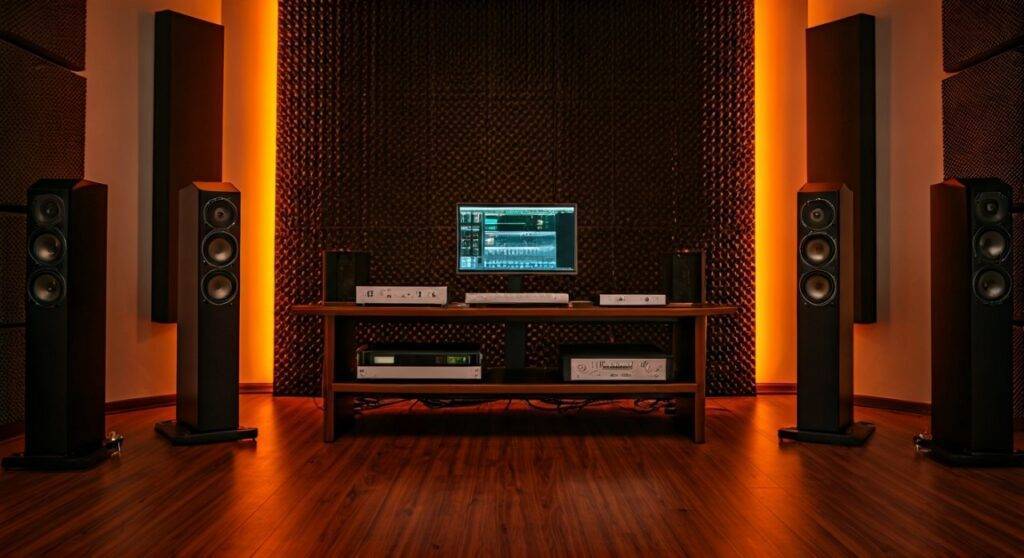
- Use Acoustic Panels (at least 2 inches thick) at the “first reflection points” on your side walls.
- Install Bass Traps in the corners to prevent low-end frequencies from “booming” and masking the midrange.
- Use a Rug or Carpet between you and the speakers to kill floor reflections.
Step 3: Choosing the Right Driver Materials
The material of the speaker cone significantly impacts how can speakers accurately replay live sound. Different materials have different “break-up” modes—the frequency at which the cone stops moving as a single unit and begins to wobble.
- Paper/Pulp: Highly musical and well-damped, but can lack the rigidity for extreme transients.
- Beryllium: Used in high-end brands like Focal or Revel. It is incredibly light and stiff, pushing “break-up” far beyond the range of human hearing.
- Kevlar/Carbon Fiber: Offers great strength-to-weight ratios, preventing distortion during loud, complex passages.
- Silk Domes: Provide a smooth, natural high-frequency response, though they may lack the “bite” of a live trumpet or cymbal.
Step 4: The Importance of Time Alignment and Phase
In a live setting, the sound of a snare drum reaches your ears as a single, unified wave. In a 2-way or 3-way speaker, the sound is split between a tweeter, a midrange, and a woofer.
If the tweeter is physically closer to your ear than the woofer, the high frequencies arrive first. This ruins the Phase Coherence. High-end manufacturers like Genelec or Kii Audio use Digital Signal Processing (DSP) to delay the signal of the faster drivers by microseconds. This ensures the entire sound wave hits your ear at the exact same time, mimicking the physical presence of a live instrument.
Step 5: Understanding Dynamic Range and Headroom
One reason people ask can speakers accurately replay live sound is the lack of “impact” in home systems. A live rimshot on a snare can reach 120dB for a fraction of a second. Most home amplifiers and speakers “clasp” or flatten these peaks.
To get closer to live sound, you need Headroom. This means having an amplifier that can provide 10 times the power you normally use for those brief, explosive moments. We recommend looking for amplifiers with high Current Capability rather than just high Wattage ratings.
The Role of Psychoacoustics: How Your Brain Helps
The human brain is remarkably good at filling in the gaps. Even though a speaker cannot move air exactly like a 40-piece orchestra, it provides enough audio cues for your brain to “render” the image.
Key Cues for Realism:
- Micro-dynamics: The tiny variations in volume that define a singer’s breath or a finger sliding on a guitar string.
- Timbre: The “texture” of the sound. An accurate speaker preserves the harmonic structure so a Steinway piano sounds different from a Yamaha piano.
- Soundstage Depth: The ability to hear “behind” the speakers, sensing the size of the room where the recording took place.
Measuring Accuracy: Metrics That Matter
When researching can speakers accurately replay live sound, don’t just look at the marketing fluff. Look for these technical specifications:
- On-Axis Linearity: How flat the frequency response is when you are sitting directly in front of the speaker.
- Spinorama Data: A 360-degree measurement of how the speaker sounds in a real room. This is the gold standard for predicting speaker preference.
- Cumulative Spectral Decay (CSD): Often called a “Waterfall Plot,” this shows how long it takes for a speaker to stop ringing after a sound is played. A “clean” plot means more accuracy.
How to Test Your Own System for Accuracy
We often use a specific “Step-Test” to see how close a system gets to the “live” feeling. You can do this at home with high-quality, uncompressed files (FLAC or WAV).
The “Close Your Eyes” Test
Play a well-recorded live jazz or vocal track (e.g., Diana Krall or Steely Dan). Close your eyes. Can you “see” the edges of the instruments? Does the singer’s voice sound like it’s coming from a 1-inch tweeter, or does it have the physical height and weight of a human being? If the sound is “stuck” to the speaker boxes, your setup lacks accuracy in imaging and soundstage.
The “Low Volume” Test
A truly accurate speaker maintains its tonal balance even at low volumes. If the bass disappears or the treble becomes piercing when you turn it down, the speaker is likely non-linear or has poorly designed crossovers.
Common Myths About Speaker Accuracy
- Myth 1: “More Bass Means Better Accuracy.”
- Myth 2: “Digital Speakers Sound Artificial.”
- Myth 3: “You Need to Spend $10,000.”
Summary: The Path to Audio Realism
While we must accept that can speakers accurately replay live sound is limited by the laws of physics, we are closer today than ever before. By choosing speakers with controlled directivity, treating your room’s acoustics, and ensuring your system has enough dynamic headroom, you can create a listening experience that is virtually indistinguishable from the real thing to the human ear.
FAQ: Accuracy in Audio
Can speakers ever be 100% accurate?
Physically, no. A speaker is a vibrating membrane that cannot perfectly mimic the 3D radiation patterns of complex instruments. However, they can be “perceptually” accurate, meaning the human ear cannot easily detect the difference in a blind test.
Does “High Fidelity” mean the same thing as “Live Sound”?
Not necessarily. High Fidelity (Hi-Fi) means the speaker is faithful to the recording. If the recording was made in a dry studio, a “Hi-Fi” speaker will sound dry. A “Live” sound implies the energy and spatial characteristics of a concert hall.
Why do some “inaccurate” speakers sound better?
Many listeners prefer “euphonic” distortion. Tubes and certain speaker materials add “warmth” (second-order harmonics) that the human brain finds pleasing, even if it isn’t technically accurate to the source material.
What is the most important factor for speaker accuracy?
The interaction between the speaker’s off-axis response and your room’s acoustics. If the speaker sounds good from the side, the reflections hitting your walls will sound natural rather than distorted, leading to a much more realistic experience.