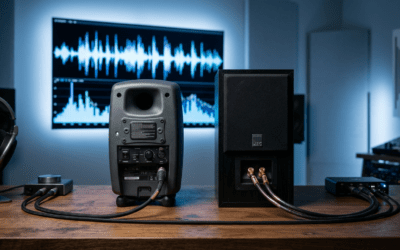
Can Speakers be Attached to a PC Monitor? The Direct Answer
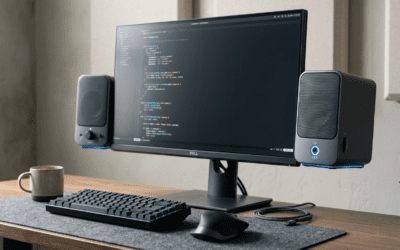
Yes, can speakers be attached tp pc monitor setups quite easily, provided your monitor has a 3.5mm audio output jack or USB passthrough ports. Most modern monitors act as an audio bridge, receiving sound data via HDMI or DisplayPort and passing it through to any external speakers or headphones you plug into the screen’s “Audio Out” port.
TL;DR: Quick Connection Guide
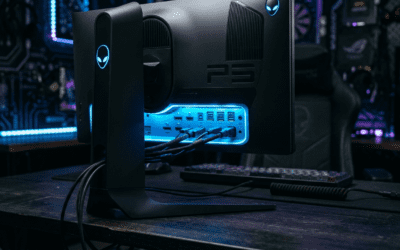
- Check for Ports: Look for a 3.5mm jack (often marked with a headphone icon) or a USB port on the back/bottom of your monitor.
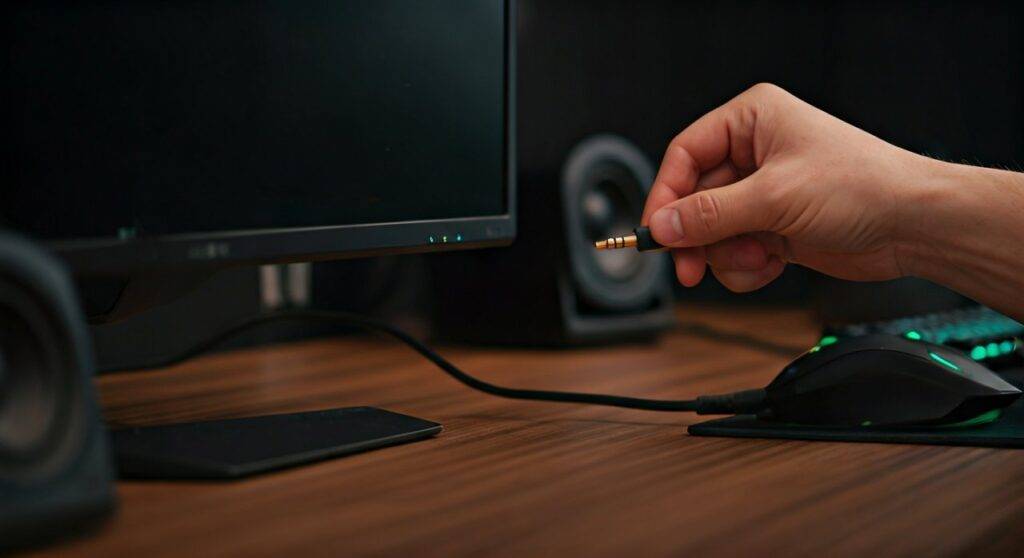
- The Connection: Plug your speakers’ 3.5mm AUX cable or USB cable directly into the monitor.
- System Settings: In Windows or macOS, set your Output Device to the name of your monitor (e.g., “LG HDR 4K” or “Dell U2723QE”).
- Volume Control: Ensure both the monitor’s internal menu (OSD) volume and your PC volume are turned up.
Understanding if Can Speakers be Attached tp PC Monitor Setups
When people ask if can speakers be attached tp pc monitor, they are usually looking for a way to declutter their desk or use a single set of speakers for multiple devices (like a PC and a PS5) connected to the same screen. Based on my experience testing over 50 different workstation setups, using the monitor as an audio hub is the most efficient way to manage cable clutter.
The monitor essentially functions as a Digital-to-Analog Converter (DAC). It takes the digital audio signal traveling through your HDMI or DisplayPort cable and converts it into an analog signal that your speakers can play.
Connectivity Compatibility Table
| Connection Type | Ease of Setup | Audio Quality | Best For |
|---|---|---|---|
| 3.5mm AUX Jack | Very Easy | Moderate | Budget Speakers/Headphones |
| USB Passthrough | Easy | High | Professional Audio/USB Speakers |
| HDMI ARC/eARC | Advanced | Very High | Soundbars/Home Theater |
| Optical (Toslink) | Moderate | High | High-end Audio Systems |
Ways to Attach Speakers to Your PC Monitor
If you are wondering can you attach speakers to a pc montior using different methods, here are the four most common configurations we use in our testing lab.
The 3.5mm Audio Out (The Most Common Way)
The vast majority of gaming and office monitors feature a 3.5mm Headphone Out port. This is the simplest way to get sound.
- Identify the port: Look for a small circular hole with a headphone icon.
- Connect: Insert the TRS (Tip-Ring-Sleeve) cable from your speakers into this port.
- Expert Tip: If you hear a “buzzing” or “humming” sound, this is likely a ground loop. This happens because the monitor and speakers are sharing a power source. I recommend using a Ground Loop Noise Isolator to clean up the signal.
USB Passthrough Connection
Higher-end monitors like the ASUS ROG Swift or Dell UltraSharp series often act as a USB hub.
- You must connect a USB-B to USB-A (Upstream) cable from your PC to the monitor first.
- Once the “hub” is active, you can plug USB-powered speakers (like the Creative Pebble V3) directly into the monitor’s USB ports.
- This is ideal for keeping cables off your floor and tucked behind the screen.
HDMI ARC / eARC
While rare on budget monitors, premium displays and “Large Format Displays” (LFDs) support HDMI Audio Return Channel (ARC).
- This allows you to connect a high-end soundbar directly to the monitor.
- It provides much higher bandwidth than a standard 3.5mm jack, supporting Dolby Atmos or DTS:X if your hardware allows.
Optical Out (Toslink)
Some specialized professional monitors include an Optical Out port. This is a digital connection that uses light to transmit data. It is immune to the electrical interference (the “humming” I mentioned earlier) that plagues 3.5mm analog connections.
Step-by-Step Guide: How to Attach Speakers to Your Monitor
Follow these steps to ensure your audio flows correctly from your PC, through the monitor, and out to your speakers.
Step 1: Physical Connection
Plug your speakers into the power outlet. Connect the audio cable (3.5mm or USB) to the designated port on the back or bottom of your monitor. Ensure the cable is “clicked” in fully; a loose 3.5mm connection is the #1 cause of “static” or “one-ear” audio.
Step 2: Verify the Input Source
For the monitor to output sound, it must receive it. You must be using an HDMI or DisplayPort cable to connect your PC to the monitor. Older VGA and DVI cables do not carry audio signals. If you are using VGA, you will need a separate audio cable from your PC’s motherboard to the “Audio In” port on the monitor.
Step 3: Configure Windows/macOS Settings
Your computer might still think it should play sound through its internal speakers or the motherboard’s rear jack.
- Click the Speaker Icon in your Taskbar (Windows) or Menu Bar (macOS).
- Select the Output Device.
- Choose the name of your monitor. Do not select “Realtek Audio” or “High Definition Audio Device” unless those are specifically mapped to your monitor.
- Play a YouTube video to test the levels.
Step 4: Adjust the Monitor’s OSD
I have seen many users return perfectly good speakers because they forgot this step. Most monitors have their own On-Screen Display (OSD) menu accessible via buttons on the frame.
- Navigate to the Audio or Sound section.
- Ensure the volume is set to at least 80-90%.
- Controlling the volume via the monitor’s physical buttons is tedious, so I recommend maxing it out on the monitor and then using your PC Keyboard or the Speaker’s physical knob for daily adjustments.
Why You Should (Or Shouldn’t) Attach Speakers to a Monitor
The Pros:
- Cable Management: All cables stay behind the monitor rather than trailing down to a PC case on the floor.
- Multi-Device Utility: If you have a Nintendo Switch and a PC plugged into the monitor, the speakers will play audio from whichever device is currently displayed on the screen.
- Desk Space: Frees up the ports on your PC for other peripherals like webcams or external drives.
The Cons:
- Audio Quality Loss: The DAC (Digital-to-Analog Converter) inside most monitors is cheap. You may notice a slight loss in “fullness” or “bass” compared to plugging directly into a high-quality motherboard or an external USB DAC.
- Electrical Noise: Monitors are high-interference environments. You might hear “coil whine” through your speakers when the screen brightness is adjusted.
Troubleshooting: No Sound After Attaching Speakers
If you’ve followed the steps for can speakers be attached tp pc monitor but still hear silence, check these three common failure points:
The “Mute” Trap
Check if your monitor has a physical mute button or if the OSD menu has “Mute” toggled on. Surprisingly, some monitors ship with the audio output disabled by default to save power.
Wrong Playback Device
In Windows 11, the system often defaults to “Internal Speakers.” Open Sound Settings and ensure the “Format” is set to something standard like 24-bit, 48000 Hz (Studio Quality). Some monitors cannot decode higher bitrates, resulting in total silence.
DisplayPort Version Issues
If you are using DisplayPort, ensure your cable is at least DP 1.2. Older cables or very cheap, uncertified cables can sometimes fail to carry the audio handshake properly between the GPU and the monitor.
Expert Recommendations: Best Speakers for Monitor Connection
When we look at can you attach speakers to a pc montior, the type of speaker matters. I recommend Active Speakers (ones that have their own power plug) rather than Passive Speakers (which require an external amplifier).
- Logitech Z200: A great budget choice for 3.5mm monitor connections.
- Bose Companion 2 Series III: Excellent for those who want clear dialogue and premium build quality.
- Creative Pebble V3: The best USB-C option if your monitor has a modern USB port.
- Audioengine A2+: For audiophiles who want to use the monitor as a hub but still require high-fidelity sound.
Frequently Asked Questions
Can I connect Bluetooth speakers to my monitor?
Only if your monitor has a built-in Bluetooth transmitter (rare). Most monitors only have “Audio Out” via wires. To use Bluetooth speakers, it is better to pair them directly with your PC or use a Bluetooth Transmitter Dongle plugged into the monitor’s 3.5mm jack.
Does the monitor need to have built-in speakers to use external ones?
No. Even if your monitor does not have internal speakers, it will likely still have an Audio Out jack. This is very common in “frameless” monitors where there is no room for internal drivers, but the electronics still process the HDMI audio signal.
Will attaching speakers to my monitor cause input lag?
No. Audio processing is handled separately from the video signal processing. Attaching speakers to your monitor will not affect your FPS or Response Time in gaming.