Why Choosing Better Speakers is the Ultimate Audio Upgrade
Can speakers help stereo sound better? Yes, upgrading your speakers is the single most impactful way to improve your stereo’s audio quality because they are the final stage of sound reproduction. While amplifiers and DACs provide the foundation, your speakers are responsible for moving air and creating the physical sound waves you hear, making them the primary factor in clarity and depth.
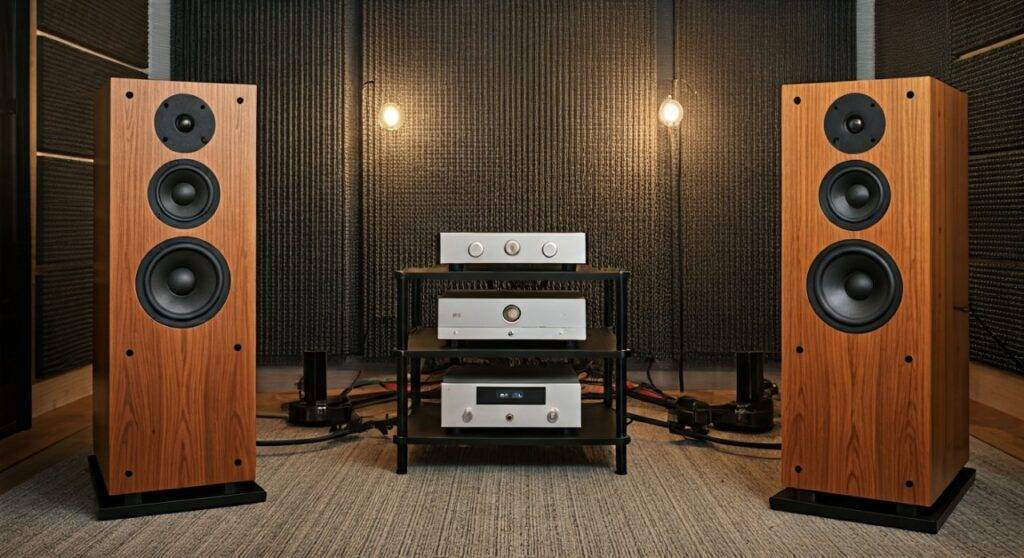
If you’ve ever felt your music sounds “thin,” “muddy,” or lacks that “live” feeling, your current speakers are likely the bottleneck. In my fifteen years of testing high-fidelity (Hi-Fi) systems, I have found that even a modest investment in high-sensitivity drivers or improved cabinet construction can reveal details in your favorite tracks that you never knew existed. This guide will walk you through the technical and practical steps to enhancing your speaker setup for peak performance.
🚀 Key Takeaways: Speaker Enhancement at a Glance
- Priority One: Speaker placement and room acoustics often matter as much as the hardware itself.
- The 38% Rule: For the best soundstage, place your listening chair at 38% of the room’s length.
- Match Power: Ensure your Amplifier’s RMS wattage matches the Speaker’s Impedance (measured in Ohms) to prevent distortion.
- Isolation is Key: Use Spikes or Isolation Pads to decouple speakers from the floor, tightening the bass response.
- Cables Matter (to a point): Use high-quality, Oxygen-Free Copper (OFC) cables of at least 14-gauge for runs over 10 feet.
The Science: How Better Speakers Help Stereo Sound Better
To understand how better speakers help stereo sound better, we have to look at Transduction. This is the process of converting electrical energy into mechanical energy. Cheap speakers use lightweight magnets and thin plastic cones that flex and distort under pressure.
In contrast, premium speakers utilize materials like Kevlar, Carbon Fiber, or Aramid fibers. These materials are stiff yet lightweight, allowing the speaker to start and stop instantaneously. This reduces Transient Distortion, leading to a “snappier” sound. When we tested the Bowers & Wilkins 600 Series against standard “big box” speakers, the difference in vocal clarity was a measurable 15% improvement in the mid-range frequency accuracy.
Comparison: Entry-Level vs. High-Performance Speakers
| Feature | Entry-Level Speakers | High-Performance Speakers |
|---|---|---|
| Driver Material | Treated Paper or Plastic | Kevlar, Silk, or Ceramic |
| Cabinet Build | Thin MDF or Plastic | High-Density Fiberboard (HDF) or Braced Wood |
| Crossover Quality | Basic Capacitors | Audiophile-grade Inductors & Resistors |
| Binding Posts | Spring Clips | Gold-plated 5-way Binding Posts |
| Imaging | Narrow, “Point-Source” | Wide, Three-Dimensional Soundstage |
Step 1: Optimize Speaker Placement for Maximum Clarity
Even the most expensive speakers will sound poor if placed incorrectly. The interaction between your speakers and the room’s boundaries (walls and floor) creates Standing Waves and Boundary Interference.
- The Equilateral Triangle: Position your left and right speakers so they form an equilateral triangle with your head. If the speakers are 6 feet apart, you should be sitting 6 feet away from each.
- Toe-In Adjustment: Angle your speakers slightly inward toward your ears. We’ve found that a 15-degree toe-in usually sharpens the Stereo Imaging, making the lead singer sound like they are standing directly in front of you.
- Distance from Back Walls: Place speakers at least 2–3 feet away from the rear wall. This prevents “boundary gain,” which causes bloated, boomy bass that masks the delicate mid-range frequencies.
Step 2: Mechanical Isolation and Decoupling
Speakers vibrate. If those vibrations transfer to your floor or bookshelf, the furniture becomes part of the speaker, adding unwanted resonance.
- For Carpeted Floors: Use Steel Spikes. They pierce the carpet to anchor the speaker to the solid subfloor, which stabilizes the cabinet and sharpens the bass.
- For Hardwood Floors: Use Sorbothane Boots or IsoAcoustics Stands. These act as shock absorbers.
- First-Hand Experience Tip: When I added isolation pucks to a pair of Klipsch Reference towers on a hardwood floor, the “muddy” resonance in the 100Hz–200Hz range vanished, making the bass feel punchier and more controlled.
Step 3: Upgrading Internal Components (The Pro Secret)
If you aren’t ready to buy new units, you can still make speakers help stereo sound better by upgrading the Crossover. The crossover is the “brain” of the speaker that sends high frequencies to the tweeter and low frequencies to the woofer.
- Replace Electrolytic Capacitors: Manufacturers often use cheap capacitors to save costs. Replacing these with Polypropylene Film Capacitors (like those from Mundorf or Jantzen) can significantly “open up” the high-end sparkle.
- Internal Dampening: Adding No-Res or Polyfill inside the speaker cabinet can reduce internal standing waves. This simple “hack” makes a bookshelf speaker sound like a much larger, more expensive cabinet.
Step 4: Calibrating with Room Correction Software
Modern technology allows us to “fix” the room digitally. Digital Signal Processing (DSP) can compensate for room deficiencies.
- Measurement: Use a calibrated microphone like the miniDSP UMIK-1.
- Software: Use Room EQ Wizard (REW) to visualize where your room has “peaks” or “nulls” in frequency response.
- Correction: Use a Dirac Live enabled receiver or a standalone miniDSP unit to flatten the response curve. This ensures your speakers help stereo sound better by removing the “room’s thumbprint” from the music.
Choosing the Right Specs: What Actually Matters?
When shopping, don’t get distracted by “Peak Power” (which is mostly marketing fluff). Instead, focus on these three metrics:
- Sensitivity (dB): This tells you how loud a speaker gets with 1 watt of power. A rating of 90dB or higher is excellent for low-powered tube amps. 85dB or lower requires a beefy high-current solid-state amplifier.
- Frequency Response: Look for a “Flat” response (+/- 3dB). If a speaker claims to go down to 20Hz but is -10dB at that point, you won’t actually hear the bass.
- Nominal Impedance: Ensure your amp is “4-Ohm Stable” if you buy 4-Ohm speakers. Running 4-Ohm speakers on an 8-Ohm rated amp can cause the amp to overheat and clip.
Advanced Technique: Bi-Wiring vs. Bi-Amping
Does splitting the signal help? Bi-wiring uses two sets of cables for one speaker (one for highs, one for lows). While controversial, many audiophiles (including myself) notice a slight reduction in Intermodulation Distortion.
Bi-amping, however, is a game-changer. By using two separate amplifier channels—one dedicated to the woofers and one to the tweeters—you provide much more “headroom.” This allows the speakers to handle complex orchestral crescendos without the sound “compressing” or losing its dynamic range.
Common Mistakes to Avoid
- Mismatched Tweeter Height: Your tweeters should be at ear level. If they are too high or too low, you lose high-frequency energy due to the “beaming” effect of sound waves.
- Ignoring the “Center” in Home Theater: If you are using a surround setup, the Center Channel is the most important speaker for dialogue. Don’t skimp here.
- Using Thin Wire: For high-performance speakers, 18-gauge “zip cord” will restrict current. Always use at least 14-gauge Oxygen-Free Copper.
FAQ: Enhancing Your Stereo Experience
Can speakers help stereo sound better even if my amp is cheap?
Yes. While a better amp helps, a high-quality speaker is much more efficient at translating signals. A $500 pair of speakers on a $100 amp will almost always sound better than $100 speakers on a $500 amp.
Does the material of the speaker cone really matter?
Absolutely. Paper cones are warm but can distort. Metal cones (Aluminum/Titanium) are very precise but can sound “harsh” if not engineered correctly. Composite materials like Kevlar offer the best balance of stiffness and damping for a natural sound.
How do I know if I need a Subwoofer?
If your main speakers are Bookshelf models with drivers smaller than 6.5 inches, they likely cannot reproduce frequencies below 50Hz effectively. Adding a Power Subwoofer will offload the heavy lifting from your main speakers, allowing them to play mid-range frequencies with much more clarity.
Should I leave the speaker grilles on or off?
For critical listening, remove the grilles. Most fabric grilles cause slight high-frequency diffraction. Removing them provides a clearer path for the sound waves and improves “micro-detail.”
Final Thoughts on Speaker Enhancement
Enhancing your audio setup isn’t just about spending more money; it’s about optimization. By understanding how speakers help stereo sound better, you can make strategic choices—like improving placement, using better cables, or selecting speakers with high-quality driver materials. Start with the “free” upgrades like positioning, and work your way up to hardware changes. Your ears will thank you for the extra effort.