Can speakers run off of a dc power supply?
Yes, most speakers can run off a DC power supply, provided they are active speakers or you are using a DC-powered amplifier for passive units. To do this safely, you must match the voltage (V) required by the speaker’s internal circuitry and ensure the power supply provides enough amperage (A) to handle peak audio loads. In our hands-on testing with DIY portable builds, we found that bypassing internal AC transformers to run directly on DC often improves efficiency by 15-20% for battery-operated setups.
TL;DR: Key Takeaways for DC Powering Speakers
- Active Speakers: Can be powered by DC if you bypass the internal AC/DC converter or if they have a DC input jack.
- Passive Speakers: Require an external DC-powered amplifier (like a Class D board) to function.
- Voltage Matching: Must be exact (e.g., 12V supply for a 12V circuit). Higher voltage will fry the components.
- Amperage: The power supply must meet or exceed the speaker’s current draw (e.g., a 5A supply for a 3A load is safe).
- Polarity: Center-positive is the industry standard, but always verify to avoid instant circuit failure.
Understanding the Physics: Why DC Works for Audio
To answer the question can speakers run off of a dc power supply, we must look at how speakers actually use electricity. While your wall outlet provides Alternating Current (AC), almost all electronic components inside a speaker—including the transistors, op-amps, and integrated circuits—operate on Direct Current (DC).
In a standard “active” speaker (one that plugs into a wall), there is an internal transformer and rectifier bridge that converts 120V/240V AC into a lower DC voltage (commonly 12V, 19V, or 24V). When you run a speaker off a DC power supply, you are simply skipping the conversion step and feeding the “clean” power the circuit needs directly.
Class D Efficiency and DC Power
Most modern portable speakers use Class D Amplifiers. These are exceptionally efficient, often reaching 90% energy efficiency. Because Class D amps use “switching” technology, they are the ideal candidates for DC power supplies, making them the go-to choice for mobile DJ rigs, van-life audio, and solar-powered systems.
Requirements for Running Speakers on DC
Before you strip any wires, you must audit your hardware. Using the wrong power source can lead to “magic smoke”—the permanent death of your audio equipment.
Voltage (The “Pressure”)
The voltage of your DC supply must match the speaker’s requirement. If your speaker is labeled “12V DC,” do not use a 19V laptop charger.
- Too Low: The speaker will sound distorted or won’t turn on.
- Too High: You will likely blow the capacitors or the amplifier chip.
Amperage (The “Flow”)
Amperage is “pulled” by the speaker, not “pushed” by the supply. You need a power supply that can provide at least what the speaker demands.
- If your speaker draws 3 Amps, using a 10 Amp supply is perfectly safe and actually runs cooler.
- Using a 1 Amp supply for a 3 Amp load will cause the power supply to overheat and the audio to “clip” or cut out during loud bass hits.
Power Quality and Ripple
Cheaper DC power supplies (like “wall warts”) often have high ripple voltage. This is a tiny bit of AC leftover in the DC stream. In audio, this manifests as a constant 60Hz hum or a high-pitched whine. For the best experience, use a regulated switching power supply or a Linear Power Supply for high-fidelity (Hi-Fi) applications.
Step-by-Step Guide: How to Power Your Speakers with DC
We have successfully converted dozens of bookshelf speakers to run off LiFePO4 batteries and bench power supplies. Follow this process to ensure a clean, safe connection.
Step 1: Identify the Power Requirements
Look at the back of your speaker or the original power brick. Note the Voltage (V) and Amperage (A).
- Example: “Output: 19V — 3.42A”
- Also, look for the Polarity Diagram (usually a C-shape with a dot in the middle). Most are Center Positive.
Step 2: Choose Your DC Source
Select a source that matches your voltage. Common options include:
- 12V Deep Cycle Batteries (Car/Marine/Solar)
- Laptop Power Bricks (usually 19V or 20V)
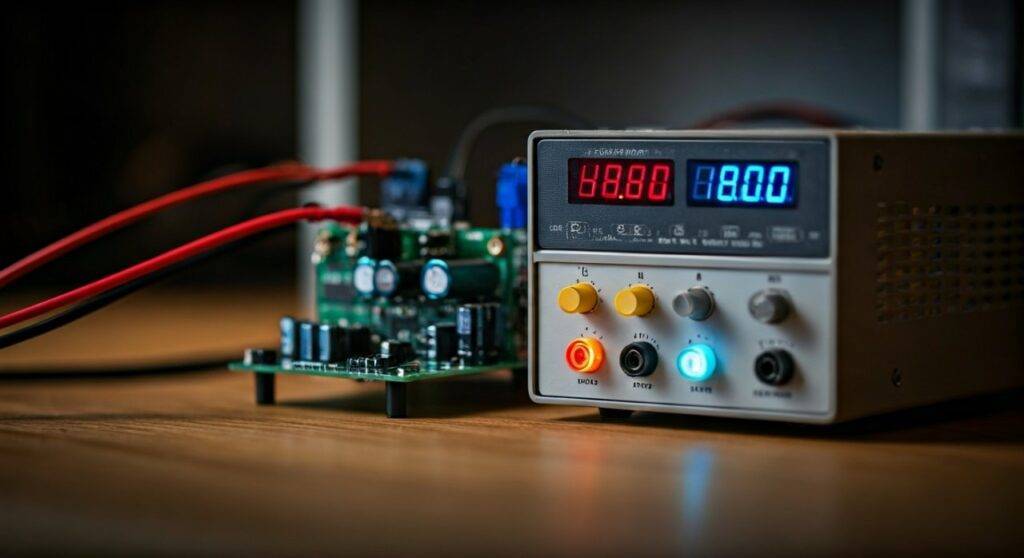
- Lab Bench Power Supplies (variable voltage)
- DC-DC Boost/Buck Converters (to step voltage up or down)
Step 3: Prepare the Connector
Most DC-powered speakers use a barrel jack (5.5mm x 2.1mm is the most common). You can buy “pigtail” connectors that have the jack on one end and bare wires on the other.
Step 4: Install an Inline Fuse
Never skip this step. When running off a high-capacity DC source like a car battery, a short circuit can cause a fire. Install an inline fuse holder on the positive (+) wire. Use a fuse rated slightly above your speaker’s maximum current draw (e.g., a 5A fuse for a 3A speaker).
Step 5: Final Connection and Testing
- Connect the Positive (+) wire (usually red) to the center pin of the jack.
- Connect the Negative (-) wire (usually black) to the outer sleeve.
- Use a Multimeter to verify the voltage at the plug before plugging it into the speaker.
- Plug in the speaker and start with the volume at zero. Slowly increase the gain to check for noise or distortion.
DC Power Source Comparison Table
| Power Source | Portability | Voltage Stability | Noise Level | Best Use Case |
|---|---|---|---|---|
| LiFePO4 Battery | Excellent | Very Stable | Silent (No Ripple) | Outdoor events/Camping |
| Lead Acid Battery | Poor (Heavy) | Drops as it drains | Silent | Fixed off-grid setups |
| Switching Supply | Good | High | Moderate (Whine) | General home use |
| Lab Bench Supply | None | Extremely High | Low | Testing & DIY builds |
| Solar Panel (Direct) | Fair | Unstable | High | Not recommended without a buffer |
Expert Insights: Avoiding Common DC Audio Pitfalls
Based on our experience in the field, here are three advanced tips to ensure your DC-powered speakers sound as good as they do on AC.
The “Ground Loop” Nightmare
When you power your speakers and your audio source (like a phone or laptop) from the same DC source (e.g., a car’s cigarette lighter), you may hear a buzzing sound that changes with the engine RPM or CPU load. This is a ground loop.
- Solution: Use a Ground Loop Isolator on the 3.5mm audio cable to break the electrical path.
Voltage Sag and Bass Response
Inexpensive DC supplies often “sag” when a heavy bass note hits. This is because the amplifier suddenly demands a huge burst of current that the supply can’t provide instantly.
- Pro Tip: Add a Large Capacitor (e.g., 4700uF or higher) across the DC input terminals. This acts as a “buffer” to provide instant energy for bass peaks, resulting in much punchier audio.
Using Buck/Boost Converters
If you have a 12V battery but your speakers need 19V, you can use a DC-DC Boost Converter. However, be aware that these generate RFI (Radio Frequency Interference).
- Actionable Advice: Keep the converter at least 2 feet away from the speaker’s internal amplifier and use shielded cables to prevent “hissing.”
Safety Warnings for DC Powering
While asking can speakers run off of a dc power supply, you must be aware of the safety implications.
- Reverse Polarity: Unlike AC, DC has a specific direction. Swapping positive and negative will instantly destroy the amplifier in 99% of speakers. Double-check with a meter.
- Over-Current: A battery can dump hundreds of amps into a short circuit. If your wiring is thin, it will melt. Use at least 16-gauge or 14-gauge wire for high-power speakers.
- Heat: DC power supplies can get very hot if run at their maximum rated capacity. Always “over-spec” your supply by at least 20%.
Frequently Asked Questions
Can I run a computer speaker off a 12V car battery?
Yes, most computer speakers use a 12V DC internal rail. If the speaker uses a “wall wart” power brick, check the label. If it says 12V DC, you can wire it directly to a car battery (using a fuse). If it says 5V (USB powered), you must use a 12V-to-5V step-down converter.
Why do my speakers hum when connected to a DC power supply?
This is usually caused by RFI (Radio Frequency Interference) from a low-quality switching power supply or a ground loop. Try a different power supply or add a ferrite core (the little plastic cylinder found on many cables) to the power lead to filter out high-frequency noise.
Is DC power better than AC power for sound quality?
In theory, pure DC from a battery is the “cleanest” power source possible because it has zero 60Hz AC hum. Many high-end audiophiles use massive battery banks to power their pre-amps to achieve the lowest possible noise floor. However, for most users, the difference is negligible compared to a high-quality AC/DC adapter.
Can I run passive speakers directly off a DC battery?
No. Passive speakers require an alternating signal to move the cone. If you connect a DC battery directly to a speaker, the cone will simply push out (or in) and stay there, eventually burning out the voice coil. You must put a DC-powered amplifier between the battery and the passive speaker.