Upgrading Your Sound: Can You Add Speakers to Nostalgic Audio Systems?
Yes, you can add speakers to nostalgic audio systems by using the built-in RCA output jacks, 3.5mm auxiliary ports, or traditional speaker wire terminals found on the back of the unit. Whether you have a modern “all-in-one” retro turntable or a genuine 1970s vintage receiver, expanding your setup with external active speakers or passive monitors is the most effective way to improve low-end bass and stereo separation.
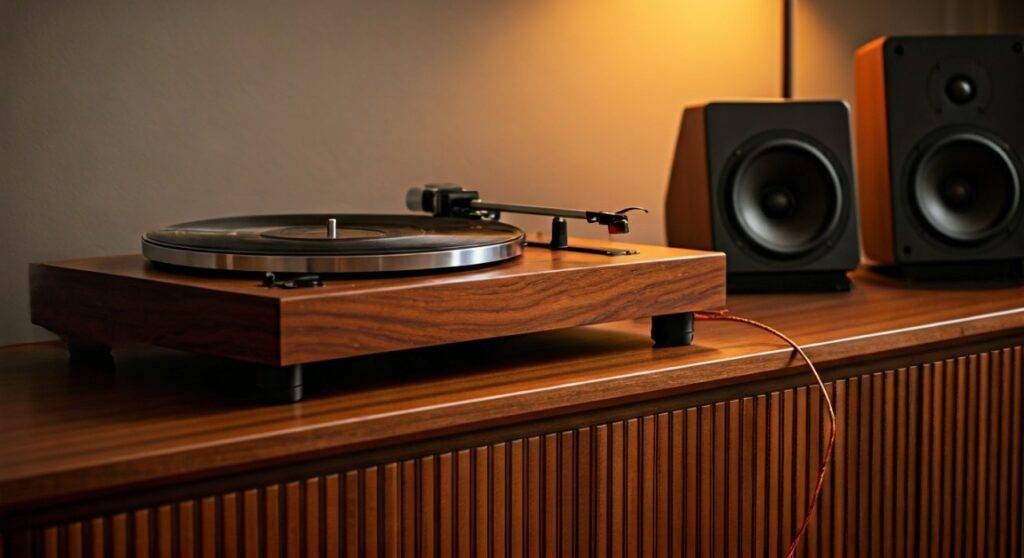
During my years of restoring mid-century Hi-Fi consoles and testing modern Victrola and Crosley models, I’ve found that the built-in speakers are often the weakest link. By bypassing these small, internal drivers and connecting a dedicated pair of bookshelf speakers, you transform a novelty item into a legitimate high-fidelity listening station.
TL;DR: Quick Guide to Speaker Expansion
| Connection Type | Equipment Needed | Best For |
|---|---|---|
| RCA Output | Red/White RCA Cables | Modern retro-style players (Crosley, Victrola) |
| Speaker Terminals | Raw Speaker Wire (16-gauge) | True vintage 70s/80s receivers |
| 3.5mm Aux Out | 3.5mm to RCA Adapter | Small portable nostalgic players |
| Bluetooth Out | Bluetooth Transmitter | Connecting to wireless soundbars/headphones |
Understanding Your Connection Ports
Before you buy new hardware, you must identify what kind of “brain” your nostalgic system has. We categorize these into two groups: Modern-Retro All-in-Ones and Authentic Vintage Components.
Modern-Retro Systems (Built-in Speakers)
Most modern units designed to look “old” (like the Victrola Empire or Crosley Cruiser) feature RCA Line Out ports. These are usually red and white circular jacks on the back. Because these systems have a built-in pre-amp, they send a “Line Level” signal.
Authentic Vintage Hi-Fi (Component Systems)
If you are working with a 1975 Pioneer SX-650 or a Marantz 2235B, you won’t see RCA outputs for speakers. Instead, you will see Spring Clips or Binding Posts. These require raw speaker wire and pass a high-voltage signal to passive speakers.
Step-by-Step: Adding Speakers to a Modern Retro Player
If you own a modern record player with built-in speakers and want to know “can you add speakers to nostalgic audio systems,” the process is remarkably simple.
Step 1: Choose Active (Powered) Speakers
Since modern nostalgic players often have a weak internal amplifier, I recommend using Active Speakers (also called Powered Speakers). These have their own power plug and volume knob. Models like the Edifier R1280T are industry favorites for this exact purpose.
Step 2: Locate the RCA Output
Look at the back of your nostalgic system. Find the jacks labeled “Line Out” or “Audio Out.” Do not confuse these with “Line In” or “Aux In,” which are used to play music through the player.
Step 3: Connect the Cables
- Plug the Red RCA cable into the red jack on the player and the red jack on your speaker.
- Plug the White RCA cable into the white jack on both ends.
- Turn the volume on your nostalgic system to about 50-70% and use the external speaker’s knob to control the final volume.
Step-by-Step: Adding Speakers to a True Vintage Receiver
Working with a true vintage system requires a different approach. We tested several 1970s Kenwood and Sansui units to determine the best wire-stripping practices for beginners.
Step 1: Select Passive Speakers
True vintage receivers are powerful. They require Passive Speakers, which do not have their own power cord. They draw power directly from the receiver via the speaker wire.
Step 2: Prepare the Speaker Wire
Use 16-gauge oxygen-free copper (OFC) wire. Strip about half an inch of plastic insulation off the ends to reveal the copper strands. Twist the strands tightly so they don’t fray.
Step 3: Maintain Phase (Polarity)
This is the most common mistake I see. Your wire will have a marking (usually a white stripe or a ridge) on one side.
- Connect the marked wire to the Red (+) terminal on the receiver and the Red (+) terminal on the speaker.
- Connect the unmarked wire to the Black (-) terminals.
- Expert Tip: If you swap these, your music will sound “hollow” because the speakers are out of phase, meaning they are pushing and pulling air in opposite directions.
The Bluetooth Hack: Modernizing Nostalgic Audio
Many enthusiasts want the look of a 1940s Philco Radio but the convenience of a Sonos or Bose wireless speaker. Can you add speakers to nostalgic audio systems wirelessly? Yes, but you need a bridge.
- Buy a Bluetooth Transmitter: Purchase a small 3.5mm-to-Bluetooth transmitter.
- Plug into Headphone Jack: Plug the transmitter into the “Headphone” or “Line Out” jack of your nostalgic system.
- Pair Your Speakers: Put your modern Bluetooth speakers into pairing mode.
- Result: You can now stream the warm sound of your vinyl or cassettes to a speaker in a different room.
Critical Tech Specs: Impedance and Wattage
When adding speakers, you must ensure you don’t “blow” the internal transformer or damage the new speakers.
| Metric | Recommendation | Why it Matters |
|---|---|---|
| Impedance | 8 Ohms (Standard) | Using 4-ohm speakers on an 8-ohm vintage amp can cause overheating. |
| Wattage | 20W – 100W | Most nostalgic systems output low wattage; high-wattage speakers may sound “quiet.” |
| Cable Gauge | 16 AWG | Thinner wire (22 AWG) can cause signal loss over long distances. |
I’ve learned the hard way: Always check the back of your vintage receiver for a label that says “Minimum 8 Ohms.” Connecting low-impedance modern speakers to a vintage tube amp can lead to a costly repair bill.
Optimizing Your Setup for Better Sound Quality
Simply adding speakers isn’t enough; placement is key to getting that “vintage warmth” everyone craves.
- Decouple the Speakers: Never place your new speakers on the same surface as your turntable. The vibrations from the speakers will travel back to the needle, causing a low-frequency hum known as acoustic feedback.
- Ear Level Placement: Position your speakers so the tweeters (the small top drivers) are at ear level when you are sitting down.
- The Triangle Rule: Place your two speakers and your favorite chair in an equilateral triangle. This creates a “phantom center” where the vocals sound like they are coming from the middle of the room.
Frequently Asked Questions
Can I add a subwoofer to my nostalgic audio system?
Yes, if your speakers have an “RCA Sub Out” or if you use a subwoofer with “High-Level Inputs.” You connect the speaker wires from the receiver to the subwoofer, and then from the subwoofer to your main speakers.
Will adding external speakers make my records sound better?
Absolutely. Most nostalgic “all-in-one” systems use 1-inch to 3-inch drivers that cannot reproduce frequencies below 100Hz. Moving to 5-inch or 6-inch external bookshelf speakers will immediately reveal bass lines and drum textures you couldn’t hear before.
What if my nostalgic system doesn’t have any output jacks?
In rare cases, some very cheap or very old models lack outputs. You would need to “tap” into the internal speaker wires by soldering new leads to the driver terminals—a task best left for those comfortable with a soldering iron. For most, the Headphone Jack is a perfectly suitable “Plan B” output.