Can You Change Amp Speakers by Yourself?
Yes, you can change amp speakers by yourself with minimal tools and no advanced electrical training. Most modern amplifiers use spade connectors that allow for a “plug-and-play” experience, though some vintage or high-end models may require basic soldering.
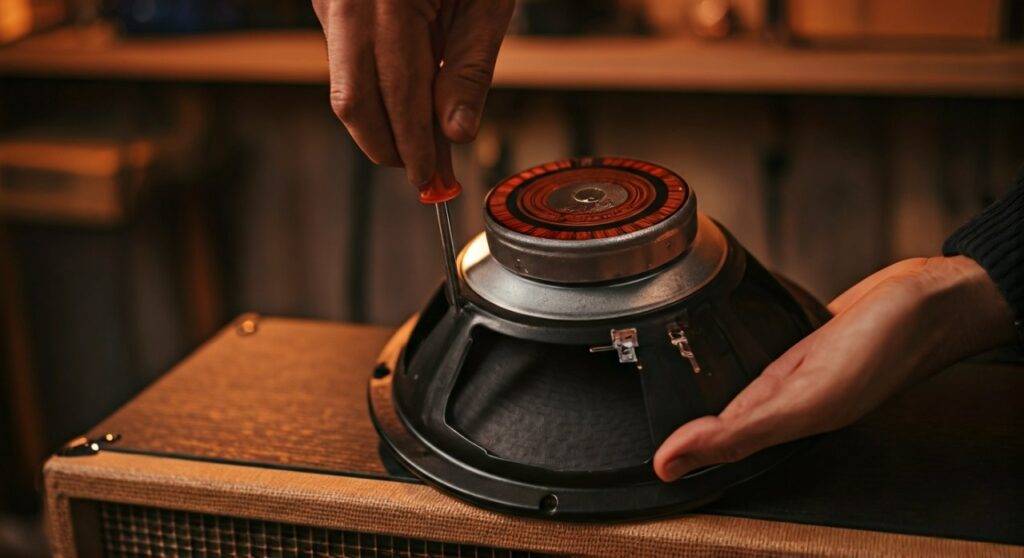
If your amplifier sounds “boxy,” lacks high-end clarity, or has a physical tear in the cone, a speaker swap is the single most effective way to overhaul your tone. In my experience gigging with various tube and solid-state combos, I’ve found that a $100 speaker upgrade often provides a more significant sonic improvement than buying a new $500 amplifier. This guide will walk you through the safety protocols, technical specifications, and physical steps required to successfully replace your amp speaker.
### ⚡ Quick Summary: The DIY Speaker Swap* Difficulty: Low to Medium (depending on soldering needs).* Time Required: 30–60 minutes.* Primary Risk: Ensuring Impedance (Ohms) matches the amplifier’s requirements.* Core Tools: Screwdriver set, needle-nose pliers, and (sometimes) a soldering iron.* Pro Tip: Always take a photo of the original wiring before disconnecting anything.
Why You Should Consider a DIY Speaker Replacement
Many guitarists ask, “can you change amp speakers by yourself?” because they are afraid of the high voltages inside an amp. While it is true that filter capacitors in tube amps can hold a lethal charge, the speaker cabinet is generally a “safe zone” as long as the unit is unplugged.
Replacing a speaker allows you to customize the EQ curve of your instrument. For example, swapping a generic factory speaker for a Celestion Vintage 30 can add the mid-range “honk” necessary for rock, while a Jensen P12N can provide the “sparkle” desired by jazz and country players.
| Feature | Factory Speaker (Stock) | Aftermarket Upgrade (e.g., Eminence, Celestion) |
|---|---|---|
| Magnet Type | Often low-cost Ceramic | Choice of Alnico, Neodymium, or High-grade Ceramic |
| Sensitivity | Usually 95–97 dB | Can reach 100+ dB (makes the amp louder) |
| Tonal Profile | Neutral/Flat | Specific (e.g., British Growl, American Clean) |
| Durability | Standard | Often reinforced for high-gain/touring |
Technical Essentials: Matching Specs to Avoid Damage
Before you unscrew the first bolt, you must understand two critical numbers: Impedance and Power Handling. Failing to match these can result in a “blown” transformer, which is a very expensive repair.
Understanding Impedance (Ohms)
The Impedance of your new speaker must match the output requirement of your amp. Most amps are rated for 4, 8, or 16 Ohms.
- Rule of Thumb: Look at the back of your amp or the label on the old speaker. If the amp says “8 Ohms Min,” your new speaker must be 8 Ohms.
- The Danger: Running a 4-ohm speaker into an 8-ohm output can overheat the power tubes and damage the Output Transformer (OT).
Power Handling (Wattage)
The speaker’s Wattage rating should always be higher than the amplifier’s output.
- Safety Margin: I recommend a speaker rated for at least 1.5x the amp’s wattage.
- Example: If you have a 20-watt Fender Princeton, use a speaker rated for at least 30 watts. This prevents the speaker from “farting out” or blowing when you crank the volume to 10.
Tools and Materials Needed
To change amp speakers by yourself, you don’t need a professional workshop. However, having the right tools prevents stripped screws and damaged gaskets.
- Screwdriver Set: You will need a Philips #2 for most mounting bolts.
- Needle-Nose Pliers: Useful for removing tight spade connectors.
- Soldering Iron (Optional): Required if your speaker wires are soldered directly to the terminals.
- Multimeter: Highly recommended to verify the DC Resistance of the new speaker before installation.
- Soft Towel: To lay the amp face-down without scratching the Tolex or grill cloth.
Step-by-Step Guide: How to Replace Your Amp Speaker
Step 1: Safety First and Disconnection
Unplug the amplifier from the wall outlet. Even though you aren’t touching the internal circuitry, it is a mandatory safety habit. If it is a tube amp, let the tubes cool for 15 minutes to avoid burns.
Step 2: Accessing the Speaker
Most combo amps have a back panel.
- Unscrew the back panel using your Philips screwdriver.
- Carefully set the screws in a magnetic tray or a bowl.
- Pro Tip: If you have a closed-back cabinet, you may need to remove the front grill or the entire baffle.
Step 3: Disconnecting the Wires
Look at the two wires (usually Red/White or Black/White) connected to the speaker.
- Spade Connectors: Use pliers to gently wiggle the metal clips off the speaker tabs. Do not pull by the wire; pull by the metal connector.
- Soldered Joints: Heat the solder with your iron until it melts, then gently pull the wire away. Use a solder sucker to clean the wire ends for the next step.
Step 4: Removing the Old Speaker
- Lay the amp face-down on a soft towel. This prevents the speaker from falling and ripping the grill cloth once the bolts are out.
- Loosen the mounting nuts/bolts in a “star pattern” (top left, then bottom right, etc.) to ensure even tension.
- Lift the old speaker straight up. Be careful not to snag the delicate paper cone on the mounting studs.
Step 5: Installing the New Speaker
- Place the new speaker (e.g., a Celestion Creamback) onto the mounting studs.
- Rotate the speaker so the terminals are in the same position as the old ones. This ensures the wires will reach.
- Hand-tighten the nuts first.
- Crucial: Use the star pattern to tighten with a screwdriver. Do not over-tighten. Over-tightening can warp the speaker frame (basket), causing the voice coil to rub and distort.
Step 6: Reconnecting and Testing
- Slide the spade connectors onto the new terminals.
- Polarity Matters: Ensure the positive (+) wire goes to the positive terminal. Connecting them backward won’t break the amp, but it will put the speaker “out of phase,” resulting in thin, weak bass.
- Plug the amp in, turn the volume to 1, and play a few notes. If you hear clear sound, you’ve succeeded!
The “Break-In” Period: Making a New Speaker Sound Good
Brand-new speakers often sound “stiff” or “harsh” right out of the box. This is because the spider and surround (the flexible parts of the cone) are factory-new.
How to break in your speaker:
- Playing Method: Play at a moderate volume for 10–20 hours. Use heavy power chords to move the cone.
- The Looping Method: Connect an MP3 player or a looper pedal to the amp and play clean music through it overnight at a low-to-medium volume.
- Expert Insight: I’ve found that many Eminence speakers take longer to break in than Celestions. Don’t judge your new tone in the first five minutes!
Common Mistakes to Avoid
- Using the wrong Ohm rating: As mentioned, this is the most common way to “fry” an amp.
- Dropping the speaker: The magnet is heavy. If it slips during installation, it can puncture the paper cone.
- Stripping the baffle holes: If your amp uses wood screws instead of machine bolts, don’t over-tighten, or you will strip the wood, and the speaker will rattle.
- Ignoring Polarity: If you have a multi-speaker cabinet (like a 2×12 or 4×12), one speaker wired backward will cancel out the bass of the others.
Frequently Asked Questions
Does replacing the speaker void my warranty?
In many cases, yes. If your amp is brand new and under a manufacturer warranty, opening the chassis or swapping components may void it. Always check the manual first. However, for most out-of-warranty or used gear, it is a standard modification.
What is the difference between Alnico and Ceramic magnets?
Alnico (Aluminum, Nickel, Cobalt) magnets are known for “smooth” compression and a vintage feel. They are usually more expensive. Ceramic magnets are punchier, louder, and handle high-gain distortion with more clarity.
Can I put a 12-inch speaker in a 10-inch amp?
Not without significant modification. You would need to cut a larger hole in the baffle board or replace the baffle entirely. It is generally better to stick to the original size or buy an external cabinet.
Do I need to solder the wires?
Only if your amp doesn’t have spade clips. If you are uncomfortable soldering, you can buy “solderless” spade connector kits at most electronics stores to convert your wiring.
Why does my new speaker sound darker than the old one?
This is often due to the break-in process or the doping (the chemical treatment on the edge of the cone). Give it at least 20 hours of playing time before deciding the tone is too dark.