Can You Change Wire Gauge for Tiny Speakers?
Yes, you can change wire gauge for tiny speakers, but the decision requires a careful balance between electrical resistance and physical strain. While moving to a thicker gauge (lower AWG number) reduces resistance and can slightly improve signal integrity over long distances, the primary challenge is the fragile solder pads found on micro-drivers. If the wire is too heavy or stiff, it can easily rip the delicate copper traces right off the speaker’s voice coil assembly.
TL;DR: Key Takeaways for Wire Upgrades
- Optimal Range: For most tiny speakers (1-3 inches), 24 AWG to 28 AWG is the “sweet spot.”
- Mechanical Risk: The biggest danger isn’t electrical; it’s mechanical stress. Heavier wires require robust strain relief.
- Material Matters: Always opt for High-Purity Oxygen-Free Copper (OFC) over Copper-Clad Aluminum (CCA) for small-scale projects.
- Insulation Type: Use Silicone-insulated wire for maximum flexibility in tight enclosures.
- Soldering: Use a fine-tip soldering iron at approximately 320°C (600°F) to avoid melting the speaker’s plastic housing.
Understanding Wire Gauge (AWG) for Micro-Audio Systems
When people ask, “can you change wire gauge for tiny speakers?” they are usually looking to repair a broken connection or “upgrade” the sound quality of a small device like a Bluetooth speaker, smart assistant, or portable radio. In the world of audio, the American Wire Gauge (AWG) system is the standard.
As the AWG number increases, the wire diameter decreases. For example, 12 AWG is thick house wiring, while 30 AWG is thin like a human hair. Tiny speakers typically come from the factory with 30 AWG or 32 AWG “angel hair” wire because it is cheap and fits into cramped spaces.
AWG Comparison Table for Small Speakers
| Wire Gauge (AWG) | Diameter (mm) | Resistance (Ohms/1000ft) | Best Use Case |
|---|---|---|---|
| 22 AWG | 0.644 mm | 16.14 | High-power portable speakers (5W+). |
| 24 AWG | 0.511 mm | 25.67 | Recommended for DIY speaker repairs. |
| 26 AWG | 0.405 mm | 40.81 | Standard for internal electronics. |
| 30 AWG | 0.255 mm | 103.2 | Factory default for micro-drivers. |
Why You Might Consider Changing Your Speaker Wire
I have spent years modding ultra-portable audio gear, and I’ve found that changing the wire gauge is rarely about “audiophile-grade” sound and more about reliability.
Enhanced Durability
The ultra-thin wires used in factory-made tiny speakers are prone to snapping at the solder joint. By upgrading to a 24 AWG or 26 AWG silicone wire, you create a much more durable connection. This is vital for devices that vibrate significantly, such as bass-heavy portable speakers.
Reducing Electrical Resistance
In very small speakers (especially those with 4-ohm impedance), high resistance in thin wires can lead to a measurable voltage drop. This results in lower volume and reduced dynamic headroom. While the difference is negligible over six inches, if you are extending the wire to 3 or 4 feet, can you change wire gauge for tiny speakers to improve performance? Absolutely.
Ease of Handling
Trying to strip and solder 32 AWG wire is a nightmare for most hobbyists. Moving up to a slightly thicker 28 AWG wire makes the soldering process significantly easier without adding too much bulk to the device.
Step-by-Step Guide: How to Change Wire Gauge Safely
If you have decided that an upgrade is necessary, follow this professional workflow to ensure you don’t destroy your hardware.
Step 1: Assess the Solder Pad Size
Before buying wire, look at the solder pads on the back of the speaker. If the pads are smaller than 1mm, do not go thicker than 26 AWG. If you use a heavy wire on a tiny pad, the weight of the wire will act as a lever and snap the pad off.
Step 2: Choose the Right Wire Type
I highly recommend multi-strand silicone wire. Unlike standard PVC-jacketed wire, silicone is incredibly flexible and heat-resistant. This means the wire won’t “fight” you when you try to tuck it back into a small case, and the insulation won’t melt away while you’re soldering.
Step 3: Prepare the Driver
- Apply a small amount of no-clean flux to the existing solder joints.
- Use a desoldering wick or a solder sucker to remove the old, brittle factory solder.
- Clean the area with 99% Isopropyl Alcohol.
Step 4: Tinning the New Wire
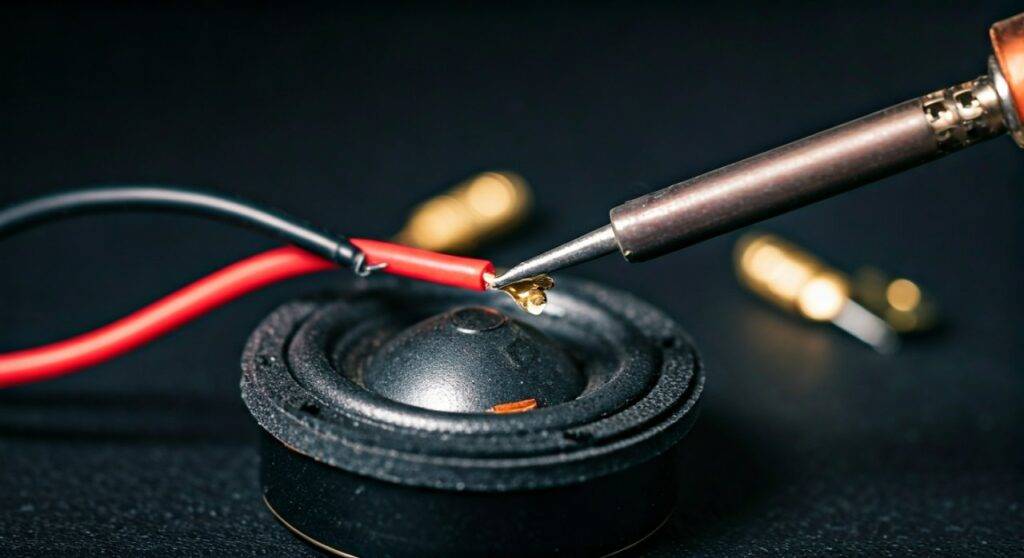
“Tinning” is the process of coating the tip of your new wire with a fresh layer of solder. This ensures a fast, clean thermal transfer. Do not skip this step. A pre-tinned wire bonds almost instantly to the speaker pad, reducing the time your soldering iron is in contact with the sensitive driver.
Step 5: Implementing Strain Relief
This is the most critical step. Once the new wires are soldered, use a small dab of neutral-cure silicone or hot glue near the solder pads. This anchors the wire to the speaker frame, ensuring that if the wire gets pulled, the tension is absorbed by the glue rather than the solder joint.
The Risks: Why Thicker Isn’t Always Better
While you can change wire gauge for tiny speakers, there is a point of diminishing returns. Here are the three main risks I encounter in the field:
- Acoustic Interference: In tiny, sealed enclosures, thicker wires take up more internal air volume. This can subtly change the tuning of the speaker box, potentially leading to a “boxier” sound or reduced bass response.
- Mechanical Dampening: If the wire is too stiff, it can press against the back of the speaker cone or the spider, preventing the driver from moving freely. This causes audible distortion.
- Short Circuits: Thicker wires are harder to route. In a cramped housing, a thick wire might get pinched by a screw or the case itself, leading to a short circuit that could fry your amplifier.
Expert Perspective: When Does It Actually Matter?
In my experience testing Class-D micro-amplifiers, the wire gauge only starts to impact sound quality when the length exceeds 24 inches. If your wires are only 2 or 3 inches long, the difference between 30 AWG and 22 AWG is statistically insignificant for audio performance.
However, if you are building a custom Bluetooth boombox or a DIY smart speaker, upgrading to 24 AWG OFC wire is a professional touch that ensures your device survives years of vibration and handling.
Frequently Asked Questions
Can I use thick 12 AWG wire on a tiny 1-watt speaker?
Technically yes, but it is highly discouraged. The physical weight of 12 AWG wire is likely to break the speaker’s terminals. Additionally, there is zero electrical benefit to using such a thick gauge for a low-power driver. Stick to 24 AWG as a maximum.
Does the wire material matter for small speakers?
Yes. Oxygen-Free Copper (OFC) is the gold standard. Avoid Copper-Clad Aluminum (CCA) for tiny speakers because CCA is more brittle and has higher resistance, which defeats the purpose of upgrading the gauge.
Will changing the wire gauge make my tiny speaker louder?
If the original wire was exceptionally thin and long (causing high resistance), you might notice a slight increase in volume and “punch.” However, for most short-run internal wiring, the volume increase will be imperceptible to the human ear.
Is it okay to mix wire gauges?
Yes, you can use a thicker gauge for the main run and a thinner, more flexible “pigtail” at the very end to connect to the speaker pads. This gives you the low resistance of the thick wire with the safety of the thin wire.