Why You Should Hook Up an Amp to Car Speakers
Yes, you can hook up an amp to car speakers, and in most cases, you absolutely should if you want high-fidelity audio. While factory head units usually provide only 10 to 15 watts of RMS power, an external amplifier can deliver 50 to 100+ watts, providing the “headroom” needed to eliminate distortion at high volumes.
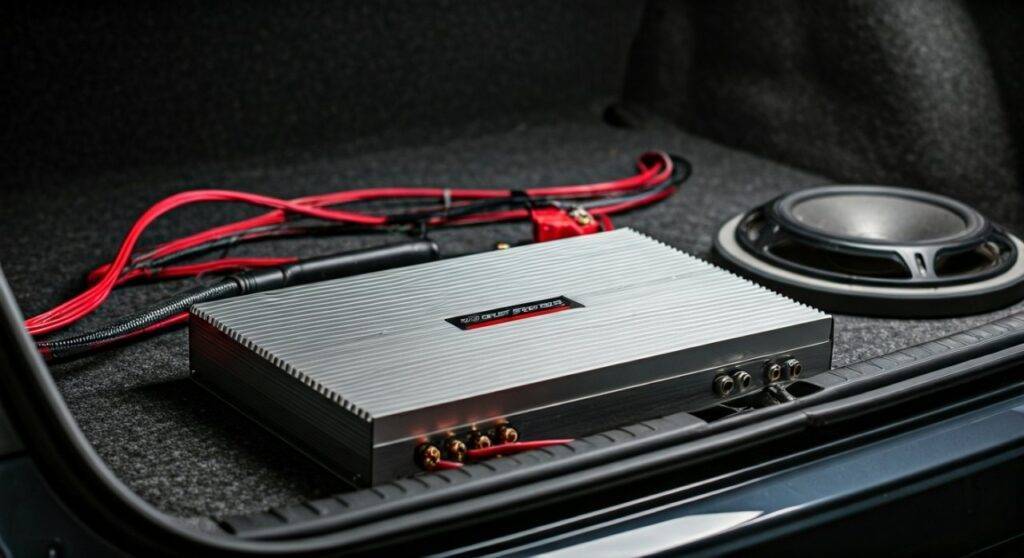
In my years of professional car audio installation, I’ve found that even budget speakers sound significantly better when powered by a dedicated amp rather than a factory radio. This setup allows your door speakers to move with more precision, resulting in tighter bass and clearer highs.
TL;DR: Key Takeaways for Amp Installation
- Direct Answer: You can definitely hook up car speakers to a amp to increase clarity, volume, and dynamic range.
- Safety First: Always disconnect the negative battery terminal before starting any electrical work.
- Match Specs: Ensure your amplifier’s RMS wattage matches your speakers’ power handling to avoid blowing the voice coils.
- Wiring Matters: Use Oxygen-Free Copper (OFC) wiring rather than Copper Clad Aluminum (CCA) for better conductivity and longevity.
- Complex Setups: You can hook up speakers in series to amp to manage impedance (Ohms) if you are running multiple speakers off a single channel.
Can You Hook Up an Amp to Car Speakers Directly?
The short answer is yes, but the method depends on whether you are using a factory head unit or an aftermarket stereo. Most people wonder, “can you hook up car speakers straight to an amp without changing the radio?” The answer is yes, provided you use a Line Output Converter (LOC) or an amplifier with high-level inputs.
Understanding Power Ratings: Peak vs. RMS
When you hook up speakers to an amp, ignore the “Peak Power” printed on the box. This is a marketing number. Instead, look for the RMS (Root Mean Square) rating.
- Underpowering: Paradoxically, sending too little power to a speaker can cause “clipping,” which generates heat and destroys speakers faster than overpowering them.
- Overpowering: Sending 200 watts to a speaker rated for 50 watts RMS will likely tear the surround or burn the coil.
Component vs. Coaxial Speakers
- Coaxial Speakers: These are “all-in-one” speakers (woofer and tweeter combined). They are the easiest to wire when you hook up door speakers to an amp.
- Component Speakers: These have separate woofers and tweeters with an external crossover. You must wire the amp to the crossover first, then the crossover to the individual drivers.
Essential Tools and Materials for the Job
Before we dive into the “how-to,” you need the right gear. Based on my experience, skimping on the wiring kit is the most common cause of “engine whine” or system failure.
| Component | Purpose | Expert Recommendation |
|---|---|---|
| Amplifier | Powers the speakers | Class D for efficiency; Class A/B for sound quality |
| Amp Wiring Kit | Connects amp to battery | Use 4-gauge OFC for most 4-channel setups |
| RCA Cables | Carries signal from radio | Twisted-pair design to reject noise |
| Speaker Wire | Connects amp to speakers | 16-gauge is standard for door speakers |
| Multimeter | Measures voltage and Ohms | Essential for setting the Gain correctly |
| Wire Strippers | Preps the wires | High-quality crimping tool for secure connections |
Step-by-Step: How to Hook Up an Amp to Car Speakers
If you are ready to hook up car speakers to a amp, follow these steps precisely to ensure a clean, fire-safe installation.
Disconnect the Battery
Safety is paramount. Remove the negative (-) cable from your car battery. This prevents short circuits while you are routing the main power wire through the vehicle.
Run the Power Wire
You need to run a heavy-gauge power wire from the battery to the location of the amp (usually under a seat or in the trunk).
- Pro Tip: Always install an in-line fuse within 12-18 inches of the battery.
- Look for a factory rubber grommet in the firewall to pass the wire through. Never run the wire around the door jam where it can be pinched.
Establish a Solid Ground
The ground wire is the most frequent point of failure.
- Find a bolt on the metal chassis of the car.
- Sand the paint away until you see bare, shiny metal.
- The ground wire should be the same gauge as the power wire and no longer than 3 feet.
Connect Signal (RCA) and Remote Turn-On
- RCA Cables: If using an aftermarket radio, plug these into the “Pre-amp” outputs.
- Remote Turn-on (REM): This is a thin (usually blue) wire that tells the amp to turn on when the radio starts.
- Tip: Run the RCAs on the opposite side of the car from the power wire to prevent electromagnetic interference (buzzing sounds).
Wire the Speakers to the Amp
Now you can hook up car speakers straight to an amp. You have two choices:
- Direct Wiring: Run new speaker wires from the amp directly into each door. This is the “best” way for sound quality but is difficult because of the rubber boots in door jams.
- Factory Harness Tap: Run wires from the amp back to the wires behind the stereo. This uses the existing factory wiring to reach the speakers.
Advanced Wiring: Series vs. Parallel
When you hook up speakers in series to amp, you are changing the total impedance (resistance) the amplifier “sees.” This is crucial if you are adding more than one speaker per channel.
Wiring in Series
- How it works: You connect the positive of the amp to the positive of Speaker A, then the negative of Speaker A to the positive of Speaker B, and finally the negative of Speaker B back to the amp.
- The Result: Impedance increases (e.g., two 4-ohm speakers become 8 ohms).
- When to use: Use this if your amp isn’t “stable” at low impedances and you want to keep it running cool.
Wiring in Parallel
- How it works: You connect both speaker positives to the amp positive and both negatives to the amp negative.
- The Result: Impedance decreases (e.g., two 4-ohm speakers become 2 ohms).
- When to use: Use this to draw more power from the amplifier, provided the amp is 2-ohm stable.
Tuning Your Amp for Maximum Performance
Many DIYers hook up an amp to speakers and immediately turn the volume to 100%. This is how speakers die. Tuning is the most important step.
Setting the Gain
The “Gain” or “Input Level” is not a volume knob; it matches the amp’s input to the radio’s output.
- Turn the amp gain all the way down.
- Turn your head unit volume to about 75%.
- Slowly turn the amp gain up until you hear distortion, then back it off slightly.
- Expert Method: Use a digital multimeter and a 1kHz test tone to calculate the exact voltage needed for your target wattage (Voltage = √ (Watts x Ohms)).
Setting the Crossovers
Most amplifiers have a High Pass Filter (HPF).
- Set the HPF to around 80Hz or 100Hz for door speakers.
- This prevents the small speakers from trying to play deep sub-bass, which they aren’t designed for, allowing them to play louder and cleaner.
Common Mistakes to Avoid
In my experience, avoiding these three errors will save you hours of troubleshooting:
- Phasing Issues: If you hook up car speakers to a amp and the bass disappears, you likely have the positive and negative swapped on one speaker. This causes “cancellation.”
- Loose Connections: Use ferrules or high-quality crimp connectors. Twisting wires and using electrical tape is a recipe for a “protect mode” error.
- Wrong Fuse Size: Ensure the fuse at the battery matches the total amperage draw of your amplifier, not just a random high number.
Frequently Asked Questions
Can I hook up an amp to factory speakers?
Yes, you can hook up an amp to car speakers that came from the factory, but be careful. Factory speakers are often fragile and have low power ratings. Keep the gain low to avoid blowing them out.
Do I need a 2-channel or 4-channel amp?
If you want to power only your front door speakers, a 2-channel amp is enough. If you want to power all four speakers in the car, you need a 4-channel amp. Alternatively, you can hook up speakers in series to amp 2-channel setups, but you lose the ability to “fade” front to back.
Why is my amp getting hot?
Amps usually get hot due to low impedance (running too many speakers in parallel) or poor ventilation. If you hook up speakers to an amp and it shuts down, check your ground wire first, then your Ohm load.
Can you hook up car speakers straight to an amp without an RCA output?
Yes. If your radio doesn’t have RCA jacks, look for an amp with high-level (speaker level) inputs. You simply tap into the existing speaker wires behind the radio and run them directly into the amp’s input section.