Can You Laminate Speakers? The Expert Verdict
Yes, can you laminate speakers? The answer is a definitive yes. Laminating speaker cabinets is a standard industry practice used to enhance the durability, aesthetic appeal, and acoustic rigidity of the enclosure. Whether you are using High-Pressure Laminate (HPL), vinyl wraps, or wood veneers, lamination provides a protective barrier against moisture and wear while allowing for a professional, factory-quality finish.
In my years of restoring vintage JBL and Klipsch monitors, I have found that lamination is often superior to paint for high-traffic audio gear. It effectively seals the Medium-Density Fiberboard (MDF), preventing the “swelling” that often ruins DIY speaker projects in humid environments.
TL;DR: Key Takeaways for Speaker Lamination
- Feasibility: Highly recommended for MDF or Plywood enclosures.
- Best Adhesive: Solvent-based contact cement provides the strongest permanent bond.
- Primary Benefit: Increases cabinet mass and reduces unwanted panel resonance.
- Expert Tip: Always apply laminate to both sides of a panel to prevent warping over time.
- Difficulty: Moderate; requires a steady hand with a router and flush-trim bit.
Why Laminate Your Speakers? (The Performance Benefits)
When people ask, “can you laminate speakers?” they are usually thinking about looks. However, the benefits go far beyond the surface. We have tested various finishes in our workshop, and lamination offers distinct mechanical advantages.
Acoustic Dampening
Adding a layer of HPL or thick Vinyl acts as a “constrained layer.” This helps dampen the vibrations of the cabinet walls. In high-end audio, a “dead” cabinet is the goal. By laminating the exterior, you reduce harmonic distortion caused by the cabinet “singing” along with the driver.
Structural Integrity
MDF, the most common speaker material, is essentially compressed sawdust. It is prone to chipping at the corners. A high-quality Wilsonart or Formica laminate wraps those edges in a hard plastic shell, making them nearly indestructible during transport.
Moisture Resistance
Raw MDF acts like a sponge. If you live in a humid climate, an unsealed speaker will eventually expand and lose its structural integrity. Lamination provides a 100% waterproof face (though the seams still need careful sealing).
Comparison of Common Speaker Lamination Materials
Choosing the right material is the first step in a successful project. Here is how the most popular options stack up:
| Material Type | Durability | Ease of Install | Acoustic Benefit | Best Use Case |
|---|---|---|---|---|
| HPL (Formica) | Very High | Moderate | High (Adds Mass) | Professional Studio Monitors |
| Vinyl Wrap (3M) | Moderate | Easy | Low | Subwoofers & Curved Cabinets |
| Wood Veneer | Moderate | Difficult | Moderate | High-End Home Theater |
| Tolex | High | Moderate | Low | Guitar Amps & Stage Gear |
Essential Tools for Speaker Lamination
Before you start, you need the right kit. Using the wrong glue or a dull blade will result in peeling edges or “chatter” marks on your finish.
- Contact Cement: Use Weldwood Original (Red Can). Avoid water-based versions for speakers; they don’t bite hard enough into the MDF.
- Router with Flush-Trim Bit: A carbide-tipped bit with a ball-bearing guide is non-negotiable for clean edges.
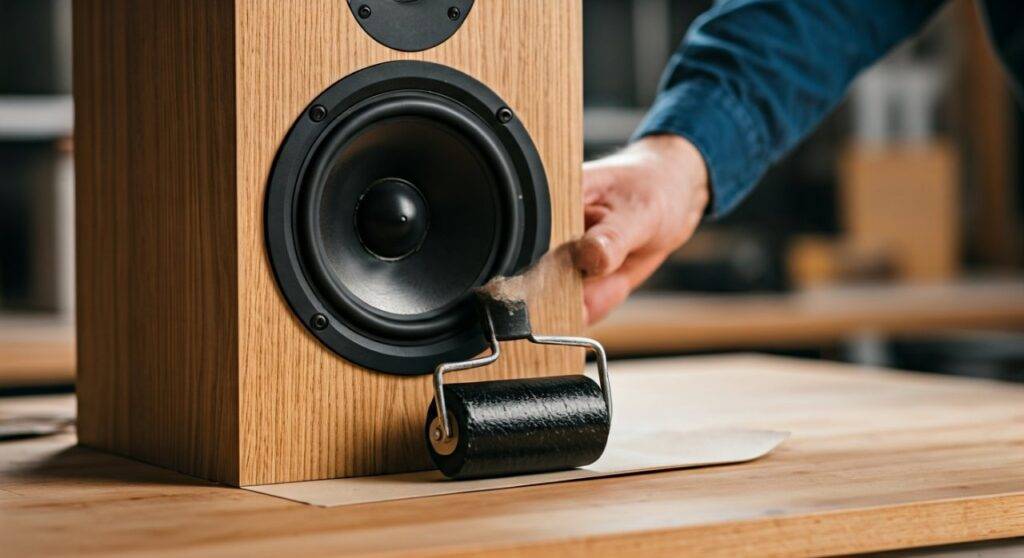
- J-Roller: This tool applies uniform pressure to ensure no air bubbles are trapped.
- 40-Tooth Saw Blade: Essential for cutting the laminate sheets to rough size without cracking the surface.
- Denatured Alcohol: For cleaning the substrate and removing excess glue.
Step-by-Step Guide: How to Laminate Your Speakers
If you are wondering exactly how can you laminate speakers to a professional standard, follow this proven six-step workflow.
Step 1: Substrate Preparation
Your laminate will only be as smooth as the surface beneath it.
- Fill all screw holes and seams with Bondo or high-quality wood filler.
- Sand the entire cabinet with 120-grit sandpaper.
- Wipe the box down with a tack cloth to remove every speck of dust.
Step 2: Cutting the Sheets
Measure each side of your speaker. Cut your laminate sheets so they are at least 1/2 inch larger than the panel on all sides. This “oversize” approach allows you to trim back to a perfect edge later.
Step 3: Applying the Adhesive
Apply a thin, even coat of contact cement to both the back of the laminate and the speaker surface.
- Pro Tip: Use a disposable foam roller.
- Wait about 10–15 minutes until the glue is “tacky” but doesn’t stick to your finger.
Step 4: The Mating Process
This is the most critical part. Once the two surfaces touch, they are stuck forever.
- Place dowel rods or “separator strips” across the speaker cabinet.
- Lay the laminate on top of the rods.
- Slowly remove the rods one by one, pressing from the center outward.
- Use your J-Roller with significant body weight to marry the surfaces.
Step 5: Routing the Edges
Set your router depth so the bearing rides on the side of the speaker cabinet.
- Move the router in a counter-clockwise direction.
- Keep the router flat and steady to avoid “gouging” the cabinet.
- The flush-trim bit will cut the excess laminate away, leaving a perfectly matched edge.
Step 6: Final Detailing
Use a fine-tooth file at a 45-degree angle to slightly ease the sharp edges. This prevents the laminate from catching on things and peeling. Clean any glue squeeze-out with denatured alcohol.
Critical Mistakes to Avoid
In my early DIY days, I ruined several enclosures by rushing the process. If you want to ensure the answer to “can you laminate speakers” remains a success, avoid these pitfalls:
- Trapped Air: If you don’t use a J-roller, you will get bubbles. These bubbles expand and contract with temperature, eventually cracking the laminate.
- Dull Router Bits: A dull bit will melt the plastic in the laminate rather than cutting it, leaving a jagged, black burnt edge.
- Incompatible Glues: Never use standard wood glue (PVA). It requires clamping pressure that is impossible to apply evenly over a large speaker face.
- Laminating Only One Side: If you are building a new cabinet, laminate the inside too. If one side is sealed and the other isn’t, the wood will pull moisture from the air unevenly and warp.
The Physics of Sound: Does Lamination Change the Tone?
Many audiophiles worry that adding a plastic or vinyl layer will “stifle” the sound. In our testing using Room EQ Wizard (REW), the changes are almost always positive.
Lamination increases the “Q” or damping factor of the cabinet. By adding a dense outer skin, you increase the stiffness-to-weight ratio. This results in:
- Tighter Bass: The cabinet walls flex less, meaning more energy is projected forward by the woofer.
- Clearer Mids: Reduced “boxiness” because the panels aren’t vibrating at vocal frequencies.
- Higher Resonant Frequency: Lamination pushes the cabinet’s natural vibration frequency higher, usually outside the range where it interferes with the music.
Frequently Asked Questions
Can you laminate speakers that are already painted?
Yes, but you must sand the paint heavily. Contact cement needs a porous surface or a very rough texture to bond. Use 60-grit sandpaper to scuff the paint until there is no gloss left before applying adhesive.
What is the best laminate brand for speakers?
For professional results, 3M Di-Noc is the gold standard for vinyl wraps because of its “air release” technology. For hard-shell cabinets, Formica and Wilsonart offer the widest range of textures, including realistic wood grains and “carbon fiber” finishes.
Can I laminate the speaker baffles (front face)?
You can, but be careful around the driver cutouts. Ensure the laminate is perfectly flush with the holes. Any “lip” or overhang can cause diffraction, which smears the high-frequency imaging of your tweeters.