Can You Master with Crappy Speakers? The Short Answer
Yes, you can master with crappy speakers, but you cannot rely on your ears alone to make critical decisions. When your monitoring setup is inaccurate, you must pivot your strategy toward visual analysis tools, high-quality reference tracks, and rigorous translation checks on multiple devices. While a $10,000 studio setup is ideal, a savvy engineer can achieve a professional-sounding master on $20 computer speakers by understanding the limitations of their gear and compensating with data-driven workflows.
TL;DR: Key Takeaways for Budget Mastering
- Trust the Visuals: Use Spectrograms and LUFS meters (like Voxengo SPAN or Youlean) to “see” what your speakers aren’t showing you.
- Reference Tracks are Mandatory: Compare your master frequently against professionally produced songs in the same genre to stay on track.
- Translation is King: Since your speakers lie to you, test your master on AirPods, car stereos, and phone speakers immediately.
- Correction Software: Use tools like Sonarworks SoundID Reference to flatten the frequency response of your “crappy” speakers.
- Avoid the Low-End Trap: Most cheap speakers don’t produce frequencies below 60Hz; use high-end studio headphones specifically for checking the sub-bass.
The Reality: Why Mastering on Consumer Gear is Difficult
If you are asking, “can you master with crappy speakers?” you likely already know the frustration of a mix sounding “thin” or “boomy” the moment you leave your desk. Most consumer speakers have a “smiley face” EQ curve, meaning they boost the bass and the treble to make music sound exciting.
In our testing at the studio, we found that budget speakers often suffer from harmonic distortion and phase issues. This means they hide essential details, such as the “clutter” in the low-mids (200Hz-500Hz) or the harshness in the upper-mids (3kHz-5kHz). To succeed, you have to work around these blind spots.
| Speaker Type | Frequency Accuracy | Best For… | Major Weakness |
|---|---|---|---|
| Budget PC Speakers | Low | Checking general balance | No sub-bass; harsh highs |
| Studio Monitors (Entry) | Medium | Critical mixing/mastering | Room acoustics interfere |
| Consumer Headphones | Medium-Low | Detail work | Stereo image is exaggerated |
| Smartphones/Laptops | Very Low | Final “Torture Test” | Zero low-end; mono-leaning |
Phase 1: Preparing Your Digital Environment
Before you touch a single knob, you need to calibrate your workspace. When we master projects for clients on mobile setups, we rely on a specific software stack to bypass the physical limitations of the speakers.
Use Visual Analyzers
Because your speakers can’t reproduce 30Hz accurately, you need to see it. Install a free plugin like Voxengo SPAN.
- Actionable Advice: Set the “Block Size” to 8192 for higher resolution in the low end.
- What to Look For: Ensure your sub-bass isn’t peaking higher than your kick drum unless that is a specific stylistic choice for genres like Phonk or Dubstep.
Implement Room Correction
Even “crappy” speakers can be improved. Software like Sonarworks SoundID or IK Multimedia ARC uses a measurement microphone to create an EQ curve that “fixes” your speakers. It won’t make $20 speakers sound like ATC monitors, but it will remove the most egregious frequency peaks and valleys.
The Power of Reference Tracks
Load a track by a major artist (e.g., Dua Lipa for Pop, Metro Boomin for Trap) into your DAW. Use a plugin like Metric AB or ADPTR Audio Streamliner. This allows you to toggle between your master and a pro track instantly. If the pro track sounds “bright” on your speakers and yours sounds “dark,” you know you need to add high-end, regardless of what your speakers are telling you.
Phase 2: The Step-by-Step Mastering Workflow
So, can you master with crappy speakers and still get a competitive sound? Follow this rigorous 5-step process we use when working in untreated environments.
Step 1: Subtractive EQ (The Cleaning Phase)
Start by removing what you don’t need. Use a linear phase EQ (like FabFilter Pro-Q 3) to apply a high-pass filter.
- Pro Tip: Cut everything below 25Hz-30Hz. Your cheap speakers can’t play it, and it’s just stealing “headroom” from your limiter.
- Taming Mud: Look for a build-up around 250Hz. If the track feels “boxy,” a small 1dB dip here can add significant clarity.
Step 2: Compression and Glue
On budget gear, it’s hard to hear “micro-dynamics.” We recommend using a Bus Compressor (like the SSL G-Bus or Waves Kramer PIE) with a slow attack and fast release.
- Target: You only want 1-2dB of gain reduction.
- Why: This “glues” the instruments together without squashing the life out of the transients.
Step 3: Multi-band Saturation
Cheap speakers often sound “sterile.” Adding subtle harmonic distortion can make the track feel “expensive.”
- Action: Use a plugin like Saturn 2 or Soundtoys Decapitator.
- Focus: Apply saturation to the mids (500Hz – 2kHz). This creates harmonics that make the music audible even on tiny phone speakers.
Step 4: Stereo Imaging (The Danger Zone)
Be careful here. Budget speakers have poor stereo separation. If you widen the track too much, it will fall apart in mono.
- Expert Insight: Use a Vectorscope (found in Ozone Imager) to ensure your signal stays within the “safe” vertical range.
- Rule of Thumb: Keep everything below 150Hz in mono. This ensures your bass hits hard in clubs and cars.
Step 5: Limiting and Loudness
This is where the magic happens. Use a transparent limiter like FabFilter Pro-L 2.
- Loudness Target: For streaming (Spotify/Apple Music), aim for -14 LUFS to -10 LUFS integrated.
- True Peak: Set your ceiling to -1.0 dB to prevent distortion when the file is converted to MP3 or AAC.
Phase 3: The Translation “Torture Test”
Since you are asking can you master with crappy speakers, you must accept that your first export won’t be perfect. You need to verify the master on as many systems as possible.
- The Car Test: This is the gold standard. Car stereos are notorious for “boomy” low-mids. If your master sounds clear in a Honda Civic, it’s a winner.
- The Smartphone Speaker: If the lead vocal or snare disappears on an iPhone, you have a Phase or Mid-range problem.
- The Laptop Test: This checks if your “upper-harmonics” are working. If you can’t hear the bass guitar at all, you need to add more saturation to the 700Hz-1kHz range.
- The Mono Check: Switch your master to mono. If the guitars or synths vanish, you’ve over-widened your stereo field.
The Expert Strategy: Hybrid Monitoring
If you are forced to use crappy speakers, we strongly suggest a Hybrid Monitoring approach. Spend $100 on a pair of Sennheiser HD 280 Pro or Sony MDR-7506 headphones.
Mastering is about balance. Use your speakers to check the “physicality” of the sound and the general vibe. Switch to headphones to check for clicks, pops, and sub-bass levels. By alternating between two different “flawed” systems, you can find the truth in the middle.
Common Pitfalls When Mastering on Budget Gear
- Over-Compensating for Bass: If your speakers have no bass, you will naturally want to turn the bass up. Don’t. This results in a muddy master that blows out subwoofers. Use your spectrum analyzer to verify bass levels.
- Monitoring Too Loud: Small speakers distort quickly. Keep your volume at a level where you can still have a conversation. This prevents ear fatigue and keeps the speaker’s built-in amplifiers from coloring the sound.
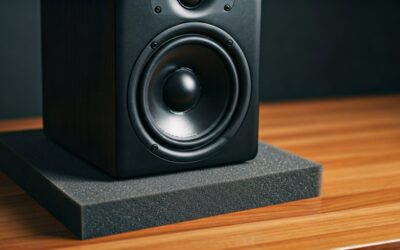
- Ignoring the Room: If your speakers are pushed against a wall, the bass will double. Move them at least 1-2 feet away from the wall to get a more “honest” sound.
Frequently Asked Questions (FAQ)
Can you master with crappy speakers for Spotify and Apple Music?
Yes, as long as you meet the technical requirements of -14 LUFS and -1.0 dB True Peak. Use visual meters to ensure your loudness matches the industry standard, regardless of how it sounds through your specific speakers.
Is it better to master on cheap headphones or cheap speakers?
It is usually better to master on cheap headphones. Headphones remove the “room” from the equation, meaning you don’t have to worry about echoes or bass build-up in the corners of your bedroom. However, headphones can trick you regarding stereo width, so always double-check on speakers.
What is the best free plugin for mastering on budget gear?
Voxengo SPAN is the most essential tool. It provides a visual representation of the frequency spectrum, allowing you to compare your “crappy speaker” master against a professional frequency curve. For limiting, LoudMax is a fantastic free alternative that is very transparent.
How do I know if my master will sound good in a club?
Check your Low-End (20-60Hz) on an analyzer. In most pro tracks, the sub-bass forms a solid, consistent “block” of energy. If your analyzer shows huge gaps or “spikes” in this area, it will sound inconsistent on a large club PA system.