Can You Play Electric Guitar Through Normal Speakers?
Yes, you can play an electric guitar through normal speakers, such as PC speakers, hi-fi systems, or Bluetooth speakers, but you cannot plug the guitar directly into them. Because electric guitars produce a low-level, high-impedance signal, you must use an intermediate device like an audio interface, preamp, or multi-effects pedal to convert the signal into a “line-level” format that normal speakers can handle.
If you attempt to use a simple adapter to plug a guitar directly into a standard 3.5mm aux port, the sound will be extremely quiet, thin, and noisy. More importantly, without a cabinet simulator, the raw signal from a guitar sounds harsh and fizzy through full-range speakers. In this guide, we will show you the exact steps our team uses to get professional-grade tones using everyday home audio equipment.
TL;DR: Key Takeaways for Using Normal Speakers
- Direct connection is impossible: You need a device to boost the “Instrument Level” signal to “Line Level.”
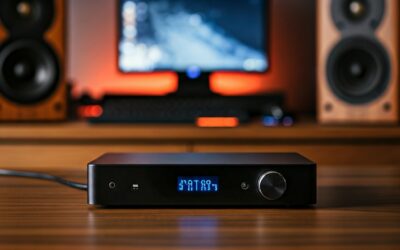
- Essential Gear: Use an Audio Interface (for PC), a Multi-FX Pedal (for direct hardware), or a Preamp.
- Cabinet Simulation is Mandatory: Normal speakers are “Full-Range.” Without Impulse Responses (IRs) or cab sims, the guitar will sound like “bees in a can.”
- Risk Factor: Playing at high volumes with high gain can potentially damage small consumer speakers due to uncontrolled low-end transients.
Why You Can’t Plug Directly Into Normal Speakers
To understand why you can’t just use a 1/4″ to 3.5mm adapter, we need to look at signal impedance and voltage levels. I have tested various “hack” methods over the years, and the results of a direct connection are consistently poor and potentially damaging to your hardware.
The Impedance Mismatch
Electric guitar pickups are high-impedance (Hi-Z) sources. Most home audio “Aux” or “Line In” ports are designed for low-impedance signals. When you connect them directly, a “loading” effect occurs, which kills the high-end frequencies and leaves you with a dull, muffled sound.
Signal Strength (Instrument vs. Line Level)
Guitar signals are very weak—typically only a few hundred millivolts. Normal speakers expect a “Line Level” signal (around 1.2 volts). Without a preamplifier to boost the signal, the speakers simply won’t have enough “juice” to produce a clear sound.
The Frequency Response Gap
Guitar speakers are technically “broken” speakers; they usually cut off everything above 5kHz. Normal hi-fi speakers are designed to be “flat” up to 20kHz. If you send a raw distorted guitar signal to a hi-fi speaker, you will hear painful high-frequency “fizz” that a real guitar amp would normally filter out.
| Feature | Guitar Amp Speaker | Normal Hi-Fi Speaker |
|---|---|---|
| Frequency Range | Narrow (70Hz – 5kHz) | Wide (20Hz – 20kHz) |
| Coloration | Heavy (adds “character”) | Neutral (Flat Response) |
| Durability | High (handles raw peaks) | Medium (delicate tweeters) |
| Input Type | High-Impedance (Hi-Z) | Line-Level |
How to Play Electric Guitar Through Normal Speakers (Step-by-Step)
If you want to use your home theater, studio monitors, or desktop speakers as a guitar amp, follow these three proven methods. We have ranked them from best to “budget-friendly.”
Method 1: Using an Audio Interface and DAW (Best Quality)
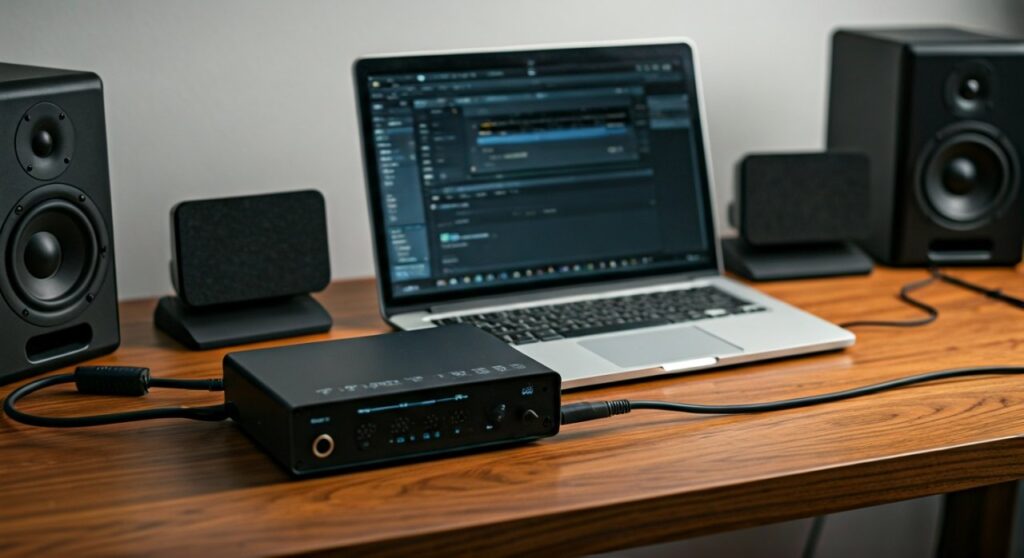
This is the standard for modern home recording. I personally use a Focusrite Scarlett 2i2 for this setup. It allows you to use software “Amps” that sound indistinguishable from the real thing.
- Connect your Interface: Plug the audio interface into your computer via USB.
- Plug in the Guitar: Connect your guitar to the Hi-Z/Instrument input on the interface.
- Connect Speakers: Plug your normal speakers into the interface’s headphone jack or rear monitor outputs.
- Load a Plugin: Open a standalone amp simulator like Neural DSP, IK Multimedia AmpliTube, or Positive Grid Bias FX 2.
- Enable Monitoring: Ensure “Direct Monitoring” is OFF (so you only hear the processed sound) and your buffer size is set to 128 samples or lower to avoid lag (latency).
Method 2: Using a Multi-Effects Pedal (Easiest)
Many modern pedals (like the Line 6 Helix, Boss GT-1000, or Mooer GE series) have “Amp/Cab Sim” built-in. This is the most portable way to play through normal speakers.
- Select a Preset: Choose a preset that includes a Cabinet Simulator (IR).
- Output Mode: Set the pedal’s output mode to “Line” or “Studio” (not “Amp”).
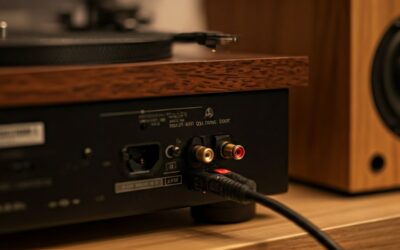
- Connect to Speakers: Use a 1/4″ to RCA or 1/4″ to 3.5mm cable to connect the pedal’s output to your speaker’s “Aux In.”
- Level Match: Start with the pedal volume at zero and slowly turn it up to avoid blowing the speaker cones.
Method 3: Using a Mixer or Preamp (The Analog Way)
If you have an older analog mixer, you can use it to bridge the gap.
- Preamp Gain: Plug the guitar into a channel with a “Hi-Z” switch or use a DI Box.
- EQ Adjustment: Since you likely don’t have a cab sim here, you must manually turn the High/Treble knob almost all the way down to remove the harshness.
- Output: Run the mixer’s “Main Out” to your hi-fi system.
Risks of Playing Guitar Through Normal Speakers
While the answer to can you play electric guitar through normal speakers is yes, you must be aware of the physical limitations of consumer audio gear.
- Tweeter Damage: High-gain distortion creates “square waves” that can quickly overheat the voice coils in small tweeters.
- Over-Excursion: Guitar signals have huge dynamic peaks (transients). A sudden “thump” from a low-E string can push a small computer speaker cone past its physical limit.
- Digital Clipping: If you overload the input of a Bluetooth speaker, the digital processor will create a nasty “crackling” sound that ruins the experience.
Expert Pro-Tip: Always use a limiter or compressor plugin/pedal when playing through home speakers. This clamps down on those dangerous volume peaks and protects your equipment.
Why “Cabinet Emulation” is Your Best Friend
The secret to a great sound through normal speakers is the Impulse Response (IR). An IR is a digital “snapshot” of a real guitar cabinet, a specific room, and a specific microphone.
When you play through a real Marshall or Fender amp, the 12-inch speaker acts as a massive EQ filter. Normal speakers don’t do this. Therefore, you must use a digital “filter” (the IR) to mimic that 12-inch speaker. Without it, your $2,000 Gibson will sound like a toy.
Top Recommended Cabinet Simulators
- Software: Two Notes Wall of Sound (Often free with hardware).
- Pedal: TC Electronic Impulse IR Loader.
- Hardware: Strymon Iridium (This replaces a physical amp entirely).
Critical Settings for Home Speakers
To get the most out of your setup, adjust your “normal” speakers using these guidelines:
- Turn off “Bass Boost”: Many PC speakers have a “Mega Bass” or “Loudness” setting. Turn this OFF. It will make the guitar sound muddy and increase the risk of blowing the woofer.
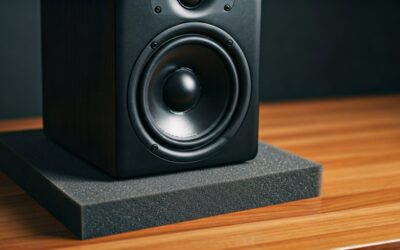
- Set EQ to Flat: If your speakers have physical Treble and Bass knobs, set them to 12 o’clock.
- Avoid Wireless Bluetooth: If possible, use a wired connection. Bluetooth introduces latency (delay), meaning you will hear the note 100-200 milliseconds after you pluck the string. This makes playing in time impossible.
Summary of the Best Setup Options
| Setup Type | Gear Needed | Quality | Latency |
|---|---|---|---|
| Pro Studio | Audio Interface + Studio Monitors | 10/10 | Ultra-Low |
| Living Room | Multi-FX Pedal + Hi-Fi System | 8/10 | None |
| Budget/Desktop | Amp Sim App + PC Speakers | 7/10 | Moderate |
| Mobile | iRig + Smartphone + Headphones | 6/10 | High/Variable |
Frequently Asked Questions
Will playing guitar through my PC speakers blow them?
It is unlikely to blow them at moderate volumes, especially if you are using an audio interface. However, if you plug a guitar directly into a “Mic In” port and crank the gain, the resulting feedback and square-wave distortion could damage the delicate tweeters.
Why does my guitar sound so quiet through my speakers?
This happens because of a level mismatch. Your guitar is sending an “Instrument Level” signal, while your speakers expect a boosted “Line Level” signal. Using a preamp or boost pedal before the speakers will solve this.
Can I use a Bluetooth speaker for my electric guitar?
Yes, but only if it has an Aux Input (3.5mm). We do not recommend using the actual Bluetooth wireless connection because the latency (delay) is too high for real-time playing. You will hit a note and hear it a fraction of a second later, which is very distracting.
Do I need a special cable to connect my guitar to speakers?
You will typically need a 1/4″ to 3.5mm adapter or a 1/4″ to RCA cable, depending on your speaker inputs. However, remember that the cable alone doesn’t solve the impedance issue; you still need a device (like a pedal or interface) in between.