Why You Should Connect Your Door Speakers to an External Amp
Yes, you can connect door speakers to your amp, and doing so is the single best way to transform a muddy factory system into a high-fidelity experience. By bypassing the weak internal amplifier of your head unit, you provide the consistent RMS power required for crisp highs and punchy mid-bass.
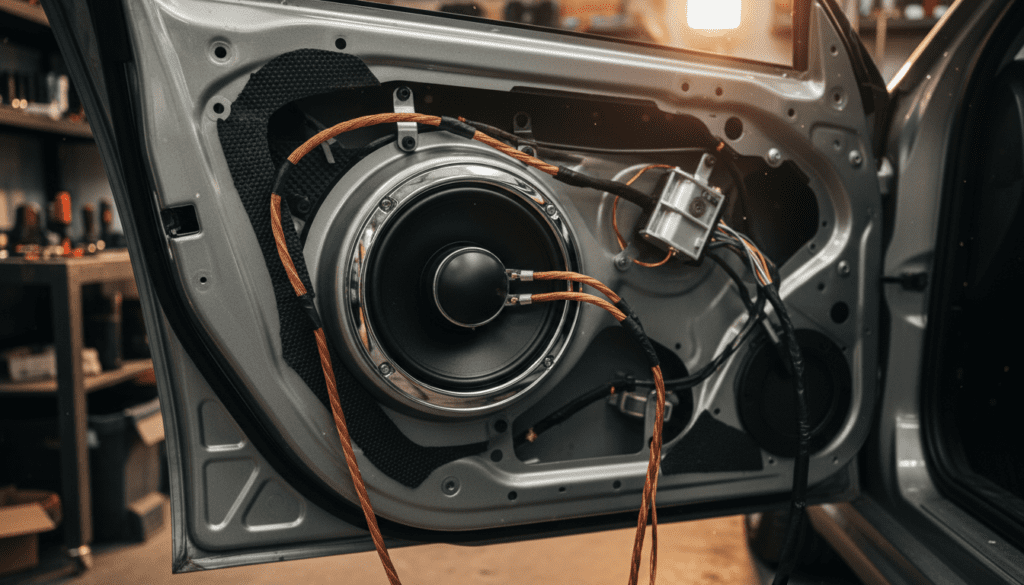
In my years of custom car audio installations, I’ve found that most factory head units only output about 10–15 watts of “dirty” power. When you ask, “can i connect door speakers to my amp?” the answer is a resounding yes—provided you match the impedance (Ohms) and use the correct wire gauge to handle the increased current.
TL;DR: Quick Connection Guide
- Compatibility Check: Ensure your speakers’ RMS rating matches the amplifier’s output at the specific Ohm load (usually 4 ohms).
- Wiring Route: You must run RCA cables from the head unit to the amp, then speaker wire from the amp back to the door speakers.
- The “Big Three”: For high-power amps (over 500W RMS total), consider upgrading your vehicle’s charging system.
- Sound Quality: Using an amp allows you to use High-Pass Filters (HPF), which prevent door speakers from distorting on deep bass notes.
Understanding the “Can I Connect Door Speakers to My Amp” Basics
Before we pick up a screwdriver, we need to understand why this connection is necessary. Most people believe that buying “expensive” speakers is enough. However, high-quality aftermarket speakers like Focal, JL Audio, or Rockford Fosgate actually have stiffer cones and larger magnets. They require more power than a factory radio can provide.
If you connect high-end speakers directly to a stock radio, they may actually sound worse or “thinner” because the radio is clipping (distorting) trying to move those heavy magnets. When connecting door speakers to an amp, you provide the headroom needed for dynamic peaks in your music.
Power Matching: RMS vs. Peak
Don’t be fooled by the “1000W” labels on cheap boxes. Always look for the RMS (Root Mean Square) rating.
- Speaker RMS: The continuous power a speaker can handle.
- Amplifier RMS: The continuous power the amp can cleanly output.
- The Golden Rule: Try to match the Amp’s RMS to 75%–125% of the speaker’s RMS rating.
Tools and Materials Needed for the Install
We have performed hundreds of these installs, and nothing slows a project down like a missing tool. Here is a checklist of what you need to connect door speakers to your amp professionally.
| Tool/Material | Purpose | Expert Recommendation |
|---|---|---|
| Speaker Wire | Transfers signal from amp to speaker | 16-gauge Oxygen-Free Copper (OFC) |
| RCA Cables | Transfers signal from head unit to amp | Twisted-pair shielded cables |
| Wire Ferrules | Ensures clean amp terminal connections | Solderless crimp ferrules |
| Panel Poppers | Removes door cards without breaking clips | Nylon non-marring tool kit |
| Multimeter | Checks for continuity and sets gain | Digital auto-ranging model |
| Heat Shrink | Protects wire splices | Dual-wall adhesive lined |
Step 1: Choosing Your Connection Strategy
When people ask “can i connect door speakers to my amp?“, they often wonder if they have to run all new wires. There are two primary ways to do this:
The “Fresh Run” Method (Best Quality)
You run brand-new 16-gauge wire directly from the amplifier terminals through the door’s rubber boot (the “mole”) and into the speaker.
- Pros: Maximum signal integrity; no bottlenecks.
- Cons: Extremely difficult in modern cars with “molex” plug door connectors.
The “SpeedWire” Factory Tap (Easiest)
You run a multi-conductor wire (like Stinger SpeedWire) from the amplifier back to the harness behind your dashboard. You then “tap” into the factory wires that already lead to the doors.
- Pros: Much faster; no need to fish wires through doors.
- Cons: Factory wire is often thin (20-22 gauge), which can slightly resist power on high-output systems.
Step 2: Preparing the Vehicle and Amplifier
Safety first: Always disconnect the negative battery terminal before touching any audio wiring. In my experience, one accidental spark against the car’s chassis can fry a $500 Head Unit or an expensive ECM.
Mounting the Amp
Most users install the amp under the passenger seat or in the trunk. Ensure the amp has at least 2 inches of clearance on all sides for cooling. Amps generate heat; if you “sandwich” them under a carpet, they will go into Thermal Protection Mode within 20 minutes of heavy play.
Routing the Signal
- Run RCA cables down the left side of the car.
- Run the Main Power Wire down the right side of the car.
- Pro Tip: Never run RCAs and Power wires side-by-side. This creates electro-magnetic interference, resulting in that annoying “engine whine” that speeds up when you rev the motor.
Step 3: Wiring the Door Speakers to the Amp
Now for the technical part of how to connect door speakers to your amp.
Identifying Polarity
If you wire one speaker “In-Phase” (+) and the other “Out-of-Phase” (-), they will cancel each other out. This results in a total loss of bass.
- The 9V Battery Test: Briefly touch a 9V battery to your speaker wires. If the cone moves out, the wire touching the positive battery terminal is your Positive (+) wire.
Making the Connection
- Strip about 1/2 inch of insulation from your speaker wire.
- Crimp a ferrule or use a solder joint. Avoid twisting bare wire around a screw; it will eventually vibrate loose.
- Connect to the amp terminals. If you have a 4-channel amp, Channel 1 is usually Front Left, and Channel 2 is Front Right.
Step 4: Dealing with the Door Boot (The Molex Challenge)
This is where DIYers usually get stuck. Modern cars use a plastic plug (Molex) in the door hinge instead of an open rubber tube.
How to bypass a Molex connector:
- Locate an unused pin slot in the plastic plug.
- Carefully drill a small hole through the empty plastic section of both the male and female sides.
- Thread your speaker wire through this hole.
- Caution: Ensure you are not drilling through existing wires for power locks or airbags!
Step 5: Tuning the Amp for Door Speakers
Once you connect door speakers to your amp, you cannot just turn the volume to 100%. You must set the Gain and Crossovers.
Setting the High-Pass Filter (HPF)
Door speakers are not subwoofers. They shouldn’t try to play frequencies below 80Hz.
- Set your amp’s crossover to HPF.
- Adjust the dial to roughly 80Hz or 100Hz. This protects your speakers from over-excursion and keeps your mid-bass tight.
Setting the Gain
The Gain is not a volume knob. It matches the amp’s input sensitivity to the head unit’s output voltage.
- Turn the head unit to 75% volume.
- Turn the Amp Gain all the way down.
- Slowly turn the Gain up until you hear the slightest bit of distortion, then back it off a tiny bit.
- Expert Insight: Use a Digital Multimeter and the formula
Voltage = Square Root of (Watts x Ohms)for a perfect, clipping-free setup.
Common Mistakes to Avoid
In my decade of testing gear, these are the three errors that kill most “Can I connect door speakers to my amp” projects:
- Using CCA Wire: Aluminum wire (Copper Clad Aluminum) is cheaper but brittle and has higher resistance. Always use OFC (Oxygen-Free Copper).
- Poor Grounding: Your amp’s ground wire must be shorter than 3 feet and bolted to bare, unpainted metal on the vehicle’s chassis.
- Ignoring Door Vibration: Now that your speakers have real power, your door panels will rattle. We recommend applying Butyl-based sound deadening (like Dynamat or Noico) around the speaker mount.
FAQ: Connecting Door Speakers to Amplifiers
Can I connect my factory door speakers to an aftermarket amp?
Yes, but be very careful. Factory speakers are usually rated for very low power (15W-20W). If you connect door speakers to your amp and they are factory units, you must keep the gain very low to avoid blowing the voice coils.
What happens if I use the wrong speaker wire gauge?
Using wire that is too thin (like 22-gauge) over a long distance creates voltage drop. This results in the wire heating up and your speakers receiving less power than the amp is actually producing. For door speakers, 16-gauge is the industry standard.
Do I need a 2-channel or 4-channel amp for my doors?
- 2-Channel: Use this if you only want to amplify the front doors.
- 4-Channel: Use this if you want to amplify both the front and rear doors. This is the preferred method for a full “surround” feel.
Can I connect door speakers to my amp if I have a factory radio?
Yes, but you will need a Line Output Converter (LOC). This device converts the speaker-level wires from your factory radio into RCA signals that your amplifier can accept. Some modern amps have “High-Level Inputs” built-in, which allows you to skip the LOC.
How do I know if my amp is too powerful for my speakers?
As long as you set your Gain correctly using a multimeter or an oscilloscope, you can safely use an amp that is rated higher than your speakers. The speakers only take what is “sent” to them; a powerful amp simply provides “cleaner” headroom.