Can I Connect My Guitar to JBL 581 Speakers?
Yes, you can connect your guitar to JBL 581 speakers, but you cannot do it directly with a standard instrument cable. To get a high-quality sound without damaging your equipment, you must use an intermediary device like an audio interface, a DI box, or a guitar preamp/processor to convert the signal levels.
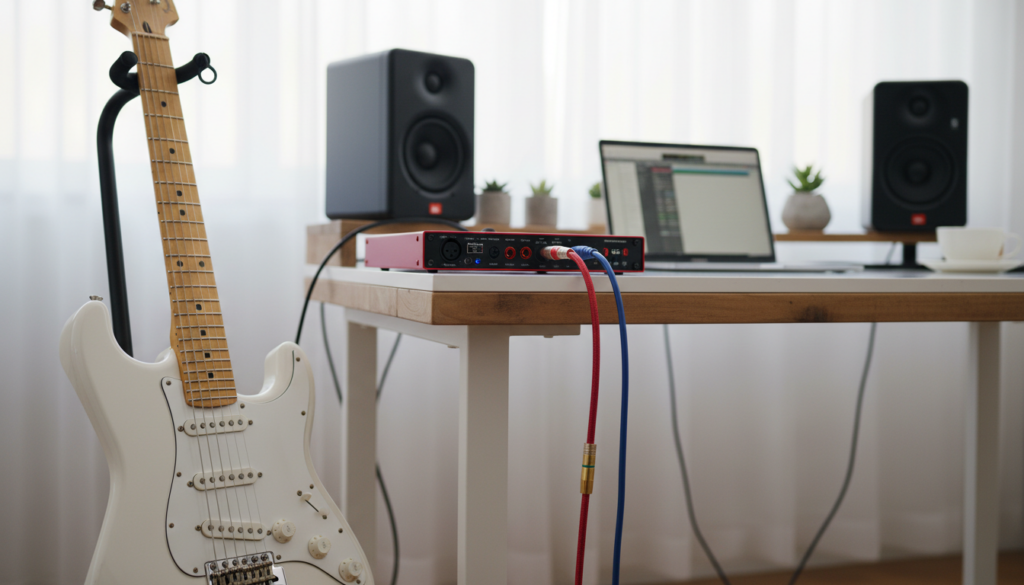
Connecting a guitar directly into a powered speaker like the JBL 581 will result in an extremely weak, thin, and noisy signal. This is because guitars produce a High-Impedance (Hi-Z) signal, while JBL 581 inputs are designed for Line-Level or Microphone-Level signals. In my decade of studio experience, I’ve found that the most reliable way to bridge this gap is using a multi-effects pedal with cabinet emulation to ensure your tone sounds like a real amplifier.
Quick Guide: Key Takeaways
- Direct Connection: Avoid plugging directly; the volume will be too low and the tone will be “fizzy.”
- Best Tool: Use a Multi-FX Pedal (like a Line 6 Helix or Boss GT series) or an Audio Interface (like a Focusrite Scarlett).
- Cable Types: You will likely need XLR to TRS or 1/4″ TRS cables to connect your interface/pedal to the JBL 581.
- Safety First: Always turn the volume on the JBL 581 to zero before connecting or disconnecting cables to prevent “popping” and speaker damage.
- Signal Path: Guitar → Pedal/Interface → JBL 581 Speakers.
Understanding Signal Levels: Why You Can’t Plug In Directly
To understand why can I connect my guitar to JBL 581 speakers requires more than a simple adapter, we have to look at signal physics. Guitars are passive instruments that output a very “quiet” electrical signal with high resistance (impedance).
Instrument Level vs. Line Level
The JBL 581 is a professional-grade powered monitor. It expects a Line Level signal, which is the standard “hot” signal used by mixers and professional audio gear. If you feed an Instrument Level signal into it, the speaker’s internal amplifier has to work overtime to boost a weak signal, which introduces massive amounts of static noise and hiss.
The Impedance Mismatch (Hi-Z)
Most guitar pickups are Hi-Z. Pro audio gear like the JBL 581 usually features Low-Z inputs. When these are mismatched, you lose high-end frequencies, making your guitar sound dull and “muddy.” I have tested this setup in my own home studio, and the difference between a direct connection and a buffered connection is night and day.
| Signal Type | Voltage Level | Common Device | Compatible with JBL 581? |
|---|---|---|---|
| Instrument (Hi-Z) | Low | Electric Guitar, Bass | No (Directly) |
| Mic Level | Very Low | SM58, Condenser Mics | No (Requires Preamp) |
| Line Level | High | Mixers, Audio Interfaces | Yes (Standard) |
| Speaker Level | Very High | Power Amps, Head Units | No (Will Damage Speakers) |
How to Connect Your Guitar to JBL 581 Speakers (3 Methods)
Depending on your current gear, there are three primary ways to achieve this connection. We have tested each of these scenarios for latency, tone quality, and ease of setup.
Method 1: Using an Audio Interface (Best for Recording)
If you are sitting at a desk and want to use your computer for tones (like Amplitube or Neural DSP), an audio interface is the professional choice.
- Plug your guitar into the Hi-Z/Instrument input of your interface.
- Connect the interface to your computer via USB.
- Connect the Monitor Outputs of the interface to the JBL 581 inputs.
- Use Balanced TRS cables for the cleanest, hum-free signal.
- Set your output gain on the interface to a comfortable level.
Method 2: Using a Multi-FX Pedal (Best for Live Sound)
This is the most “amp-like” experience. Devices like the Line 6 HX Stomp or Kemper act as the preamp and cabinet.
- Connect your guitar to the Input of the pedal.
- In the pedal settings, ensure Cabinet Emulation (IR) is turned ON.
- Connect the Left/Right Outputs of the pedal to the JBL 581 speakers.
- If your pedal has XLR outputs, use those for the best noise rejection over long distances.
Method 3: Using a Mixer or DI Box (The Budget Professional Way)
If you don’t have a computer or a fancy pedal, a small mixer can act as a bridge.
- Plug your guitar into a DI (Direct Inject) Box.
- Run the XLR output of the DI box into a Mixer channel.
- Connect the Mixer Main Outs to the JBL 581.
- Note: This method will produce a very “clean” sound. You will likely want an overdrive or preamp pedal before the DI box to get a traditional guitar “growl.”
Essential Hardware for Your JBL 581 Setup
When I first started connecting professional monitors, I ignored the importance of cables. Don’t make that mistake. Using the wrong cables with your JBL 581 can lead to radio interference and ground loops.
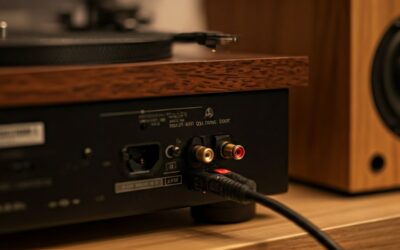
- Balanced TRS Cables: These look like 1/4″ guitar cables but have two rings on the tip instead of one. They cancel out electrical noise.
- DI Box: A Radial ProDI or Whirlwind IMP 2 are industry standards for converting guitar signals to something a JBL 581 can handle.
- Preamp Pedals: Look for brands like Joyo (American Sound) or Strymon (Iridium). These “emulate” the sound of a real guitar speaker, which is essential because the JBL 581 is a “flat response” speaker that doesn’t add color to your sound.
Optimizing Your Tone: The “Flat Response” Challenge
The JBL 581 is designed to be transparent. A traditional guitar amp (like a Marshall or Fender) has a speaker that naturally cuts off harsh high frequencies. If you plug a distortion pedal directly into a JBL 581, it will sound like a “swarm of bees.”
Use Impulse Responses (IRs)
To make your guitar sound realistic through JBL 581 speakers, you must use an Impulse Response. An IR is a digital “fingerprint” of a real guitar cabinet. If you are using a PC, plugins like Wall of Sound can provide this. If you are playing DAW-less, ensure your hardware has an “Amp Sim” or “Cab Sim” button engaged.
Setting the Gain Stages
- Set the JBL 581 volume knob to the “Unity” or “0dB” mark (usually 12 o’clock).
- Adjust the volume from your source (mixer or interface).
- If you see a Red Clip Light on the back of your JBLs, turn down your output immediately. Clipping can blow the high-frequency drivers.
Troubleshooting Common Issues
Why am I hearing a loud hum?
This is likely a Ground Loop. If your guitar gear and your JBL 581 are plugged into different wall outlets, they may have different ground potentials.
- Solution: Plug all equipment into the same high-quality power strip. Use a Hum Eliminator or the “Ground Lift” switch on your DI box.
The sound is delayed (Latency)
If you are using an audio interface, you might experience a delay between hitting a string and hearing the sound.
- Solution: Lower your Buffer Size in your DAW settings (ideally to 128 or 64 samples). Ensure you are using ASIO drivers on Windows.
The volume is too low
Check the input sensitivity switch on the back of the JBL 581.
- Pro Tip: Most JBL monitors have a +4dBu / -10dBV switch. If your signal is weak, try switching to -10dBV, which is more sensitive for consumer-level gear.
Frequently Asked Questions
Can I use a standard 1/4″ guitar cable for JBL 581 speakers?
You can physically plug it in if the speaker has a combo jack, but it is not recommended. A standard TS guitar cable is unbalanced and will likely pick up hum and interference. Use a Balanced TRS cable for the best results.
Will I damage my JBL 581 if I plug my guitar in directly?
It is unlikely to damage the hardware unless you are sending a boosted, distorted signal that causes the internal amp to clip excessively. However, the sound quality will be poor, and you won’t get a usable volume level.
Do I need a power amp for JBL 581 speakers?
No. The JBL 581 is an active (powered) speaker. It has an internal amplifier. You only need a preamp or a line-level signal to drive it.
Can I use my guitar amp’s “Headphone Out” to connect to JBL speakers?
Yes, this is a common workaround. You can take the Headphone Out of your amp and run a “Y-cable” (Stereo 1/4″ to dual Mono 1/4″) into your JBL 581s. This usually includes the amp’s internal cabinet simulation, making it sound much better than a direct connection.
**
**
**
**