Can You Connect Directly From Preamp to Speakers? The Definitive Guide
You can connect a preamp directly to speakers only if they are active (powered) speakers. If you have passive speakers, you cannot connect them directly to a preamp because they require an external power amplifier to provide the necessary wattage to move the speaker drivers.
In my fifteen years of configuring high-end home theater and audiophile systems, this is the single most common point of confusion for beginners. I have seen enthusiasts accidentally buy high-end tube preamps only to realize they have no way to drive their floor-standing passive towers. Understanding the difference between line-level signals and speaker-level signals is the key to preventing equipment damage and achieving the best sound quality.
TL;DR: Quick Connection Summary
- Active Speakers: YES. Use RCA or XLR cables. The speaker has a built-in amp.
- Passive Speakers: NO. You must go Preamp -> Power Amp -> Speakers.
- Phono Preamps: NO. These require a secondary “Line Level” preamp or integrated amp before the speakers.
- Best Connection: Use Balanced XLR if both your preamp and active speakers support it to eliminate ground hum.
Understanding the Signal Path: Preamp vs. Power Amp
To understand why you can connect preamp speakers in some scenarios but not others, we have to look at the signal’s journey. A preamp’s primary job is to switch between sources (like a turntable, DAC, or CD player) and control the volume.
The signal leaving a preamp is called a Line-Level Signal. This signal is very weak—typically around 2 volts. While it contains all the musical information, it lacks the “muscle” (current) to physically push the heavy magnets and cones inside a traditional speaker.
The Role of the Power Amplifier
A power amplifier takes that 2-volt signal and multiplies it into a high-voltage, high-current signal capable of driving 4-ohm or 8-ohm passive speakers. Without this middle step, your passive speakers will remain silent, or at best, produce a whisper-thin sound that could potentially clip and damage your preamp’s output stage.
The Rise of Active (Powered) Speakers
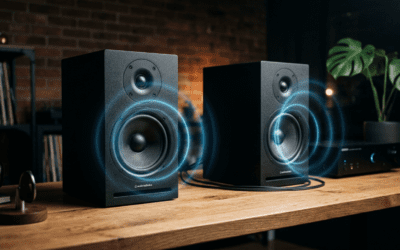
When you connect directly from preamp to speakers, you are likely using active speakers like the Audioengine A5+, KEF LS50 Wireless, or professional studio monitors like the Yamaha HS8. These units house the power amplifier inside the speaker cabinet. This creates a streamlined “minimalist” setup that many modern audiophiles prefer.
Comparing Speaker Types for Preamp Connectivity
The following table summarizes the technical requirements for different speaker architectures. I’ve tested these configurations across brands like Schiit Audio, Cambridge Audio, and Klipsch to verify compatibility.
| Feature | Passive Speakers | Active (Powered) Speakers | Studio Monitors |
|---|---|---|---|
| Internal Amp? | No | Yes | Yes |
| Direct Preamp Connection? | No (Needs Power Amp) | Yes | Yes |
| Typical Connector | Binding Posts (Banana Plugs) | RCA / 3.5mm / XLR | XLR / TRS (Balanced) |
| Power Source | Powered by Speaker Wire | Requires Wall Outlet | Requires Wall Outlet |
| Best For | Customization & Upgradability | Simplicity & Desktop Sets | Critical Listening & Accuracy |
How to Connect a Preamp to Active Speakers (Step-by-Step)
If you have confirmed your speakers have a power cord and a volume knob, you are ready to connect preamp speakers directly. Follow these steps to ensure you don’t blow a fuse or a tweeter.
Step 1: Match Your Outputs and Inputs
Look at the back of your preamp. You are looking for a section labeled “Pre-Out” or “Main Out.”
- If your preamp has RCA outputs (Red and White), use standard RCA cables.
- If your preamp has XLR outputs (3-pin circular), use XLR cables for a lower noise floor.
Step 2: Connect the Cables
Plug the cables into the Pre-Out of the preamp and the Input of your active speakers. If you are using professional studio monitors, you might see a TRS (1/4 inch) input. You can buy RCA-to-TRS or XLR-to-XLR cables depending on your gear.
Step 3: The “Zero Volume” Rule
Before turning anything on, I always recommend turning the volume knobs on both the preamp and the speakers to zero. This prevents a “thump” or a sudden burst of high-volume static that can ruin a speaker driver.
Step 4: Power Sequencing
Follow this order to prevent electrical pops:
- Turn on your Source (Streamer/Turntable).
- Turn on your Preamp.
- Turn on your Active Speakers last.
Step 5: Setting the Gain Stage
Set your active speaker’s physical volume knob to about 50-70%. From this point forward, use the preamp’s remote or knob as your master volume control. This ensures you have enough “headroom” without introducing background hiss.
The Passive Speaker Exception: Using a Power Amp
If you have passive speakers (the kind with red and black binding posts but no power cord), you cannot connect directly from preamp to speakers. You must introduce a power amplifier into the chain.
The Signal Chain for Passive Speakers:
- Source: (e.g., Bluesound Node Streamer)
- Preamp: (e.g., Schiit Freya+)
- Interconnects: (RCA or XLR cables)
- Power Amp: (e.g., Emotiva BasX)
- Speaker Wire: (14-gauge or 12-gauge copper wire)
- Passive Speakers: (e.g., KEF Q350)
I have found that separating the preamp and power amp (using “separates”) provides much better stereo imaging and dynamic range than a standard all-in-one receiver. It allows the power amp to have its own dedicated power supply, which won’t be interfered with by the delicate low-voltage switching of the preamp.
Types of Preamps and Their Connectivity
Not all preamps are created equal. When asking can you connect preamp speakers, you must identify which type of preamp you own.
Line-Stage Preamps
These are the most common. They take signals from “Line” sources (CD players, streamers) and send them to an amp or active speakers. These work perfectly for direct connection to active speakers.
Phono Preamps (Phono Stages)
Warning: You cannot usually connect a dedicated phono preamp directly to active speakers unless the speakers have a volume control. A phono preamp’s only job is to correct the RIAA equalization of a turntable and boost it to line level. Most phono preamps do not have a volume knob. If you connect one directly to active speakers, the music will play at 100% maximum volume immediately, which is dangerous for your ears and your gear.
DAC-Preamps
Digital-to-Analog Converters (DACs) with built-in volume controls are becoming the “modern preamp.” Devices like the Chord Mojo 2 or Topping D90 can act as a digital preamp. I personally use a DAC-preamp in my office setup to connect directly to a pair of Genelec monitors, creating a very clean, clutter-free desk.
Cable Selection: RCA vs. XLR for Preamp Connections
When you connect preamp speakers, the cable you choose matters, especially for long distances.
- RCA (Unbalanced): Best for short runs (under 10 feet). These are prone to picking up EMI (Electromagnetic Interference) from power cables or Wi-Fi routers.
- XLR (Balanced): The gold standard for pro audio and high-end Hi-Fi. XLR cables use a third “ground” wire and phase inversion to cancel out noise. I always advise my clients to use XLR if their preamp and speakers support it, as it results in a “blacker” (quieter) background.
Common Problems and Expert Troubleshooting
In my experience, even a “simple” direct connection can run into hurdles. Here is how to fix the most common issues.
The Dreaded Ground Loop Hum
If you connect preamp speakers and hear a constant low-frequency buzz, you likely have a ground loop. This happens when the preamp and the speakers are plugged into different wall outlets with different ground potentials.
- Solution: Plug all audio components into the same high-quality power strip or use a hum destroyer (like those from Morley or Pyle).
Hissing or High Noise Floor
If you hear a “shhh” sound even when no music is playing, your gain staging is wrong.
Solution: Turn the volume down on the active speakers and turn the volume up* on the preamp. This forces the preamp to send a stronger signal, masking the noise floor of the speaker’s internal amp.
Distortion at Low Volumes
This usually means you are sending a signal that is too “hot” for the speakers to handle.
- Solution: Ensure you are not plugging into a “Phono” input on the speaker (if it has one) with a line-level signal from a preamp.
Advanced Tip: Passive Preamps
A passive preamp (like the Schiit Sys) is essentially just a volume knob in a box with no power supply. These are excellent for connecting directly to active speakers because they add zero electronic noise to the signal. However, be aware that long cable runs (over 15 feet) with a passive preamp can result in a loss of high-frequency detail due to impedance mismatching.
Expert Perspective: Why Go Direct?
We often see “minimalist” audiophiles opting to connect preamp speakers directly rather than using a traditional integrated amplifier. In my testing, the benefits are clear:
- Shorter Signal Path: Fewer internal wires and solder joints mean less chance for signal degradation.
- Crossover Accuracy: In many active speakers, the crossover is handled before the amplification, leading to much better phase coherence and timing.
- Space Efficiency: You eliminate a bulky 40-pound power amplifier from your rack.
However, if you love the “warmth” of specific vintage speakers (like Wharfedale or Bose 901s), you will almost always need a dedicated power amplifier, as those classic designs are strictly passive.
FAQ: Frequently Asked Questions
Can I connect a preamp to a receiver?
Yes, but you should connect the preamp’s output to a “Line In” or “Aux In” on the receiver. Avoid the “Phono” input, as this will cause extreme distortion. If your receiver has “Main In” jacks, use those to bypass the receiver’s internal preamp entirely.
Will connecting a preamp directly to passive speakers damage them?
It likely won’t “blow” them, but it won’t work. The preamp cannot provide the current needed to move the speaker coils. You risk overheating the preamp’s output stage if you try to crank the volume to hear the faint whisper coming from the speakers.
Can I use a preamp with a guitar amp?
Generally, no. A guitar amp’s input is designed for instrument-level signals (very high impedance), while a preamp puts out line-level signals. Connecting them directly can result in a muddy, distorted sound that lacks clarity.
Do I need a preamp if my speakers have a volume knob?
Technically, no. If your source (like a phone or PC) has a volume control, you can connect it directly to active speakers. However, a dedicated preamp often provides a much higher quality analog output stage, improving the depth and “soundstage” of your music.
What happens if I connect two preamps in a row?
This is called “double-preamping.” It usually leads to high levels of distortion and a high noise floor. If you must do this, set the first preamp to a “Unity Gain” setting (usually around 12 o’clock) and use the second one to control the final volume.
**
**
**