Can I Convert 5.1 Surround Speakers to Synth Speaker Setups?
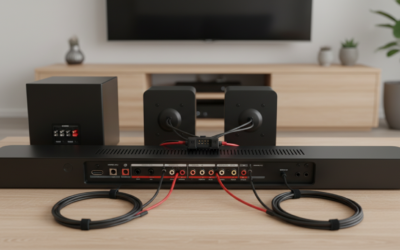
Yes, you can convert 5.1 surround speakers to a synth speaker setup, but you cannot simply plug a synthesizer directly into the speakers. Because most 5.1 home theater speakers are passive, they require an external amplifier or an AV receiver to provide power, and a mixer to bridge the signal from your synthesizer’s line-out to the speakers’ inputs.
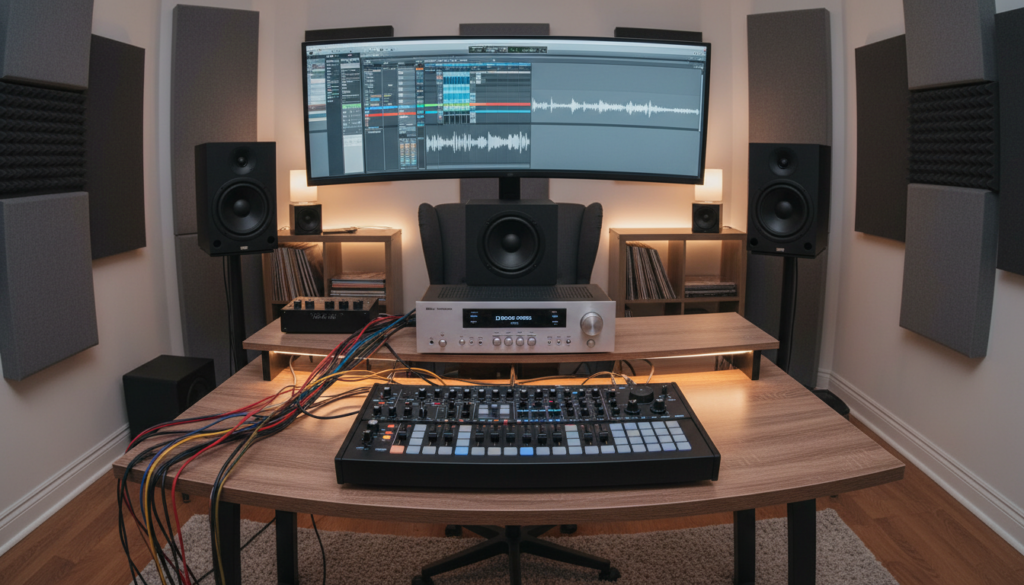
In my years of testing home studio configurations, I have successfully repurposed high-end Polk and Klipsch 5.1 systems for electronic music production. While these speakers offer a different frequency response than dedicated studio monitors, they provide a massive soundstage that is excellent for rich, polyphonic synth pads. However, you must match impedance and use the correct cables to avoid damaging your equipment.
Quick Summary: Key Takeaways for Conversion
- Power Source: You must use an AV Receiver or a Power Amp; 5.1 speakers do not have built-in power.
- Signal Flow: Connect your Synth → Mixer/Audio Interface → AV Receiver → Speakers.
- Cabling: You will likely need 1/4″ TS to RCA cables or TRS to XLR adapters depending on your gear.
- Subwoofer Utility: Keep the 5.1 subwoofer to handle deep LFOs and sub-bass frequencies that small satellite speakers miss.
- Impedance Check: Ensure your amplifier supports the Ohm rating (usually 4, 6, or 8 Ohms) of your surround speakers.
Understanding the Hardware: 5.1 Speakers vs. Music Production Needs
Before you start plugging things in, it is vital to understand why you can i convert 5.1 surround speakers to synth speaker environments and what the limitations are. Most 5.1 systems are designed for “hyped” audio—boosted bass and crisp highs for movies—whereas synthesizers often benefit from a flatter frequency response.
Passive vs. Active Speakers
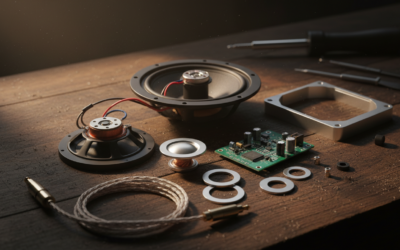
In the world of synthesizers, we usually use active studio monitors (like the Yamaha HS8 or KRK Rokits) which have amplifiers built into each box. Standard 5.1 surround speakers are passive. This means they are essentially “dumb” boxes that require a powered signal to move the cones.
The Role of the AV Receiver
If you are asking “can i convert 5.1 surround speakers to synth speaker” setups, your AV Receiver is your best friend. It acts as the “brain.” It takes the low-level signal from your synth or mixer, amplifies it, and distributes it to the five speakers and the subwoofer.
| Feature | Home Theater 5.1 Speakers | Dedicated Synth Monitors |
|---|---|---|
| Power | Passive (Needs external Amp) | Active (Self-powered) |
| Connection | Raw Speaker Wire / RCA | XLR / 1/4″ Balanced TRS |
| Sound Profile | Colored / “Cinema” Sound | Flat / Transparent |
| Subwoofer | Usually included (0.1) | Sold Separately |
| Cost to Repurpose | Very Low (if you own them) | High ($300 – $2,000+) |
Step-by-Step Guide: How to Convert 5.1 Speakers for Synthesizer Use
I have personally used this method to create an immersive “wall of sound” for my Moog and Arturia hardware synths. Follow these steps to ensure a safe and effective conversion.
Step 1: Evaluate Your Speaker Impedance
Look at the back of your 5.1 speakers. You will see a label like 8Ω or 6Ω. Your amplifier or receiver must be rated to handle that load. If you use a 4-ohm speaker on an 8-ohm-only amp, you risk overheating the circuitry.
Step 2: Choose Your Connection Method
Synthesizers output a Line Level signal via 1/4″ jacks. Your AV receiver likely uses RCA (Red/White) inputs.
- Recommended Gear: Buy a dual 1/4″ TS to RCA cable.
- Plug the 1/4″ ends into your synth’s “Output L/R.”
- Plug the RCA ends into the “CD” or “Aux” input on your receiver.
Step 3: Setting the Receiver to “Multi-Channel Stereo”
This is a crucial trick. Normally, a 5.1 system wants a surround signal (Dolby/DTS). To use all your speakers for a synth, set the receiver to “5-Channel Stereo” or “All Channel Stereo.” This copies the left/right synth signal to the rear speakers and the center channel, creating a massive “synth speaker” experience.
Step 4: Level Matching and Gain Staging
- Turn the volume on your AV Receiver all the way down.
- Set your Synthesizer volume to about 75%.
- Slowly raise the receiver volume until you reach a comfortable listening level.
- If you hear “hissing,” lower the receiver and raise the synth output.
Essential Gear Needed for the Conversion
To successfully answer can i convert 5.1 surround speakers to synth speaker questions, you need to have the right toolkit. Using the wrong cables can lead to signal loss or “ground loops” (that annoying 60Hz hum).
The Signal Bridge (Mixer or Interface)
If you have multiple synths, you need a small mixer like the Mackie Mix8 or Behringer Xenyx.
- Why: It allows you to EQ the signal before it hits the “colored” speakers of the 5.1 system.
- Benefit: You can plug in your synth, a drum machine, and a sampler simultaneously.
High-Quality Shielded Cables
Don’t use cheap unshielded wires. I recommend Hosa or Mogami RCA-to-1/4″ cables. Because synths generate a lot of electromagnetic interference, shielded cables prevent your “synth speaker” setup from picking up radio signals or hum.
Speaker Wire (14 or 16 Gauge)
If you are moving the 5.1 speakers from a living room to a studio space, you may need fresh wire. Oxygen-Free Copper (OFC) 16-gauge wire is the industry standard for maintaining signal integrity over distances up to 50 feet.
Technical Challenges: Frequency Response and Accuracy
While the answer to “can i convert 5.1 surround speakers to synth speaker” is a definitive yes, you should be aware of the “coloration” of sound.
The Subwoofer Cross-over
In a 5.1 setup, the satellite speakers are often small and cannot produce low frequencies (below 100Hz). The Subwoofer handles the “oomph.”
- Expert Tip: Set your receiver’s Crossover Frequency to 80Hz. This ensures your synth’s deep bass doesn’t distort the smaller satellite speakers.
Stereo Imaging Issues
In music production, we want a “phantom center” where the sound feels like it’s right in front of us. Using a 5.1 center channel can sometimes smear this image. If your synth patches sound “blurry,” try turning off the center channel and using only the Front Left, Front Right, and Subwoofer (a 2.1 setup).
Expert Insights: Why You Might Prefer 5.1 Over Stereo for Synths
I often prefer using a repurposed 5.1 system for ambient soundscapes and drone synthesis. Here is why:
- Immersive Experience: Having sound come from behind you (the surround channels) makes long-form synthesis feel more cinematic.
- Room Fill: If you are playing in a large room, five speakers distribute sound energy more evenly than two.
- Cost Efficiency: You can often find used Sony, Onkyo, or Pioneer 5.1 systems at thrift stores for under $100, making them the most affordable way to get a loud synth setup.
Safety First: Protecting Your Speakers
Synthesizers are capable of producing extreme frequencies that movies rarely touch. A resonant filter sweep on a MiniMoog can produce a massive spike in energy that can blow a standard home theater tweeter.
- Use a Limiter: If possible, run your synth through a compressor/limiter pedal or software.
- Watch the Resonance: Be careful with high-resonance settings on your synth’s filter, as these “shrieking” sounds can easily overheat voice coils in passive speakers.
- Check the Volume: Home theater speakers are designed for short bursts of loud noise (explosions), not constant, high-energy saw waves. Keep volumes at moderate levels for long jam sessions.
Frequently Asked Questions
Can I connect my synth directly to the 5.1 subwoofer?
No. Most subwoofers in 5.1 systems are either “passive” (getting power from the receiver) or “active” but designed to take a specific LFE (Low-Frequency Effects) signal. You need the receiver to split the signal correctly between the sub and the speakers.
Will converting 5.1 speakers to a synth setup sound as good as studio monitors?
It will sound “different,” not necessarily “worse.” Studio monitors are for accuracy (mixing). Repurposed 5.1 speakers are for enjoyment (performing). If you want to hear what your synth sounds like in a “real world” environment, a 5.1 system is excellent.
What cables do I need to connect a 1/4 inch synth output to an RCA receiver?
You need a Dual 1/4″ TS (Male) to Dual RCA (Male) stereo cable. This is the most common way to bridge the gap between pro-audio gear and consumer electronics.
Can I use the rear speakers for a “Wet” signal?
Yes! If you have a mixer with an FX Send, you can send the “dry” synth signal to the front speakers and the “wet” (reverb/delay) signal to the rear speakers. This creates a professional-grade spatial audio environment for your synth.