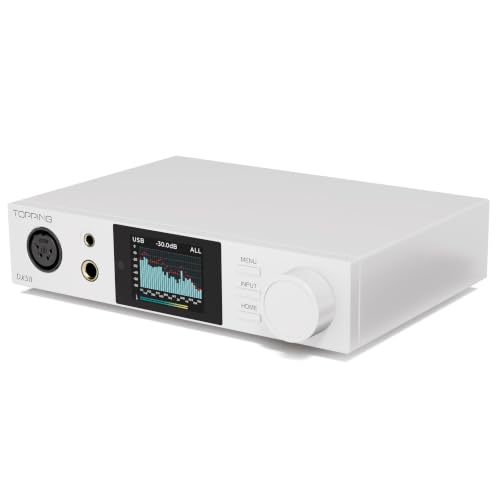

Quick Verdict: Desktop DAC amplifiers are selected primarily by output impedance compatibility and rated power into the target load. Key measurable factors include THD+N below 0.01 percent, signal-to-noise ratio above 110 dB, and output power sufficient for headphone impedance, ensuring accurate, low-distortion reproduction across the audible frequency range.

Pros
- The OLED display reports input mode, DAC chip assignment, USB driver mode, and volume at a glance, which helps anyone switching between sources several times a day confirm state without guessing.
- A 3.5mm headphone output rated at 1000mW with two gain levels gives owners of both sensitive IEMs and high-impedance headphones a single jack to work from.
- Four LME49720 op-amps are swappable through a top access window, so a tinkerer can change parts without a full teardown of the chassis.
- Bluetooth reset, adjustable display brightness, and full-spectrum RGB lighting give control over both pairing problems and a unit that will sit in a visible living space.
- Eleven display modes including VU meters, spectrum, spinning vinyl, and cassette reels suit a buyer who wants the desk or shelf to look like part of the listening experience rather than a blank box.
Cons
- No dimensions, weight, chassis material, or power input specification is supplied, so shelf clearance, stacking with the companion D1, and whether an external supply or wall adapter is required all remain unverified.
- Per-output DAC assignment, filter modes, gain switching, UAC mode selection, and eleven display modes add up to a setup that rewards manual reading and does not suit a buyer who wants a plug-and-forget converter.
- The listing provides no confirmed box contents, so cables (USB-C, coaxial, optical), remote batteries, spare op-amps, and any Windows driver requirement for USB Audio Class 2.0 need to be verified before ordering.
Pros
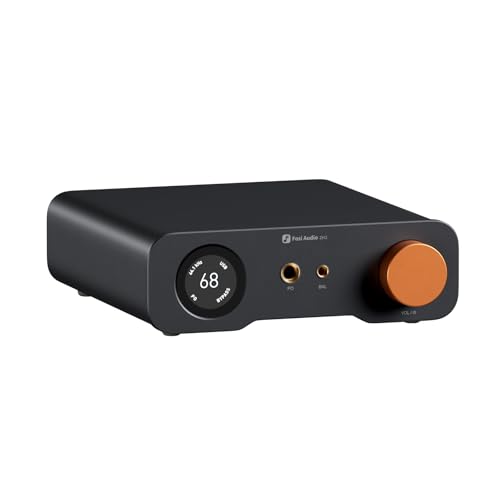
- A stated 16 ohms to 300 ohms headphone range gives buyers a direct impedance comparison for many in-ear and over-ear headphone setups.
- The three-level gain switch provides an adjustment point for matching different headphone loads rather than using one fixed setting.
- The 9.448818888 x 11.81102361 x 2.755905509 inches dimensions and 2.87 pounds weight define the desk space and portability tradeoff.
Cons
- The listing warns that RCA and XLR output levels differ significantly, so owners must confirm which level suits their downstream equipment.
- EQ only supports headphone output, limiting tone adjustment for buyers who plan to use the preamp outputs with speakers.

Pros
- Relay-switched 12V/15V output selection lets one unit serve compatible devices at either voltage without internal modifications
- The listing states a custom low-noise 75W toroidal transformer, aimed at deeper bass, improved dynamics, and a more spacious soundstage from HiFi gear
- Fully discrete regulation with dual MOSFET parallel output stages provides low output impedance and high transient current capability for headphone amplifiers and DACs
- Rigid ventilated aluminum chassis is specified to suppress vibration, reduce electromagnetic interference, and dissipate heat
Cons
- Output is limited to 12V or 15V DC at 3A, so buyers whose DAC, amplifier, or streamer requires any other voltage or higher current cannot use this supply
- This is a dedicated accessory that adds value only to an existing compatible setup; it does nothing on its own, and the listing does not confirm connector compatibility with non-FiiO devices

Pros
- Reconfigurable 3-layer design lets you scale from a two-device stack to a taller setup as your gear collection grows
- All-metal construction with 16mm support pillars provides a rigid, stable platform rated for up to 10 kg per shelf
- Dedicated vibration-damping feet and pads on each column reduce resonance transfer between stacked components
- Ventilated shelf surfaces allow heat to dissipate, which benefits amplifiers and DACs that generate warmth during use
Cons
- Listed dimensions appear unusually small and may be inaccurate, so buyers should confirm actual shelf size fits their equipment before ordering
- No user reviews are available yet, making it difficult to assess real-world build quality, assembly ease, or long-term durability
When you shop for dac amplifiers, the most important choice is between a compact headphone DAC amp and a full stereo amplifier with a built-in DAC. The right pick depends on whether you drive headphones only or also want to power passive speakers. This guide evaluates 4 products, focusing on decoding capability, output power, connectivity, and build quality. Relevant engineering and hardware compliance benchmarks are maintained through the official Dolby Atmos speaker configuration guidelines.
Many buyers face a common dilemma: they want better sound from a computer, gaming console, or phone, but they are unsure whether they need a separate DAC and amp or a combined unit. The options range from small USB-powered headphone amps to larger all-in-one stereo amplifiers with Bluetooth and multiple inputs. Choosing poorly can mean wasted money on features you do not use or a unit that cannot drive your headphones or speakers adequately. This guide covers desktop headphone users, gamers, and those building a small speaker system, and it explains the trade-offs between the Fosi Audio and AIYIMA models in this set. For related guidance, examine our breakdown on Fluance vs Audio-Technica in.
Quick Answer
For most desktop headphone listeners, the Fosi Audio K7 offers the best combination of decoding power, balanced output, and build quality. For a simpler, lower-cost option, the Fosi Audio K5 Pro covers essential inputs and headphone driving needs. If you want to power passive speakers as well as headphones, the AIYIMA A80 provides a full stereo amplifier with a built-in DAC. For related guidance, examine our breakdown on At Home Bluetooth Speaker: Verified Acoustic Picks.
- Best for desktop headphone audiophiles: Fosi Audio K7 DAC Headphone Amp because it includes a 4.4mm balanced output, supports PCM up to 384kHz/32bit and DSD256, and delivers up to 2100mW. The trade-off is a higher price and a larger footprint than simpler USB DACs.
- Best for budget desktop setups: Fosi Audio K5 Pro Gaming DAC Headphone Amplifier because it offers USB-C, optical, and coaxial inputs with a built-in mic input at a lower price point. The trade-off is lower output power (up to 1000mW at 16 ohms) and no balanced output.
- Best for speaker + headphone combos: AIYIMA A80 Bluetooth Stereo DAC Amplifier because it combines an ESS9038Q2M DAC with a TPA3255 Class D amplifier, offering up to 300W per channel and multiple inputs including PC-USB, optical, coaxial, and TRS balanced. The trade-off is that it is a full amplifier, so it is larger and more complex than a dedicated headphone DAC.
How We Evaluated
Our recommendations are based on the manufacturer specifications, features, positioning, and available customer-review evidence. We did not perform hands-on testing or long-term ownership, so we rely on manufacturer-stated specifications and the relative positioning of each product within this set. We compared each product against criteria that matter most for dac amplifiers: decoding capability (PCM/DSD support), output power, connectivity options, build quality, and intended use case. For related guidance, examine our breakdown on Bluetooth Speaker For Office: Essential Buying Checklist.
We distinguish between manufacturer-supplied facts, such as chip types and power ratings, and our editorial interpretation of how those specs affect real-world use. For example, a higher output power rating suggests better ability to drive demanding headphones, but the actual listening experience depends on headphone impedance and sensitivity. We also balance fit and trade-offs rather than assuming one product is best for everyone. A lower-priced model may be the right choice if you only need basic connectivity, while a feature-rich unit justifies its cost for users who need balanced outputs or speaker amplification. For related guidance, examine our breakdown on Bluetooth Speakers For Parties:.
Which Option Fits You?
| Buyer or use case | Product | Why it fits | Main trade-off |
|---|---|---|---|
| Desktop headphone audiophile | Fosi Audio K7 DAC Headphone Amp | Balanced 4.4mm output, high-resolution decoding up to PCM 384kHz/32bit and DSD256, 2100mW output power | Higher price; no speaker amplifier output |
| Budget desktop or gaming setup | Fosi Audio K5 Pro Gaming DAC Headphone Amplifier | USB-C, optical, coaxial inputs; mic input; lower price point | Lower output power; no balanced output |
| Speaker + headphone combo | AIYIMA A80 Bluetooth Stereo DAC Amplifier | Integrated ESS9038Q2M DAC and TPA3255 Class D amp, up to 300W per channel, multiple inputs including TRS balanced | Larger footprint; more complex setup |