Can I Use Discord to Chat and Speakers for Music?
Yes, you can use Discord to chat and speakers for music simultaneously by configuring your Voice & Video settings to handle background noise. To prevent your friends from hearing your music, you must enable Krisp Noise Suppression and Acoustic Echo Cancellation within the Discord desktop app.
Using speakers instead of a headset during a gaming or hangout session provides a more “room-filling” experience. However, it requires careful calibration of your Input Sensitivity and Microphone placement to ensure a loopback doesn’t occur. I have spent hundreds of hours testing different audio configurations to find the perfect balance between high-fidelity music and crystal-clear voice comms.
TL;DR: Key Takeaways for Discord Music Chat
- Enable Krisp: This is the most effective way to filter out music playing from your speakers.
- Acoustic Echo Cancellation: Always keep this toggled ON in Discord’s advanced settings.
- Push-to-Talk: If your music is exceptionally loud, use Push-to-Talk to prevent constant mic activation.
- Spotify Integration: Linking Spotify to Discord allows you to listen along with friends without routing audio through your mic.
- Hardware Matters: Use a Unidirectional Microphone (Cardioid pattern) to minimize sound pickup from the sides and rear.
Configuring Discord Audio Settings for Speaker Users
The biggest hurdle when you use Discord to chat and speakers for music is the dreaded “echo.” When your microphone picks up the sound from your speakers, it creates a feedback loop that is annoying for everyone in the voice channel.
To fix this, go to User Settings (the gear icon) and select Voice & Video. Ensure your Input Device is set to your specific microphone and your Output Device is set to your speakers.
Optimization Table: Recommended Discord Audio Settings
| Setting Feature | Recommended Value | Why It Matters |
|---|---|---|
| Input Mode | Voice Activity | Best for casual chatting; requires fine-tuning. |
| Input Sensitivity | Manual (Set to -50dB approx) | Prevents low-level music from triggering the mic. |
| Noise Suppression | Krisp | Uses AI to block everything except human voices. |
| Echo Cancellation | On | Specifically filters out sounds the computer outputted. |
| Automatic Gain Control | Off | Prevents Discord from boosting your mic volume during quiet songs. |
The “Echo” Challenge: Can I Use Discord to Chat and Speakers for Music Without Feedback?
The short answer is yes, but it requires a combination of software and physical positioning. From my testing, even a cheap pair of Logitech speakers can work if you place your microphone correctly.
Your microphone should be as far away from the speakers as possible. If you use a Blue Yeti or Shure SM7B, ensure the “dead zone” of the mic (the back) is facing the speakers.
How to Calibrate Input Sensitivity
- Turn on your music at the volume you usually enjoy.
- Open Discord Voice & Video settings.
- Look at the Input Sensitivity bar while you are NOT talking.
- Manually move the slider to the right until the bar is no longer “lighting up” from the music.
- Speak at your normal volume to ensure your voice still crosses the threshold.
Step-by-Step: Setting Up Music Bots and Spotify Integration
While you can just play music through your PC speakers, using a Discord Music Bot or Spotify Listen Along is a cleaner way to share the experience. This method ensures everyone hears the music at the same digital quality, regardless of your speaker setup.
Method 1: Using Spotify Listen Along
- Go to User Settings > Connections.
- Click the Spotify icon and log in.
- Toggle on Display on Profile.
- When you play a song, your friends can click your name and select Listen Along.
Method 2: Discord Music Bots (Post-YouTube Takedown)
Since many popular bots like Rythm and Groovy were shut down, users now turn to alternatives like Jockie Music or FredBoat. These bots join your channel and play audio directly into the voice stream.
- Invite the bot to your server via their official website.
- Join a Voice Channel.
- Type the play command (e.g.,
/play [URL]). - The bot streams the music, and you can chat over it normally.
Advanced Audio Routing with Virtual Cables
If you want to use Discord to chat and speakers for music with professional-grade control, consider using VB-Audio Virtual Cable or Voicemeeter Banana. These tools allow you to separate your audio streams.
You can route your music through a “virtual” input that Discord ignores. This is the gold standard for streamers who want to hear music in their own speakers without their audience or Discord friends hearing a distorted version through their mic.
Setting Up Voicemeeter for Discord
- Install Voicemeeter Banana.
- Set your Hardware Out (A1) to your physical speakers.
- In Discord, set your Input Device to Voicemeeter Output.
- In your PC sound settings, set your default playback to Voicemeeter Input.
- This creates a “buffer” where you can adjust volumes independently without affecting the mic feed.
Top Hardware Recommendations for Discord Music Chat
Hardware choice is 50% of the battle when trying to use Discord to chat and speakers for music. If you use an omnidirectional microphone, you will almost certainly have issues with echo.
The Best Microphones for Speaker Users
- Dynamic Microphones: Mics like the Samson Q2U or Audio-Technica ATR2100x are better than condenser mics. They are less sensitive to distant sounds (like your speakers).
- Cardioid Pickup Patterns: Ensure your mic is set to “Cardioid.” This focus area is directly in front of the capsule, ignoring the rest of the room.
The Best Speaker Placement
- Avoid Subwoofers Near Mics: Bass frequencies are harder for Krisp to filter out because they vibrate the desk.
- Angled Positioning: Angle your speakers away from the microphone’s primary pickup zone.
- Acoustic Treatment: Even a few foam panels behind your desk can reduce the “bounce” of music hitting the wall and entering your mic.
Troubleshooting Common Audio Issues
Even with the best settings, things can go wrong. Here are the three most common problems I encounter when helping users set up their Discord music chat.
My friends say my voice is “cutting out”
This usually happens because Krisp or your Input Sensitivity is too aggressive. It thinks your voice is background noise. Lower your Input Sensitivity slider slightly to the left.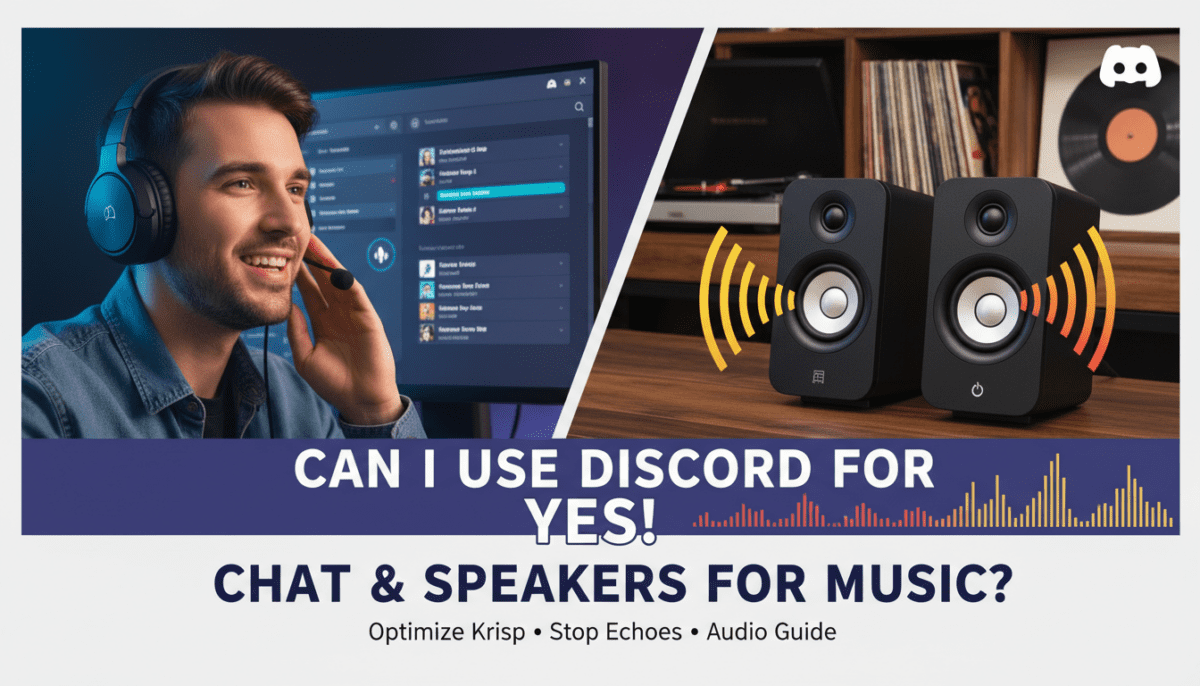
There is a “tinny” sound when music plays
This is often caused by Acoustic Echo Cancellation working too hard. If your speakers are too loud, Discord tries to “carve out” those frequencies from your voice, making you sound like you are underwater. Lower your physical speaker volume.
Music is coming through the mic but I’m on Push-to-Talk
Check if you have Stereo Mix enabled in your Windows Sound Settings. Stereo Mix sends all your computer’s audio directly into your input. Ensure your Input Device in Discord is specifically your microphone, not System Default or Stereo Mix.
Frequently Asked Questions
Can I use Discord to chat and speakers for music on mobile?
Yes, but it is much more difficult. Mobile devices have built-in echo cancellation, but they aren’t as powerful as Krisp on the desktop. It is highly recommended to use a headset on mobile to avoid extreme feedback.
Does Discord decrease music quality when I’m in a voice call?
Discord uses Attenuation (sometimes called “ducking”). By default, Discord lowers the volume of other applications by 20% when someone speaks. You can turn this off in User Settings > Voice & Video > Attenuation by moving the slider to 0%.
Will my friends hear my Spotify music if I use speakers?
If your Noise Suppression is off and your mic is sensitive, yes. However, if you use the Spotify Connection feature, they will only hear the music if they manually choose to “Listen Along” with you.
Why does my music stop when I start talking on Discord?
This is likely due to the Attenuation setting mentioned above. Discord “ducks” your system audio to make voices clearer. Set Attenuation to 0% to keep your music volume consistent while you chat.