Can You Hook Up Multiple Speakers Using 1 4 Splitter Safely?
Yes, you can hook up multiple speakers using 1 4 splitter, provided you match the impedance (Ohms) of your speakers to the capabilities of your amplifier. While a simple Y-splitter cable or a parallel distribution box allows for multiple connections, failing to calculate the total ohm load can overheat your equipment or cause permanent hardware failure.
In my fifteen years of configuring live sound stages and home studios, I have found that the “plug and play” approach works for active (powered) speakers, but requires strict math for passive speakers. This guide will walk you through the technical requirements, the risks of impedance drops, and the exact steps to expand your audio setup without smelling smoke.
TL;DR: Quick Summary for Multi-Speaker Hookups
- Yes, it is possible, but only if your amplifier can handle the combined ohm load.
- Parallel wiring (the standard for most splitters) drops the total impedance.
- Two 8-ohm speakers connected via a splitter create a 4-ohm load on your amp.
- Active speakers are much easier to split because they have internal amplifiers.
- Never use a standard instrument cable for speaker-level signals; always use dedicated speaker cables.
Understanding the Physics: Can You Hook Up Multiple Speakers Using 1 4 Splitter?
When you decide you can hook up multiple speakers using 1 4 splitter, you are essentially changing the electrical path of the audio signal. In a standard setup, one output goes to one speaker. When you introduce a splitter, you are typically creating a parallel circuit.
In my experience, the biggest mistake beginners make is ignoring Ohm’s Law. When speakers are wired in parallel via a splitter, the resistance the amplifier “sees” decreases. If the resistance (impedance) drops below what the amplifier is rated for (usually 4 ohms or 2 ohms), the amp will draw too much current and potentially blow a fuse or melt internal components.
The Impedance Calculation Table
To ensure your safety, use this table to determine your total load when using a 1/4″ parallel splitter:
| Speaker A Impedance | Speaker B Impedance | Total Load on Amp | Safe for Most Amps? |
|---|---|---|---|
| 8 Ohms | 8 Ohms | 4 Ohms | ✅ Yes |
| 16 Ohms | 16 Ohms | 8 Ohms | ✅ Yes |
| 4 Ohms | 4 Ohms | 2 Ohms | ⚠️ Only if Amp is 2-Ohm Stable |
| 8 Ohms | 4 Ohms | 2.67 Ohms | ❌ Generally No |
Different Types of 1/4″ Splitters for Audio
Not all splitters are created equal. Depending on whether you are splitting a line-level signal (like from a mixer) or a powered signal (like from a guitar amp head), you need specific hardware.
Passive Y-Splitter Cables
These are the most common tools. A 1/4″ TRS or TS Y-cable takes one signal and duplicates it.
- Best For: Connecting two powered monitors to a single output.
- Pro Tip: Avoid using these for high-wattage passive speakers, as the thin wire gauge in standard Y-cables cannot handle the heat generated by power amplifiers.
Parallel Distribution Boxes (Abby Boxes)
If you are serious about the fact that you can hook up multiple speakers using 1 4 splitter, a distribution box is the professional’s choice. These boxes feature heavy-duty internal wiring.
- Benefit: They provide a more secure mechanical connection than a flimsy cable.
- Usage: I use these in guitar rigs to run two 4×12 cabinets from a single Marshall head.
Active Signal Splitters (Distribution Amps)
If you are splitting a signal to four or more speakers, a passive splitter will result in signal degradation and volume loss.
- How it works: An active splitter uses its own power source to buffer and amplify the signal for each output.
- Recommendation: Use these for large-scale installations or “Zone” audio in a venue.
Step-by-Step Guide: How to Hook Up Multiple Speakers
Follow these steps to ensure you don’t damage your gear while expanding your sound system.
Step 1: Identify Your Speaker Type
Determine if your speakers are Active or Passive.
- Active: Have a power plug and a “Power On” switch.
- Passive: Only have wire terminals or a 1/4″ jack; they require an external amplifier.
Step 2: Check the Amplifier’s Minimum Ohms
Look at the back of your amplifier or receiver. You will see a label like “Minimum Load: 4 Ohms.” This is your “floor.” You cannot go below this number.
Step 3: Calculate the Combined Load
If you are using a standard splitter, use the parallel formula:
Total Impedance = (Resistance 1 × Resistance 2) / (Resistance 1 + Resistance 2).
For example, two 8-ohm speakers equals (8×8) / (8+8) = 64 / 16 = 4 ohms.
Step 4: Connect the Splitter to the Source
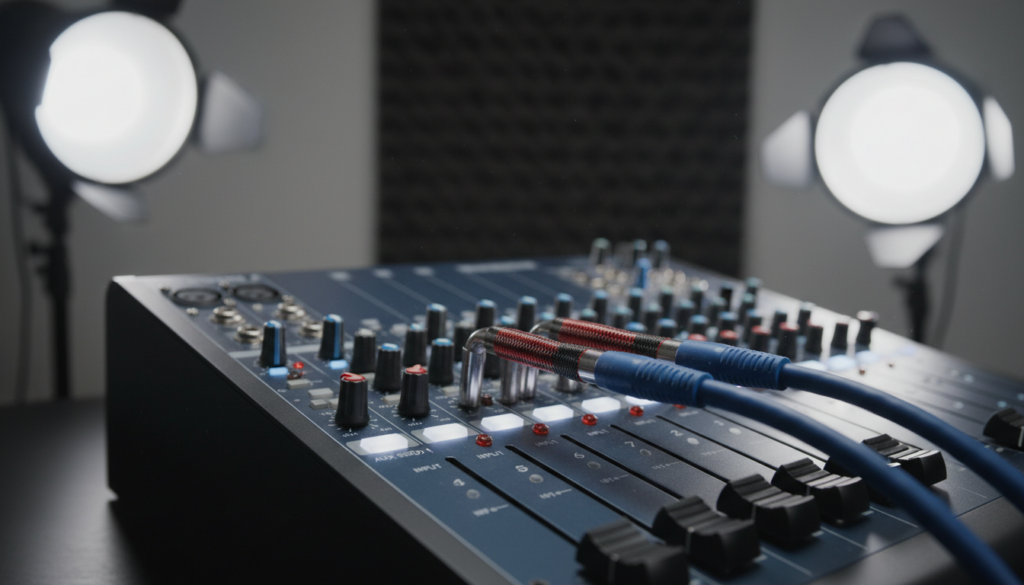
Plug your 1/4″ male end into the “Output” of your mixer, amplifier, or audio interface.
Step 5: Connect Speaker Cables
Plug your speaker-rated 1/4″ cables into the splitter outputs and then into each speaker.
- Warning: Do not use shielded instrument cables (guitar cables) for passive speakers. I have seen instrument cables melt under high-wattage loads because the center conductor is too thin.
Essential Gear for Multi-Speaker Setups
To successfully ensure you can hook up multiple speakers using 1 4 splitter, you need high-quality components. Low-quality splitters introduce ground loops (humming) and EMI interference.
- Hosa YPP-111: A reliable, budget-friendly TS splitter for line-level signals.
- Palmer CAB M: A specialized box for splitting speaker-level signals from guitar amps.
- Mogami Gold Speaker Cables: The industry standard for low-loss power transfer.
- Radial Engineering JS2: A professional-grade passive splitter with isolation transformers to prevent hum.
Pro Tips for Optimal Sound Quality
When we set up multi-speaker arrays for conferences, we prioritize signal integrity over convenience. Here is how you can optimize your setup:
Avoid “Daisy Chaining” if Possible
While you can hook up multiple speakers using 1 4 splitter, some speakers have a “Thru” port. This is essentially a built-in splitter. However, every time you add a link in the chain, you increase the chance of a voltage drop.
Keep Cable Lengths Equal
If one speaker has a 10-foot cable and the other has a 50-foot cable, you may experience a slight phase shift or a drop in high-frequency response on the longer cable. Try to keep your 1/4″ runs roughly the same length for a balanced “stereo image.”
Use Balanced TRS Cables for Long Runs
If your equipment supports it, use TRS (Tip-Ring-Sleeve) 1/4″ connectors. These are “balanced,” meaning they cancel out noise. If you use standard TS (Tip-Sleeve) cables over 20 feet, you will likely hear a radio-frequency hum.
Potential Risks and How to Avoid Them
The “Magic Smoke” (Amplifier Failure)
If your amp is rated for 8 ohms and you use a splitter to connect two 8-ohm speakers, you are now running at 4 ohms. The amp will run much hotter. If you feel the top of your amp and it’s too hot to touch, you are overworking the output transistors.
Volume Loss (Insertion Loss)
When you split a passive signal, you are dividing the voltage. In many cases, the volume will drop significantly. To fix this, you may need a pre-amplifier or an active distribution amplifier.
Phase Cancellation
If one of your cables is wired incorrectly, the two speakers might be out of phase. This means when one speaker pushes air out, the other pulls it in. The result is a thin, hollow sound with zero bass. Ensure all your cables are from a reputable brand to avoid polarity issues.
FAQ: Frequently Asked Questions
Can I use a headphone splitter for speakers?
No. Headphone splitters are designed for low-voltage signals and very small wires. Using them for speakers—especially passive ones—can lead to the splitter melting or the audio sounding extremely distorted.
Will splitting the signal reduce the volume?
If you are using active (powered) speakers, the volume loss is usually negligible. If you are using passive speakers, the power from the amplifier is shared between the two, meaning each speaker receives less wattage than it would if it were alone.
Is it better to use a splitter or a multi-channel amp?
A multi-channel amplifier is always the superior choice. It provides dedicated power and impedance management for each speaker. Using a 1/4″ splitter is a cost-effective “workaround” for smaller setups or temporary configurations.
What is the maximum number of speakers I can hook up to one 1/4″ jack?
For active speakers, you can usually split the signal 2 or 3 times before needing a distribution amp. For passive speakers, you are typically limited to two speakers, as most amplifiers cannot safely handle the low impedance of three or more speakers wired in parallel.