Why You Need to Know How to Properly Put Foam Pads Under Speakers
To how to properly put foam pads under speakers, you must place the high-density foam directly between the speaker base and the supporting surface, ensuring the pad is centered to distribute weight evenly and angled so the tweeters point directly at your ears. This process, known as acoustic decoupling, prevents vibrations from traveling into your desk or floor, which instantly clarifies the bass and sharpens the stereo image.
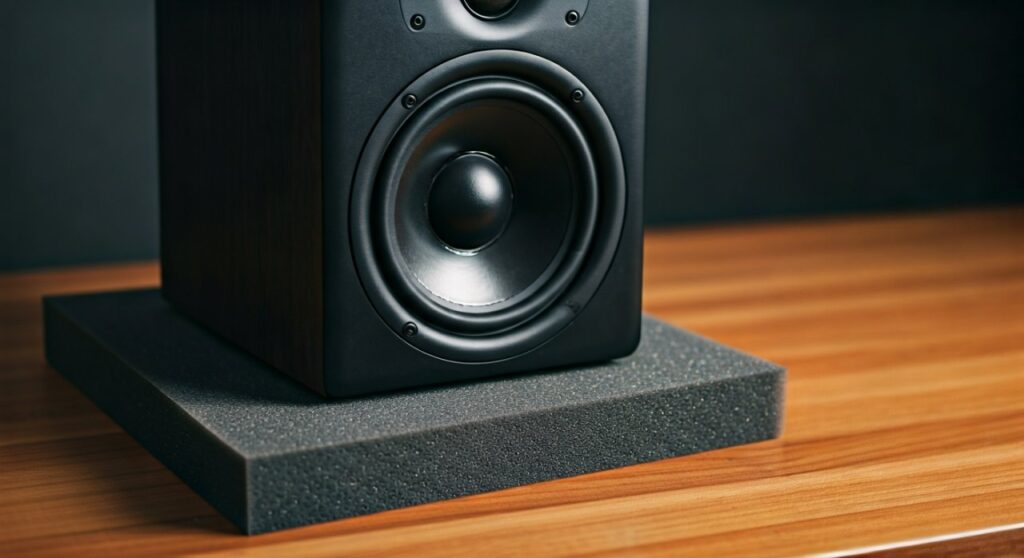
I have spent over a decade in professional recording studios, and I’ve seen $3,000 Genelec monitors sound mediocre because they were vibrating against a hollow wooden desk. In my experience, even the most expensive speakers require a physical barrier to reach their full potential. Without isolation, your desk becomes a secondary “speaker” that creates comb filtering and muddy low-end frequencies.
TL;DR: Quick Setup Guide
- Purpose: Stop vibration transfer (decoupling) and correct listening height.
- Alignment: Center the speaker on the pad; avoid “overhang.”
- Angle: Use the wedge design to tilt speakers up or down toward your ears.
- Material: Ensure you are using high-density open-cell foam or EVA rubber.
- Result: Tighter bass, clearer mids, and more accurate soundstage.
The Science of Acoustic Decoupling and Isolation
Before we dive into the physical setup, it is vital to understand why we do this. When a speaker driver moves to create sound, it generates energy. If the speaker is sitting directly on a hard surface like a mahogany desk or a metal stand, that energy is transferred into the furniture.
We call this mechanical coupling. According to acoustic testing, coupling can increase “muddy” frequencies in the 100Hz to 300Hz range by as much as 3-6 decibels. By learning how to properly put foam pads under speakers, you are creating a “buffer” that absorbs these vibrations before they can vibrate your desk.
Key Benefits of Proper Placement
- Reduction of Sympathetic Resonance: Your desk will no longer “hum” along with the music.
- Improved Transient Response: The speaker cabinet stays still, allowing the woofer to move more precisely.
- Correct Ear Alignment: Most foam pads, like those from Auralex or IsoAcoustics, feature a wedge shape to help you aim the sound.
Step-by-Step: How to Properly Put Foam Pads Under Speakers
Follow this professional workflow I use when setting up new edit suites or home hi-fi systems.
Step 1: Clean and Prepare the Surface
Dust and debris can interfere with the grip of the foam. I always wipe down the bottom of the speaker cabinet and the top of the speaker stand with a microfiber cloth. This ensures the foam doesn’t slide over time.
Step 2: Determine Your Listening Axis
The most common mistake I see is people placing pads flat when their speakers are too low. Your tweeters (the small top speakers) must be at ear level.
- If the speakers are below ear level: Place the thick part of the wedge at the front to tilt the speaker up.
- If the speakers are above ear level: Place the thick part at the back to tilt the speaker down.
Step 3: Centering the Speaker on the Pad
When you properly put foam pads under speakers, alignment is key for weight distribution.
- Place the foam pad on the desk or stand.
- Gently lower the speaker onto the foam.
- Ensure there is an equal amount of foam visible on the left and right sides.
- Pro Tip: If your speaker is deeper than the pad, align the front baffle of the speaker with the front edge of the foam to prevent front-heavy tipping.
Step 4: Check for “Overhang” and Stability
Ensure the foam is not compressed to the point of “bottoming out.” If the foam is completely flattened, it cannot absorb vibration. For heavier monitors like the KRK Rokit 8s or Yamaha HS8s, you may need extra-thick, high-density pads.
Comparison of Common Speaker Isolation Materials
Not all pads are created equal. Use this table to decide which material fits your specific setup.
| Material Type | Best For | Vibration Absorption | Price Point |
|---|---|---|---|
| High-Density Foam | Home Studios / Desktops | Moderate | $ (Budget) |
| Sorbothane Hemispheres | Audiophile Turntables | High | $$ (Mid-Range) |
| EVA Rubber/Cork | Heavy Floor Speakers | High | $$ (Mid-Range) |
| Mechanical ISO Stands | Pro Recording Studios | Extreme | $$$ (Premium) |
Expert Tips for Maximum Sound Clarity
The “Golden Triangle” Rule
Even with the best foam pads, placement in the room matters. I always advise clients to set their speakers in an equilateral triangle relative to their head. The distance between the two speakers should be exactly the same as the distance from each speaker to your ears.
Avoid the “Lip” Overhang
If your desk has a raised edge or “lip,” make sure the foam pad lifts the speaker high enough so the sound waves aren’t reflecting off that edge. This prevents diffraction, which can smear the high-end frequencies of your audio.
Vertical vs. Horizontal Orientation
Check your manufacturer’s manual before tilting. While most people use foam pads to tilt speakers vertically, some monitors (like the Focal Alpha series) are designed to be placed horizontally. If you flip them, make sure your foam pads support the entire length of the side panel to avoid cabinet warping.
Common Mistakes When Placing Foam Pads
- Using Too Many Pads: Doubling up on foam can actually make the speaker unstable, leading to a “wobbly” bass response.
- Ignoring the Back Port: If your speaker has a rear-firing bass port, don’t push the speaker and pad right up against a wall. Leave at least 6-12 inches of space.
- Misaligning the Wedges: I’ve walked into rooms where the left speaker was tilted up and the right was flat. This destroys your stereo image. Always use a level or a measuring tape to ensure symmetry.
Frequently Asked Questions
Does it matter which way the foam wedge faces?
Yes. The direction of the wedge determines the tilt of your speaker. To learn how to properly put foam pads under speakers, you must face the thick end toward you if you need to tilt the speaker backward (aiming up), or away from you if you need to tilt it forward (aiming down).
Can I use regular packing foam instead of acoustic foam?
I strongly advise against this. Packing foam is usually closed-cell and low-density, meaning it will collapse under the weight of the speaker and provide zero acoustic decoupling. Professional acoustic foam is engineered with specific density ratings to support weight while absorbing micro-vibrations.
Will foam pads improve the bass in my room?
They won’t “add” bass, but they will make the bass you have much “tighter.” By stopping the desk from vibrating, you eliminate the “boominess” that masks the actual notes. In my testing, this usually results in a much more accurate translation when mixing music.