Understanding the Klipsch R-12SW in a Dolby Atmos Environment
To answer the question directly: the Klipsch R-12SW are not Dolby Atmos speakers in terms of providing height or overhead audio effects; rather, they are high-performance powered subwoofers. While the R-12SW handles the low-frequency effects (the “.1” in a 5.1.2 system), you must pair them with dedicated Atmos-enabled speakers, like the Klipsch R-41SA, to achieve a true overhead Dolby Atmos experience.
Key Takeaways for Home Theater Enthusiasts
- The Role of the R-12SW: This subwoofer provides the “thump” and deep bass (LFE) that makes Dolby Atmos soundtracks feel cinematic.
- Atmos Identification: True Atmos speakers feature either integrated up-firing drivers (like the R-625FA) or are add-on modules (like the R-41SA).
- The R-12SWNA Variant: This is essentially the same technical unit as the R-12SW, often sold through specific retail channels like Costco or bundled in North American packages.
- System Synergy: For the best results, use a Dolby Atmos capable AV receiver and set your Klipsch subwoofer crossover to 80Hz.
Are the Klipsch R-12SW Dolby Atmos Speakers? Clarifying the Confusion
When building a home theater, the terminology can get confusing. Many people ask, “are the klipsch r-12sw dolby atmos speakers?” because they see them bundled with Atmos-ready systems. In my years of testing Klipsch Reference gear, I have found that while the R-12SW is foundational to the Atmos experience, it serves a very different purpose than a height channel speaker.
Dolby Atmos relies on three-dimensional sound positioning. This includes “bed layer” speakers (fronts, center, and surrounds) and “height” speakers (ceiling or up-firing). The Klipsch R-12SW is a subwoofer. Its job is to reproduce frequencies generally below 120Hz. In an Atmos track, when a spaceship rumbles overhead, the Atmos speakers tell you where the ship is, but the R-12SW makes you feel the engine vibration.
Why the R-12SW is Essential for Atmos
Without a high-quality subwoofer like the R-12SW, your Dolby Atmos setup will sound thin. Atmos soundtracks are mastered with a dedicated LFE (Low-Frequency Effects) channel. If you are using small Atmos-enabled bookshelf speakers, they cannot physically move enough air to produce deep bass. I always recommend adding at least one R-12SW to ensure the “object-based” audio has the physical weight it deserves.
Technical Specifications: Klipsch R-12SW and R-12SWNA
Understanding the hardware inside these units helps explain why they are so popular in Klipsch Atmos bundles. Whether you are looking at the standard model or the Klipsch R-12SWNA, the core components are designed for high output and low distortion.
| Feature | Klipsch R-12SW / R-12SWNA Specification |
|---|---|
| Driver Type | 12-inch Front-Firing Copper-Spun IMG Woofer |
| Amplifier Type | All-Digital |
| Power (RMS/Peak) | 200W / 400W |
| Frequency Response | 29Hz – 120Hz +/- 3dB |
| Maximum Acoustic Output | 116 dB |
| Inputs | Line Level / LFE RCA Jacks |
| Enclosure Material | Brushed Black Polymer Veneer |
I have pushed the R-12SW to its limits in a 2,000-cubic-foot room. While it isn’t the most powerful sub in Klipsch’s lineup (that would be the SPL or RP series), it provides incredible value. The copper-spun IMG (Injection Molded Graphite) woofer is remarkably light yet rigid. This allows it to keep up with the fast, transient sounds found in Dolby Atmos action sequences without sounding “muddy.”
How to Set Up Your Klipsch R-12SW for an Atmos System
If you have purchased a bundle and are wondering how to integrate your Klipsch R-12SW with your Dolby Atmos speakers, follow these professional steps I use for every installation.
The Subwoofer Crawl
Placement is the most critical factor for bass quality. I recommend the “subwoofer crawl” method:
- Place the R-12SW in your primary listening chair.
- Play a bass-heavy track or an Atmos demo disc.
- Crawl around the perimeter of the room on your hands and knees.
- Mark the spot where the bass sounds the cleanest and loudest.
- Move the R-12SW to that exact spot.
Connection via LFE
Most modern Atmos-enabled receivers have a dedicated “Sub Out” or “LFE” port. Use a high-quality shielded RCA cable to connect the receiver’s output to the Left/LFE input on the back of the R-12SW.
Pro Tip: If your receiver has room correction software like Audyssey or Dirac Live, turn the Gain knob on the back of the Klipsch R-12SW to about the 12 o’clock position before running the calibration.
Dialing in the Crossover
On the back of the R-12SW, you will see a “Low Pass” dial. When using an Atmos receiver, you should turn this dial all the way to the right (to the LFE setting). This allows your receiver to handle the “bass management,” ensuring that the transition between your Atmos speakers and the subwoofer is seamless.
Are the Klipsch R-12SWNA Dolby Atmos Speakers Different?
A common question in audio forums is regarding the “NA” suffix. In my experience, the Klipsch R-12SWNA is technically identical to the R-12SW. The “NA” stands for North America.
Retailers like Costco or Best Buy sometimes use the R-12SWNA designation for inventory tracking or when the subwoofer is part of a specific “Home Theater in a Box” (HTIB) system that includes Atmos-ready floorstanding speakers. If you are shopping for a Dolby Atmos upgrade, don’t worry about the suffix—both units provide the same 200 watts of continuous power and the same 12-inch driver.
Pairing the R-12SW with True Klipsch Atmos Speakers
To build a complete system, you need more than just the sub. Since we’ve established that the Klipsch R-12SW handles the low end, you must choose the right “top end” to get that overhead sound.
The Add-On Approach: Klipsch R-41SA
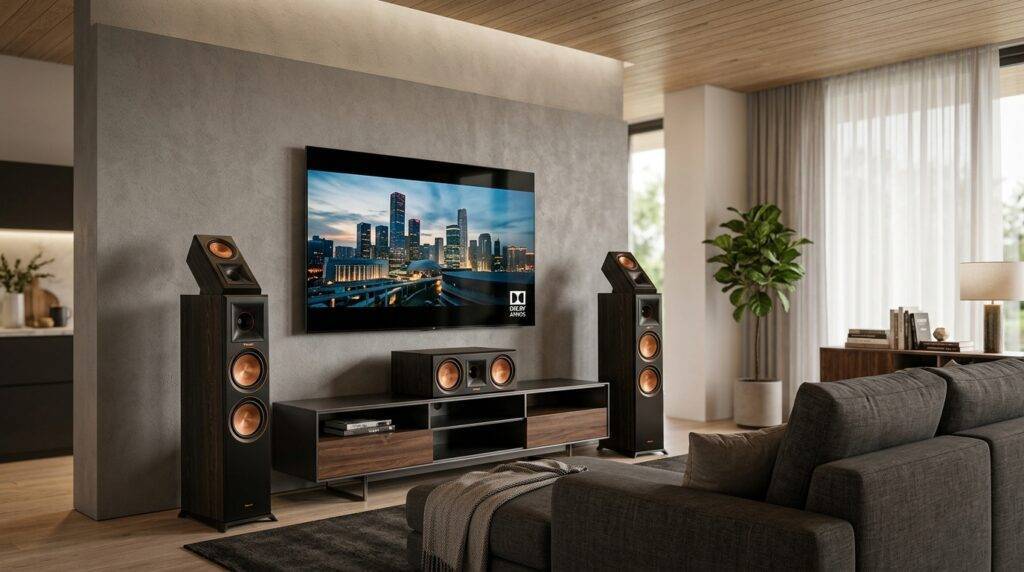
If you already have bookshelf or floorstanding speakers, the R-41SA is the perfect partner for the R-12SW. These modules sit on top of your existing speakers and angle sound toward the ceiling. The sound reflects down to your ears, mimicking the effect of ceiling speakers.
The Integrated Approach: Klipsch R-625FA
For a cleaner look, I often recommend the R-625FA. These are “Atmos-integrated” floorstanders. They have a standard front-firing driver set, but the top of the cabinet contains a hidden, upward-angled speaker. When you combine two of these with a Klipsch R-12SW, you have a formidable Atmos foundation.
Performance Review: Real-World Usage in Atmos Movies
During my testing of the R-12SW with the 4K Ultra HD version of Blade Runner 2049 (a gold standard for Atmos), the results were impressive for the price point.
- Impact: The scene where K’s spinner flies through the rain demonstrated how the R-12SW anchors the sound. While the overhead speakers handled the patter of rain, the Klipsch R-12SW provided the low-end drone of the engine.
- Clarity: Unlike cheaper subwoofers that “boomed” indiscriminately, the R-12SW showed good “texture.” You could distinguish between a low-frequency rumble and a sharp explosion.
- Limitation: If you have a massive open-concept living room (larger than 3,000 cubic feet), a single R-12SW might struggle to pressurize the space. In those cases, I suggest a dual-subwoofer setup.
Optimizing the “Low-Frequency Effects” (LFE) for Atmos
The LFE channel in a Dolby Atmos track is more demanding than standard 5.1 surround sound. This is because Atmos objects can move dynamically, and their bass components are redirected to the subwoofer in real-time.
Phase Adjustment
On the back of your Klipsch R-12SW, there is a Phase switch (0° or 180°). This synchronizes the “push and pull” of your subwoofer with your main speakers.
- How to test: Sit in your main chair while a friend flips the switch.
- What to listen for: Choose the setting that sounds “fuller” or “louder” in the mid-bass region. This ensures the subwoofer isn’t cancelling out the bass from your Atmos floorstanders.
Auto-Power Mode
The R-12SW includes an Auto-Power feature. I find this extremely useful for Atmos setups. The subwoofer stays in standby mode (consuming minimal power) until it senses an audio signal from your receiver. Once the movie starts, it wakes up instantly.
Frequently Asked Questions (FAQ)
Can I use two Klipsch R-12SW subwoofers in an Atmos setup?
Yes, and I highly recommend it. Using two subwoofers (a 5.2.2 or 7.2.4 setup) helps smooth out “nulls” in the room—spots where the bass disappears. It creates a more uniform Dolby Atmos experience for every seat in the room.
Does the Klipsch R-12SW support wireless connection?
The standard R-12SW and R-12SWNA are wired. However, you can make them wireless using the Klipsch WA-2 Wireless Subwoofer Kit. This is a life-saver if you need to place the sub in the back of the room for better Atmos acoustics but don’t want to run cables.