Can I Learn German with Native Speakers Online?
Yes, you can learn German with native speakers online through specialized tutoring platforms, language exchange apps, and structured virtual classrooms. This approach is widely considered the most effective way to achieve fluency, as it forces you to practice real-time listening and speaking while receiving immediate feedback on pronunciation and grammar.
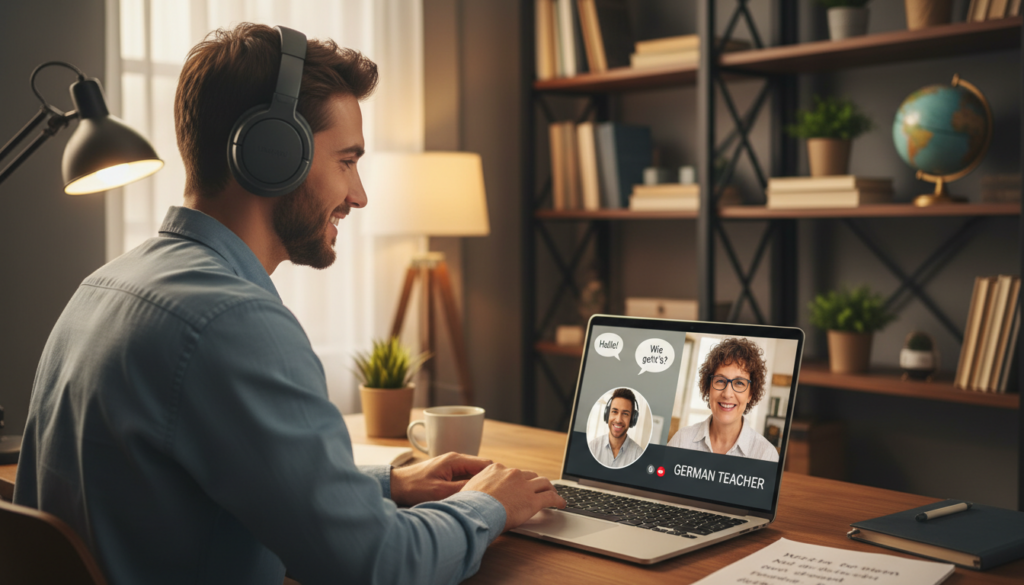
In my years of testing various language methodologies, nothing beats the “immersion from your couch” model. By connecting with a native German tutor, you bypass the robotic phrasing found in textbooks and instead learn authentic idioms, local slang, and the rhythmic flow of the language.
Key Takeaways for Fast Fluency
- Immediate Feedback: Native speakers correct your vowel shifts and word order (V2) instantly.
- Cultural Context: You learn “Social German,” not just “Academic German.”
- Affordability: Online platforms allow you to hire tutors from different regions, making private lessons accessible for any budget.
- Consistency: Booking a live session creates accountability that apps like Duolingo often lack.
Why You Should Learn German with Native Speakers Online
When I first started my German journey, I spent six months clicking through apps. I knew the words for “apple” and “bread,” but I froze the moment I stepped into a Berliner Späti. The missing link was human interaction.
Native speakers provide a level of Information Gain that software cannot replicate. They explain the “why” behind the Dative case in a way that feels intuitive rather than mechanical. Furthermore, online learning allows you to choose a tutor based on their regional accent. Whether you want to master the standard Hochdeutsch or prepare for a move to Munich with some Bavarian flair, the choice is yours.
The Benefits of 1-on-1 Instruction
- Customized Curriculum: Unlike a rigid classroom, a native tutor can focus entirely on your career-specific vocabulary or upcoming travel needs.
- Reduced Speaking Anxiety: Practicing in a safe, 1-on-1 digital environment builds the confidence needed for real-world conversations.
- Active Recall: Forcing your brain to retrieve words during a live conversation strengthens neural pathways faster than passive listening.
Top Platforms to Find Native German Tutors
Choosing the right platform is the most critical step in your journey. We have analyzed the top-tier services based on tutor quality, pricing, and user interface.
| Platform | Best For | Price Range (USD) | Key Feature |
|---|---|---|---|
| iTalki | Variety & Flexibility | $10 – $40 / hr | Huge selection of certified teachers and community tutors. |
| Preply | Beginner to Intermediate | $15 – $35 / hr | Excellent subscription model for consistent weekly habits. |
| Lingoda | Structured Curriculum | $12 – $20 / class | Small group classes following CEFR (A1-C2) standards. |
| Babbel Live | Integrated Learning | $15 – $30 / month | Unlimited group classes for a flat monthly fee. |
| Tandem | Casual Practice | Free | Language exchange with peers (no formal instruction). |
Step 1: Define Your “Why” and Your CEFR Goal
Before you book your first session to learn German with native speakers online, you must identify your target level. The Common European Framework of Reference for Languages (CEFR) is the gold standard for measuring proficiency.
- A1/A2 (Beginner): Focus on basic survival phrases, present tense, and essential nouns.
- B1/B2 (Intermediate): Focus on complex sentence structures, past tenses, and professional communication.
- C1/C2 (Advanced): Focus on nuanced expression, literature, and near-native fluency.
I recommend starting with a native speaker even at the A1 level. Getting your “Umlauts” (ä, ö, ü) right from day one prevents “fossilized errors” that are much harder to fix later.
Step 2: Selecting the Perfect Native German Tutor
Don’t just pick the first person you see. To maximize your ROI (Return on Investment), look for specific traits in a tutor’s profile.
Check for Certification
If you are preparing for a Goethe-Zertifikat or TestDaF, you need a Certified Teacher. These professionals have degrees in DaF (Deutsch als Fremdsprache) and understand the technicalities of German grammar.
Watch the Introduction Video
Pay attention to their accent and energy. You will be spending hours talking to this person; ensure their teaching style matches your personality. I personally look for tutors who use visual aids or digital whiteboards like Miro.
Read Student Reviews
Look for keywords like “patient,” “organized,” and “provided homework.” Avoid tutors who have a high number of cancellations, as consistency is the “secret sauce” to language acquisition.
Step 3: Preparing for Your First Online Session
The biggest mistake students make is showing up to a lesson with a “teach me” attitude. To truly learn German with native speakers online, you must be an active participant.
- Check Your Tech: Use a high-quality noise-canceling headset. Hearing the subtle difference between “ch” and “sch” sounds is vital.
- Prepare a “Cheat Sheet”: Keep a list of basic phrases like “Können Sie das bitte wiederholen?” (Can you repeat that, please?) and “Ich verstehe nicht” (I don’t understand) nearby.
- Set a Specific Topic: Tell your tutor, “Today I want to focus on ordering food at a restaurant” or “explaining my work history in the past tense.”
Step 4: The Core Learning Phase (The 80/20 Rule)
During your session, aim for the 80/20 rule: You should be speaking 80% of the time, and the tutor should be speaking/correcting 20% of the time.
Focus on Pronunciation
German is a phonetic language, meaning it is spoken exactly as it is written. However, the “R” sound (uvular fricative) and the “ch” sounds (Ich-Laut and Ach-Laut) require physical practice. Ask your tutor to watch your mouth movements on camera to provide corrections.
Embrace the Mistakes
We often feel embarrassed when we mess up German genders (Der, Die, Das). In my experience, native speakers don’t care if you get the gender wrong—they care if they can understand you. Focus on comprehensibility first, and perfection later.
Step 5: Post-Session Review and “Information Gain”
What you do after the lesson is just as important as the lesson itself.
- Review the Notes: Most platforms like iTalki have a chat box. Copy those corrections into a flashcard app like Anki or Quizlet.
- Record the Session: If your tutor allows it, record the Zoom or Skype call. Re-listening to your own voice helps you identify intonation patterns you missed during the live heat of the moment.
- Do the Homework: If your tutor assigns a writing task, do it. Writing reinforces the syntax you practiced orally.
Practical Tips for Staying Motivated
Learning a language is a marathon, not a sprint. To stay consistent while you learn German with native speakers online, integrate these habits:
The 15-Minute Rule: On days you don’t have a lesson, spend 15 minutes listening to a German podcast (like Easy German*) to keep your ears tuned to native speeds.
- Label Your House: Put sticky notes on your furniture with the German word and its gender.
- Change Your Phone Language: It sounds intimidating, but navigating your settings in German forces you to learn functional vocabulary quickly.
Common Pitfalls to Avoid
- Relying Solely on English: If your tutor speaks perfect English, you will be tempted to fall back on it. Challenge yourself to have “German-only” zones during the lesson.
- Ignoring Grammar Entirely: While speaking is key, German is a structural language. You cannot reach a B2 level without understanding Case endings and Adjective declension.
- Inconsistent Scheduling: One lesson every two weeks is not enough. Aim for at least two 45-minute sessions per week for noticeable progress.
FAQ: Learning German Online
Is it better to learn from a tutor or a language exchange partner?
A tutor is better for structured learning and correcting complex grammar. A language exchange partner is great for casual practice and “free” conversation, but they often lack the pedagogical skills to explain why something is wrong.
How many hours does it take to become fluent in German?
According to the FSI (Foreign Service Institute), German is a Category II language, taking approximately 750 class hours to reach professional proficiency. Working with native speakers online can often shorten this timeframe by increasing the intensity of your practice.
Can I learn German for free with native speakers?
Yes, apps like Tandem and HelloTalk connect you with natives for free. However, the “payment” is your time, as you must spend half the conversation teaching them your native language in return.
What is the best age to start learning German?
While children acquire languages faster, adults are often better at understanding the logic and structure of German grammar. With the right online native tutor, you can achieve fluency at any age.
Should I learn “Standard German” (Hochdeutsch) first?
Absolutely. Hochdeutsch is understood in Germany, Austria, and Switzerland. Once you have a solid foundation, you can then explore regional dialects like Schwiizertüütsch or Plattdeutsch.