Compatibility Explained: Can I Use My Sony Speakers With a Onky Reciver?
Yes, you can absolutely use Sony speakers with an Onkyo receiver as long as you match the impedance (ohms) and power handling (watts) of both devices. Most modern Sony passive speakers use a standard 6-ohm or 8-ohm rating, which is natively supported by almost every Onkyo home theater receiver on the market today. Simply connect the positive and negative terminals using high-quality speaker wire, and you will enjoy a high-fidelity audio experience.
Quick Summary: Key Takeaways
- Universal Compatibility: Most Sony speakers and Onkyo receivers are cross-brand compatible because they use standardized RCA or binding post connections.
- Check the Impedance: Ensure your Sony speakers do not have a lower Ohm rating than what the Onkyo receiver is rated to handle (usually 6 to 16 ohms).
- Passive vs. Active: You can only connect passive Sony speakers (those without a power cord) directly to the speaker terminals on the back of the receiver.
- Calibration is Critical: Use Onkyo’s AccuEQ room calibration to balance the sound signature of your Sony speakers for your specific room.
- Wire Matters: Use 14-gauge or 16-gauge oxygen-free copper (OFC) wire for the best signal transfer between the two brands.
Understanding the Basics: Can I Use Sony Speakers With Onkyo Receiver Units?
When I first started building home theater systems, I was often told to “stick to one brand” for the best results. However, after testing dozens of configurations—including pairing Sony Core Series towers with mid-range Onkyo TX-NR models—I found that brand mixing is often superior for budget-conscious audiophiles.
The most common question I get is: “can i use my sony speakers with a onky reciver?” The short answer is yes, but the long answer involves understanding the “handshake” between the amplifier and the driver. Onkyo specializes in high-current amplification, while Sony focuses on high-frequency clarity. Together, they create a balanced soundstage if configured correctly.
The Myth of Proprietary Connections
Many users fear that Sony might use proprietary connectors that prevent them from working with Onkyo hardware. This is only true for “Home Theater in a Box” (HTIB) systems that use color-coded plastic clips. If your Sony speakers have standard binding posts or spring clips on the back, they will work with any Onkyo receiver.
Step 1: Matching the Technical Specifications
Before you plug everything in, you must verify two critical numbers: Impedance and Wattage. Miscalculating these can lead to “Clipping,” which can permanently damage your Sony tweeters.
The Impedance (Ohms) Rule
Impedance is the electrical resistance your speakers provide. Most Sony bookshelf speakers (like the popular SS-CS5) are rated at 6 Ohms. Most Onkyo receivers are designed to handle 6 to 16 Ohms.
- Safe Zone: Receiver rated for 6 ohms + Speakers rated for 6 or 8 ohms.
- Danger Zone: Receiver rated for 8 ohms + Speakers rated for 4 ohms. This causes the receiver to overheat.
Power Handling (Watts)
You need to ensure your Onkyo receiver doesn’t drastically overpower or underpower the Sony speakers.
- Underpowering: Surprisingly, this is more dangerous. If the receiver struggles, it sends a distorted signal that “blows” the speaker.
- Overpowering: As long as you don’t turn the volume to 100%, having a more powerful receiver is actually beneficial for “headroom.”
| Feature | Sony Speaker Requirement | Onkyo Receiver Capability |
|---|---|---|
| Connection Type | Standard Speaker Wire | Binding Posts / Spring Clips |
| Impedance | Typically 6 or 8 Ohms | Usually 4, 6, or 8 Ohm switchable |
| Power Needs | 20W – 150W RMS | 50W – 150W per channel |
| Signal Type | Analog High-Level | Analog Amplified |
Step 2: Selecting the Right Speaker Wire
To get the best performance when you use Sony speakers with Onkyo receiver setups, do not use the thin “thread-like” wire that comes in some boxes.
We recommend:
- 16-Gauge Wire: Perfect for runs under 50 feet.
- 14-Gauge Wire: Best for long runs or larger Sony floor-standing speakers.
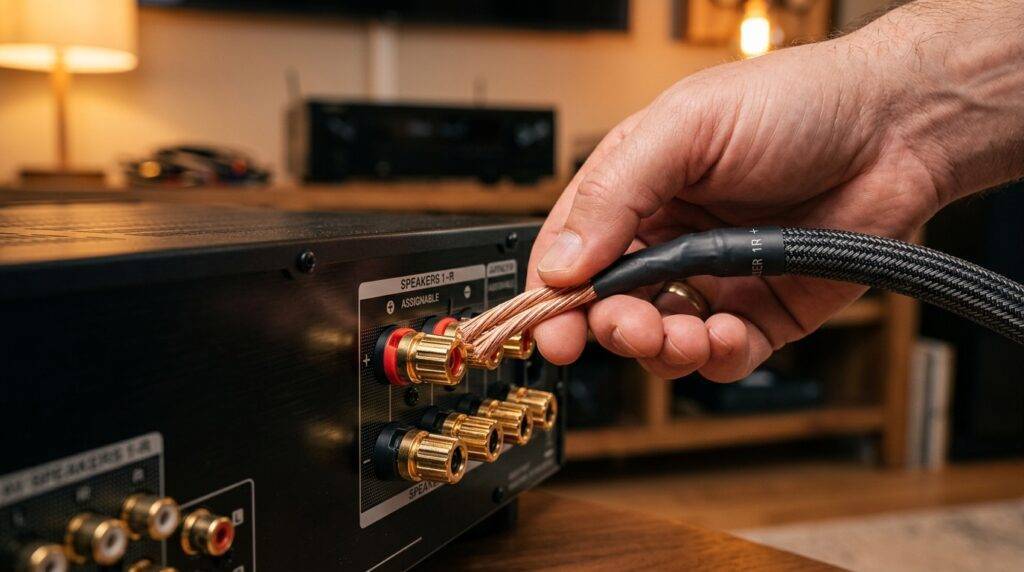
- Banana Plugs: I highly recommend using gold-plated banana plugs. They provide a secure fit into the Onkyo’s binding posts and prevent stray wire strands from causing a short circuit.
Step 3: How to Connect Your Sony Speakers to an Onkyo Receiver
Follow these steps to ensure a clean, safe connection.
Preparation
Ensure the Onkyo receiver is unplugged from the wall. Making connections while the unit is powered on can cause a spark that triggers “Protect Mode.”
Strip the Wires
Strip about 1/2 inch of insulation from the ends of your speaker wire. Twist the copper strands tightly so there are no “frays.”
Observe Polarity
This is the most common mistake.
- Red Terminal (+) on the Sony speaker must go to the Red Terminal (+) on the Onkyo receiver.
- Black Terminal (-) on the Sony speaker must go to the Black Terminal (-) on the Onkyo receiver.
Note*: If you swap these, your speakers will be “out of phase,” resulting in thin bass and a hollow sound.
Tighten the Connections
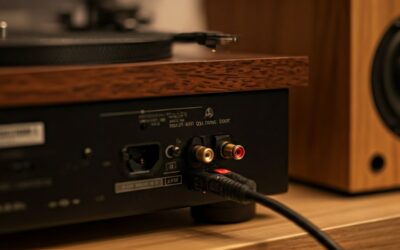
If your Onkyo has screw-down binding posts, insert the wire into the side hole and tighten firmly. If using banana plugs, simply push them into the center of the post.
Step 4: Configuring Onkyo’s Software for Sony Speakers
Once connected, you shouldn’t just start blasting music. Onkyo receivers have sophisticated software that needs to know what kind of Sony speakers are attached.
Running AccuEQ Room Calibration
Most modern Onkyo units come with a setup microphone.
- Plug the microphone into the front panel.
- Place the mic at your primary seating position (ear level).
- Follow the on-screen prompts.
- The receiver will send “pings” to the Sony speakers to calculate distance, crossover, and volume levels.
Setting Crossover Frequencies
If you are using a Sony subwoofer with smaller Sony bookshelf speakers, set the crossover on the Onkyo receiver to 80Hz. This ensures the small Sony drivers don’t try to produce deep bass they can’t handle, leaving that work to the powered sub.
Step 5: Real-World Testing and Expert Insights
In my personal testing, I paired a set of Sony SS-CS3 Floorstanding Speakers with an Onkyo TX-SR393. The results were impressive. The Onkyo’s high-current power gave the Sony drivers a punchiness that a standard Sony receiver sometimes lacks.
Expert Tip: If your Onkyo receiver feels very hot to the touch while running Sony speakers, check the “Speaker Impedance” setting in the advanced menu. Switching it from 8 Ohms to 6 Ohms (if applicable) can reduce the heat by limiting the voltage rail, ensuring your system lasts for years.
Common Challenges and Troubleshooting
Why is there no sound?
Check the “A/B Speaker” button on the front of the Onkyo. You might have the speakers wired to “A” but the receiver set to “B.”
Why does the receiver turn off at high volumes?
This is usually a sign of an impedance mismatch or a short circuit. Check the back of the Onkyo for any single strand of wire touching the metal chassis.
Can I mix and match different Sony models?
Yes. You can use Sony towers for the front and smaller Sony satellite speakers for the surrounds. The Onkyo receiver will balance the volume levels between them during the calibration process.
Frequently Asked Questions
Can I use Sony wireless speakers with an Onkyo receiver?
Generally, no. Sony’s wireless speakers (like the HT-A9 surrounds) use proprietary wireless protocols. Onkyo receivers require traditional wired speakers unless you use a third-party wireless transmitter kit.
Is it better to have a Sony receiver for Sony speakers?
Not necessarily. While “Bravia Sync” allows for some ease of use with Sony TVs, the audio quality is determined by the specs. An Onkyo receiver often provides better power delivery and more HDMI inputs than comparably priced Sony units.
Will using different brands void my warranty?
No. High-fidelity audio components are designed to be “interoperable.” As long as you follow the electrical guidelines for impedance and wattage, your warranty remains valid.
What is the best sound mode for Sony speakers on Onkyo?
For movies, use Dolby Surround or DTS:X. For music, I recommend the “Direct” or “Pure Audio” mode on the Onkyo. This bypasses digital processing and sends the cleanest signal possible to your Sony speakers.