Choosing the Right Gauge for Marine Audio Success
When determining what gauge wire for marine speakers you need, the standard choice for most boat installations is 16-gauge (AWG) tinned copper wire for runs under 20 feet. For longer runs or high-power subwoofers, you should upgrade to 14-gauge or even 12-gauge wire to prevent signal degradation and power loss. Always ensure you are using marine-grade multi-strand wire that is specifically rated for the harsh, corrosive environment of the open water.
Installing a sound system on a boat isn’t like doing a quick swap in a car; the salt air, high humidity, and constant vibrations will eat standard copper wire alive within a single season. We have seen countless “DIY” boat audio projects fail because the owner used standard automotive primary wire. By following the standards set by the ABYC (American Boat and Yacht Council) and choosing the correct gauge, you ensure your speakers deliver crisp audio without overheating your amplifier or suffering from “voltage drop.”
TL;DR: Marine Speaker Wiring Key Takeaways
- Standard Distance (0-20 ft): Use 16 AWG tinned marine wire.
- Long Distance (20-50 ft): Use 14 AWG to combat resistance.
- Subwoofers/High Power: Use 12 AWG for maximum current delivery.
- Material Matters: Only use Tinned Oxygen-Free Copper (OFC); avoid CCA (Copper Clad Aluminum).
- Protection: Use adhesive-lined heat shrink on all connections to prevent “wicking” corrosion.
Understanding What Gauge Wire for Marine Speakers You Actually Need
In our years of refitting center consoles and pontoon boats, we’ve found that the “bigger is better” rule generally applies to wire, but it must be balanced with the difficulty of routing thick cables through tight fiberglass hulls. Wire gauge is measured by AWG (American Wire Gauge); the smaller the number, the thicker the wire.
The primary enemy of your boat’s audio is resistance. As electrical signals travel through a wire, they lose energy in the form of heat. If your wire is too thin (high gauge number) for the length of the run, your speakers will sound distorted, and your amplifier will work harder than it needs to.
Marine Wire Gauge Selection Table
| Speaker Type | Run Length (ft) | Recommended Gauge (AWG) | Why? |
|---|---|---|---|
| Standard Coaxial | 0 – 20 | 16 AWG | Minimal resistance for 50-75W RMS. |
| Standard Coaxial | 20 – 50 | 14 AWG | Prevents signal loss over distance. |
| Marine Subwoofer | 0 – 30 | 12 AWG | Handles high current bursts for bass. |
| Tower Speakers | 20 – 40 | 14 AWG | High power requirements for “throw.” |
| Tweeters | 0 – 15 | 18 AWG | Low current requirements. |
Why Marine-Grade Tinned Copper is Non-Negotiable
You might be tempted to use leftover speaker wire from a home theater project, but we strongly advise against it. Standard copper wire is highly “hygroscopic”—it draws moisture into the strands through a process called capillary action. Once moisture enters, the copper oxidizes, turning green and becoming highly resistive.
Tinned Copper Wire is the industry gold standard. Each individual strand of copper is coated in a thin layer of tin. This creates a barrier against oxidation and corrosion. Look for brands like Ancor, Blue Sea Systems, or Stinger Marine. These manufacturers ensure their wire meets UL1426 standards, which means the insulation is resistant to oil, gas, and UV rays—all common elements in a boat’s bilge or deck area.
The Danger of CCA (Copper Clad Aluminum)
Many “budget” wiring kits found online use CCA. While it looks like copper, it is actually aluminum with a thin copper plating. Aluminum is much more brittle and corrodes significantly faster in saltwater environments. In our testing, CCA wire can lose up to 50% of its conductivity in just one season of coastal use. Always verify that your wire is 100% Oxygen-Free Copper (OFC).
Step-by-Step Guide: How to Wire Your Marine Speakers
Wiring a boat requires a different approach than a car or home. You are dealing with bulkheads, stringers, and the constant threat of water intrusion. Follow these steps to ensure a professional-grade installation.
Plan Your Wire Routes**
Start by mapping out where your Marine Head Unit or Amplifier is located in relation to the speakers. Avoid running speaker wires directly alongside high-current power cables (like battery cables) to prevent induced “engine hum” or electromagnetic interference.
Measure and Cut with “Slack”**
When measuring what gauge wire for marine speakers to cut, always add an extra 2-3 feet to your estimate. Boats flex and vibrate; you need “service loops” at both ends so the wire isn’t under constant tension.
Fishing the Wire**
Use a fiberglass fish tape or a “glow rod” to pull the wire through the gunwales or behind the hull liner. We recommend pulling a “chase string” along with your wire. This way, if you ever want to add more speakers or lighting later, you already have a pull-line in place.
Terminating the Connections**
This is where most DIY projects fail. Follow these sub-steps for a permanent connection:
- Strip about 1/2 inch of insulation using a quality wire stripper.
- Slide a piece of adhesive-lined heat shrink onto the wire before connecting.
- Use marine-grade crimp connectors (usually nylon-insulated).
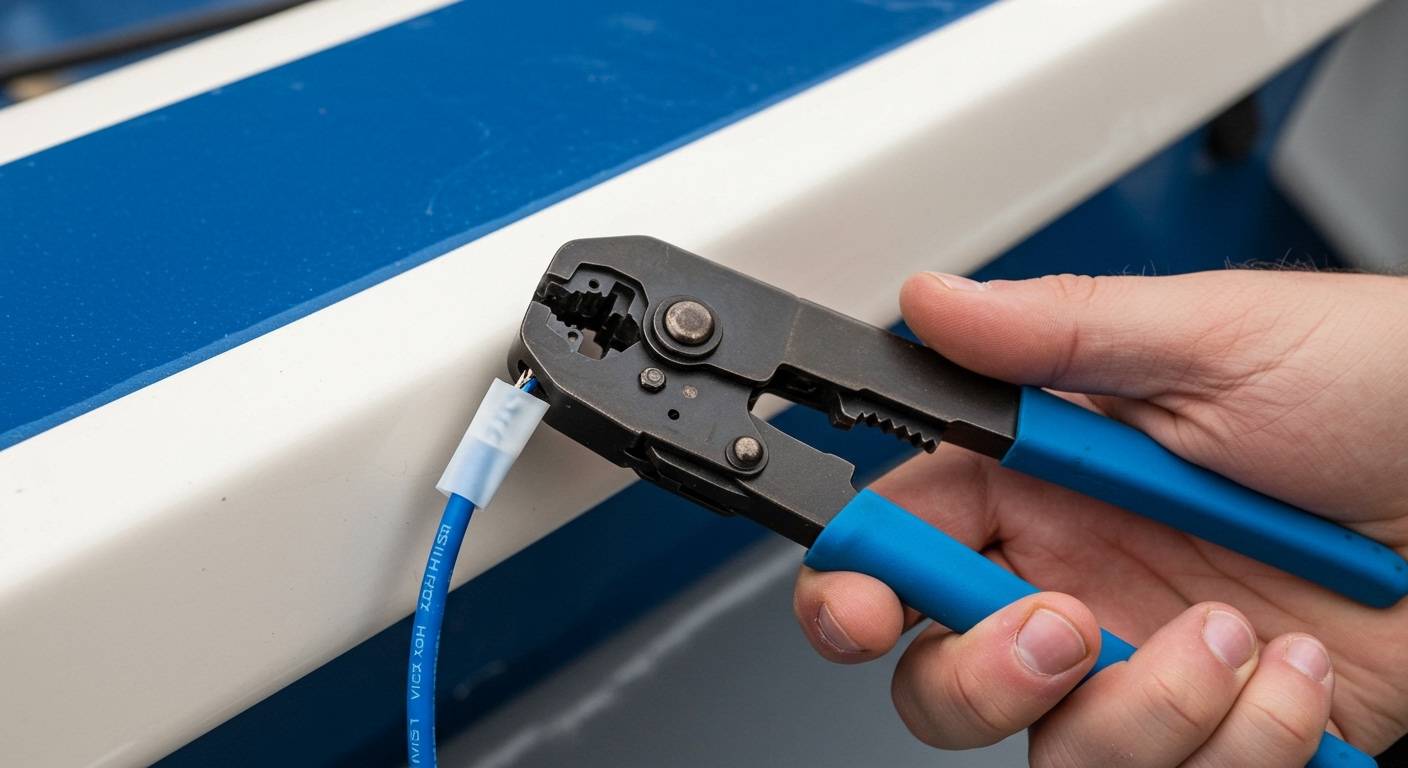
- Crimp using a ratcheting tool to ensure a mechanical bond.
- Slide the heat shrink over the connector and use a heat gun until the internal adhesive “oozes” out. This creates a waterproof seal.
Understanding Series vs. Parallel Wiring in Marine Applications
When you have multiple pairs of speakers but a limited number of amplifier channels, you need to understand how wiring affects impedance (Ohms). If you choose the wrong configuration, you could trigger the “protection mode” on your amp or even fry the internal circuitry.
Parallel Wiring (Most Common)
In parallel wiring, you connect the positive (+) of both speakers to the positive terminal of the amp, and the negative (-) to the negative.
- Result: This drops the resistance. Two 4-ohm speakers wired in parallel create a 2-ohm load.
- Expert Tip: Ensure your amplifier is “2-ohm stable” before doing this. Most modern marine amps from JL Audio or Fusion handle this easily.
Series Wiring
In series wiring, you connect the positive of the amp to the positive of speaker A, the negative of speaker A to the positive of speaker B, and the negative of speaker B back to the negative of the amp.
- Result: This increases resistance. Two 4-ohm speakers in series create an 8-ohm load.
- Usage: Use this if your amplifier is not rated for low impedance or if you are trying to bridge channels for a specific power output.
Essential Tools and Materials Checklist
Before you begin your project, ensure you have these “pro-level” materials on hand. Having the right tools makes the difference between a 2-hour job and a 2-day headache.
- Tinned Copper Wire: Based on our what gauge wire for marine speakers chart.
- Ratcheting Crimp Tool: Provides consistent pressure that manual “pliers-style” crimpers can’t match.
- Marine Heat Shrink Tubing: Must be adhesive-lined (dual-wall).
- Nylon Cable Ties (UV Rated): For securing wire every 18 inches to prevent “chafing.”
- Dielectric Grease: Apply a small amount to terminals to further repel moisture.
- Multimeter: Essential for checking continuity and ensuring you don’t have a short circuit before powering up the system.
Avoiding Common Marine Wiring Mistakes
We’ve fixed hundreds of botched boat stereo installs. Here are the “red flags” you should avoid:
- Using Electrical Tape: Never use electrical tape as a primary sealant on a boat. The adhesive fails in the heat, and it provides zero protection against moisture wicking.
- Loose Wires in the Bilge: Wires should never be allowed to “dangle.” If a wire falls into the bilge water, it will eventually fail. Secure all runs high up under the gunwales.
- Mixing Gauges: While you can use a thicker wire than necessary, never “daisy chain” a thick wire into a much thinner wire mid-run. This creates a bottleneck and potential heat point.
- Ignoring the Fuse: Even though we are discussing speaker wire, ensure your Amplifier Power Wire is fused within 12-18 inches of the battery. An unfused wire is a fire hazard on a boat.
Frequently Asked Questions (FAQ)
Can I use 18-gauge wire for marine speakers?**
You can use 18 AWG wire for very short runs (under 10 feet) to small tweeters or low-power speakers (under 30W RMS). However, for standard 6.5-inch or 7.7-inch marine speakers, 18-gauge is generally too thin and will result in noticeable power loss and poor bass response.
How do I know if my wire is “marine grade”?**
Look for the ABYC or UL1426 print on the wire jacket. Marine-grade wire will also feature tinned strands (they look silver, not copper-colored) and a more flexible, heavy-duty jacket designed to withstand vibration and temperature extremes.
Does the gauge of the wire affect sound quality?**
Directly, yes. If the wire is too thin for the distance, the damping factor of your amplifier is reduced. This results in “muddy” bass and a loss of high-frequency clarity. Using the correct gauge wire for marine speakers ensures the amplifier can “control” the speaker cone effectively.
Should I solder my marine speaker connections?**
Surprisingly, no. The ABYC recommends against using solder as the sole mechanical connection on boats. Solder creates a “stiff” spot in the wire that is prone to cracking due to the high-frequency vibrations of a boat engine. A high-quality crimp connection with heat shrink is the preferred industry standard.
Is 14-gauge wire overkill for a small boat?**
Not at all. While 16 AWG is the standard, 14 AWG provides more “headroom” for future upgrades. If you plan on adding a high-powered amplifier later, having 14-gauge wire already in the walls will save you from having to pull new wires again.