

Master the Art of Professional Klipsch Speaker Installation
To how to hang klipsch speakers effectively, you must identify your speaker’s mounting type (keyhole, threaded insert, or bracket), locate a wall stud for stability, and position the tweeter at ear level for the optimal Tractrix® Horn performance. Whether you are setting up a Reference Premiere home theater or AW-series outdoor speakers, the goal is to secure the weight while maximizing the soundstage.
Expert Summary: Key Takeaways
Safety First: Always prioritize mounting into a wall stud or using toggle bolts rated for at least double the speaker’s weight.
Optimal Height: For most Klipsch surround speakers, aim for 1-2 feet above ear level when seated to create an immersive atmosphere.
Wire Management: Use CL2 or CL3 rated in-wall speaker wire if you are running cables behind drywall to comply with fire codes.
The Klipsch Edge: Leverage the built-in keyhole mounts found on many Reference Series models for a flush, clean aesthetic.
Tools and Materials Needed for Installation
Before you begin learning how to install Klipsch speakers, gather these essential tools to ensure a smooth, professional-grade setup.
| Tool/Material | Purpose | Expert Recommendation |
|---|---|---|
| Stud Finder | Locates wood/metal studs behind drywall | Magnetic or Electronic (e.g., Franklin Sensors) |
| Level | Ensures the speaker is perfectly horizontal | 9-inch Torpedo Level |
| Power Drill | Driving screws and pilot holes | 18V Cordless Drill |
| Speaker Wire | Connects speakers to the AV Receiver | 14-gauge or 16-gauge oxygen-free copper |
| Wall Anchors | Provides support if a stud isn’t available | Toggle Bolts (avoid plastic expansion plugs) |
| Wire Strippers | Removes insulation from speaker cables | Self-adjusting strippers |
| Pencil/Masking Tape | Marking drill points without staining walls | Painter’s blue tape |
Step 1: Planning Your Klipsch Speaker Placement
The secret to how to mount Klipsch speakers successfully lies in the physics of sound. Klipsch speakers are famous for their controlled directivity, meaning where you point them matters more than other brands.
Determining the “Sweet Spot”
For a standard 5.1 or 7.1 setup, your Klipsch surround speakers should be positioned to the sides or slightly behind the listening area. I have found that placing them at a 90° to 110° angle relative to the listener provides the most realistic surround effects.
Height Matters for Surround Sound
When you mount Klipsch speakers on a wall, do not place them too high. If the Tractrix® Horn is near the ceiling, the sound will bounce awkwardly. Aim for 5 to 6 feet from the floor, which usually clears the back of your sofa while keeping the high frequencies crisp.
Step 2: How to Hang Klipsch Speakers Using Keyhole Mounts
Most Klipsch Reference and Reference Premiere bookshelf and surround models (like the RP-502S) come with pre-installed keyhole mounts.
- Measure the Distance: Measure from the top of the speaker to the center of the keyhole. This ensures your speaker sits exactly where you marked the wall.
- Locate the Stud: Use your stud finder. If you are lucky enough to have a stud where you want the speaker, use a #8 or #10 wood screw.
- Install the Screw: Drive the screw into the wall, leaving about 1/8 to 1/4 inch of the head protruding.
- The “Drop” Test: Carefully slide the speaker keyhole over the screw head. You should feel it “lock” into the narrow part of the channel.
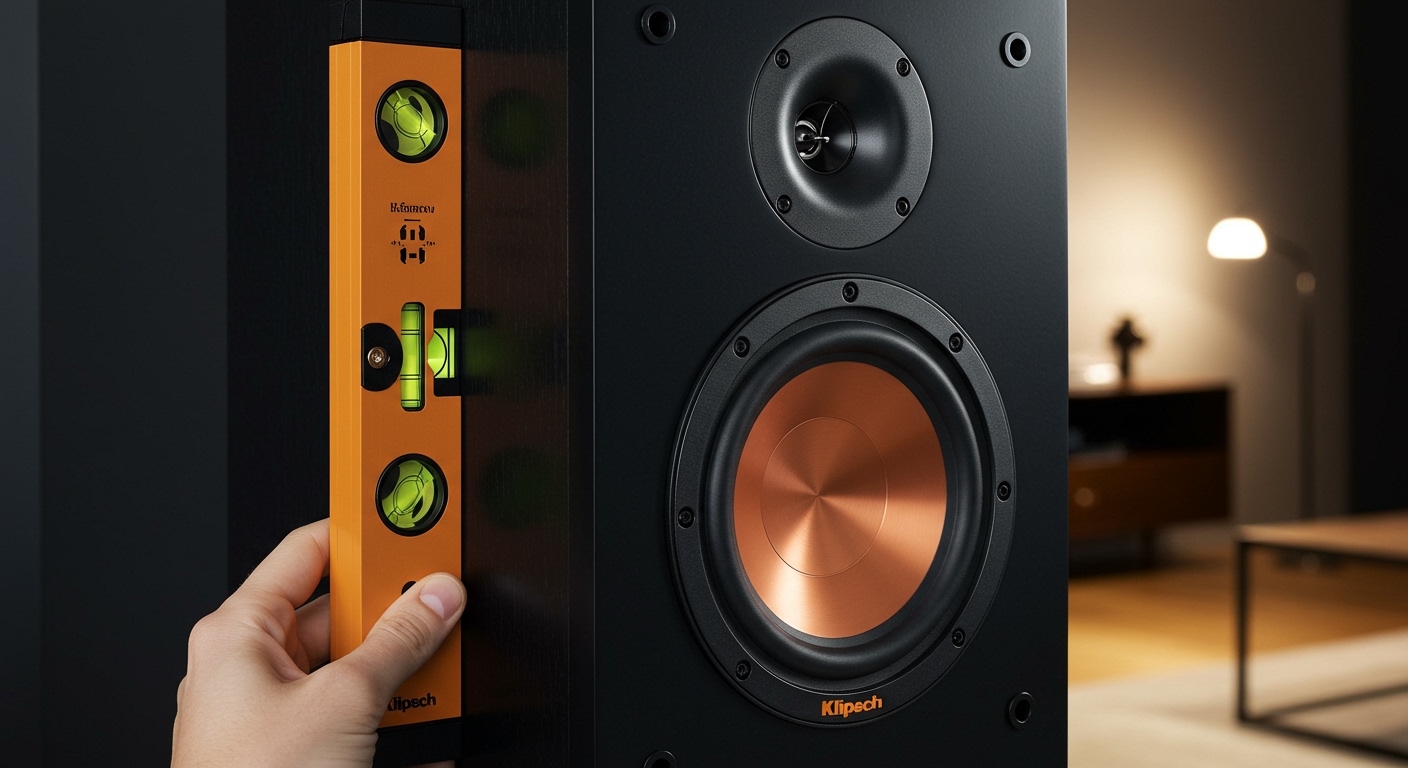
- Level Check: Place your level on top of the speaker. Adjust the screw depth if the speaker feels loose or tilts forward.
Step 3: How to Mount Klipsch Speakers with Threaded Inserts
Higher-end models often feature a 1/4”-20 threaded insert on the back or bottom. This is the gold standard for how to mount Klipsch surround speakers because it allows for articulating brackets.
Choosing the Right Bracket
Select a bracket rated for your speaker’s weight. For a Klipsch RP-140SA, a medium-duty bracket is fine. For larger monitors, look for heavy-duty steel mounts.
- Attach Bracket to Wall: Secure the wall plate into a stud using the provided lag bolts.
- Attach Arm to Speaker: Thread the mounting bolt into the back of the Klipsch speaker. Do not over-tighten, as you could strip the internal housing.
- Join the Two Pieces: Slide the speaker arm into the wall plate and tighten the adjustment nut.
- Aiming: Tilt the speaker slightly downward toward the primary listening position to optimize the high-frequency dispersion.
Step 4: How to Install Klipsch In-Wall Speakers
Installing Klipsch in-wall speakers (like the PRO-180RPW) requires a bit more “surgery” but offers a stunning, invisible look.
- Trace the Template: Use the cardboard template provided in the box. Use a level to ensure the cutout will be straight.
- Check for Obstructions: Use a small pilot hole or a “coat hanger” probe to check for wires or pipes behind the drywall.
- Cut the Drywall: Use a drywall saw to cut along your traced line. Vacuum as you go to minimize dust.
- Connect the Wires: Pull your CL3 speaker wire through the hole and connect to the spring-loaded terminals on the Klipsch speaker.
- Engage the Dog-Legs: Insert the speaker into the hole. Use a screwdriver (not a drill, to avoid cracking the frame) to tighten the screws. This flips out the “dog-leg” brackets that grip the drywall from the inside.
- Attach the Grille: Klipsch uses magnetic grilles that snap right into place.
Step 5: How to Install Klipsch Outdoor Speakers
Learning how to install Klipsch outdoor speakers (like the AW-650) involves weatherproofing and specific hardware.
The C-Bracket Method
Most Klipsch outdoor speakers utilize a heavy-duty zinc-plated C-bracket.
Mounting Surface: Try to mount under an eave or soffit. This provides extra protection from direct rain and sun, extending the life of the UV-resistant cabinet.
Vertical vs. Horizontal: You can mount them either way. Just ensure the Klipsch logo is oriented correctly (it usually rotates!).
Drip Loop: This is a pro tip. Leave a small loop of wire hanging below the entry point into the wall. This prevents rainwater from “running” down the wire and into your home’s structure.
Expert Tips for the Best Klipsch Experience
Based on years of home theater calibrations, here are the “insider secrets” for Klipsch speaker installation:
Toe-In Technique: Because of the 90×90 Tractrix® Horn, Klipsch speakers have a wide soundstage. I recommend a slight “toe-in” (turning the speakers toward the listener) of about 15 degrees to sharpen the center image.
Avoid Corners: Placing a rear-ported Klipsch speaker (like the RP-600M) directly in a corner can cause “boomy” or muddy bass. Keep them at least 12 inches away from the wall if they are on stands, or use the foam bungs if wall-mounting.
Calibration: After you wall mount Klipsch speakers, always run your receiver’s room correction software (like Audyssey or Dirac Live). This compensates for the wall’s boundary interference.
Master the Art of Professional Klipsch Speaker Installation
To how to hang klipsch speakers effectively, you must identify your speaker’s mounting type (keyhole, threaded insert, or bracket), locate a wall stud for stability, and position the tweeter at ear level for the optimal Tractrix® Horn performance. Whether you are setting up a Reference Premiere home theater or AW-series outdoor speakers, the goal is to secure the weight while maximizing the soundstage.
Expert Summary: Key Takeaways
Safety First: Always prioritize mounting into a wall stud or using toggle bolts rated for at least double the speaker’s weight.
Optimal Height: For most Klipsch surround speakers, aim for 1-2 feet above ear level when seated to create an immersive atmosphere.
Wire Management: Use CL2 or CL3 rated in-wall speaker wire if you are running cables behind drywall to comply with fire codes.
The Klipsch Edge: Leverage the built-in keyhole mounts found on many Reference Series models for a flush, clean aesthetic.
Tools and Materials Needed for Installation
Before you begin learning how to install Klipsch speakers, gather these essential tools to ensure a smooth, professional-grade setup.
| Tool/Material | Purpose | Expert Recommendation |
|---|---|---|
| Stud Finder | Locates wood/metal studs behind drywall | Magnetic or Electronic (e.g., Franklin Sensors) |
| Level | Ensures the speaker is perfectly horizontal | 9-inch Torpedo Level |
| Power Drill | Driving screws and pilot holes | 18V Cordless Drill |
| Speaker Wire | Connects speakers to the AV Receiver | 14-gauge or 16-gauge oxygen-free copper |
| Wall Anchors | Provides support if a stud isn’t available | Toggle Bolts (avoid plastic expansion plugs) |
| Wire Strippers | Removes insulation from speaker cables | Self-adjusting strippers |
| Pencil/Masking Tape | Marking drill points without staining walls | Painter’s blue tape |
Step 1: Planning Your Klipsch Speaker Placement
The secret to how to mount Klipsch speakers successfully lies in the physics of sound. Klipsch speakers are famous for their controlled directivity, meaning where you point them matters more than other brands.
Determining the “Sweet Spot”
For a standard 5.1 or 7.1 setup, your Klipsch surround speakers should be positioned to the sides or slightly behind the listening area. I have found that placing them at a 90° to 110° angle relative to the listener provides the most realistic surround effects.
Height Matters for Surround Sound
When you mount Klipsch speakers on a wall, do not place them too high. If the Tractrix® Horn is near the ceiling, the sound will bounce awkwardly. Aim for 5 to 6 feet from the floor, which usually clears the back of your sofa while keeping the high frequencies crisp.
Step 2: How to Hang Klipsch Speakers Using Keyhole Mounts
Most Klipsch Reference and Reference Premiere bookshelf and surround models (like the RP-502S) come with pre-installed keyhole mounts.
- Measure the Distance: Measure from the top of the speaker to the center of the keyhole. This ensures your speaker sits exactly where you marked the wall.
- Locate the Stud: Use your stud finder. If you are lucky enough to have a stud where you want the speaker, use a #8 or #10 wood screw.
- Install the Screw: Drive the screw into the wall, leaving about 1/8 to 1/4 inch of the head protruding.
- The “Drop” Test: Carefully slide the speaker keyhole over the screw head. You should feel it “lock” into the narrow part of the channel.
- Level Check: Place your level on top of the speaker. Adjust the screw depth if the speaker feels loose or tilts forward.
Step 3: How to Mount Klipsch Speakers with Threaded Inserts
Higher-end models often feature a 1/4”-20 threaded insert on the back or bottom. This is the gold standard for how to mount Klipsch surround speakers because it allows for articulating brackets.
Choosing the Right Bracket
Select a bracket rated for your speaker’s weight. For a Klipsch RP-140SA, a medium-duty bracket is fine. For larger monitors, look for heavy-duty steel mounts.
- Attach Bracket to Wall: Secure the wall plate into a stud using the provided lag bolts.
- Attach Arm to Speaker: Thread the mounting bolt into the back of the Klipsch speaker. Do not over-tighten, as you could strip the internal housing.
- Join the Two Pieces: Slide the speaker arm into the wall plate and tighten the adjustment nut.
- Aiming: Tilt the speaker slightly downward toward the primary listening position to optimize the high-frequency dispersion.
Step 4: How to Install Klipsch In-Wall Speakers
Installing Klipsch in-wall speakers (like the PRO-180RPW) requires a bit more “surgery” but offers a stunning, invisible look.
- Trace the Template: Use the cardboard template provided in the box. Use a level to ensure the cutout will be straight.
- Check for Obstructions: Use a small pilot hole or a “coat hanger” probe to check for wires or pipes behind the drywall.
- Cut the Drywall: Use a drywall saw to cut along your traced line. Vacuum as you go to minimize dust.
- Connect the Wires: Pull your CL3 speaker wire through the hole and connect to the spring-loaded terminals on the Klipsch speaker.
- Engage the Dog-Legs: Insert the speaker into the hole. Use a screwdriver (not a drill, to avoid cracking the frame) to tighten the screws. This flips out the “dog-leg” brackets that grip the drywall from the inside.
- Attach the Grille: Klipsch uses magnetic grilles that snap right into place.
Step 5: How to Install Klipsch Outdoor Speakers
Learning how to install Klipsch outdoor speakers (like the AW-650) involves weatherproofing and specific hardware.
The C-Bracket Method
Most Klipsch outdoor speakers utilize a heavy-duty zinc-plated C-bracket.
Mounting Surface: Try to mount under an eave or soffit. This provides extra protection from direct rain and sun, extending the life of the UV-resistant cabinet.
Vertical vs. Horizontal: You can mount them either way. Just ensure the Klipsch logo is oriented correctly (it usually rotates!).
Drip Loop: This is a pro tip. Leave a small loop of wire hanging below the entry point into the wall. This prevents rainwater from “running” down the wire and into your home’s structure.
Expert Tips for the Best Klipsch Experience
Based on years of home theater calibrations, here are the “insider secrets” for Klipsch speaker installation:
Toe-In Technique: Because of the 90×90 Tractrix® Horn, Klipsch speakers have a wide soundstage. I recommend a slight “toe-in” (turning the speakers toward the listener) of about 15 degrees to sharpen the center image.
Avoid Corners: Placing a rear-ported Klipsch speaker (like the RP-600M) directly in a corner can cause “boomy” or muddy bass. Keep them at least 12 inches away from the wall if they are on stands, or use the foam bungs if wall-mounting.
Calibration: After you wall mount Klipsch speakers, always run your receiver’s room correction software (like Audyssey or Dirac Live). This compensates for the wall’s boundary interference.
Common Mistakes to Avoid
Using Drywall Plugs: Never trust a 15lb Klipsch Reference speaker to a plastic yellow drywall plug. They will eventually pull out. Use SnapToggle bolts if a stud is unavailable.
Improper Wire Gauge: For runs over 50 feet, avoid 18-gauge wire. Use 14-gauge to prevent signal loss and maintain the high sensitivity Klipsch is known for.
Mounting Too High: Avoid the “TV near the ceiling” mistake. Sound should feel like it’s coming from the screen, not the sky.
Frequently Asked Questions
(FAQs)
Can I mount Klipsch bookshelf speakers on the wall?
Yes, but check the back first. If they have a rear-firing port, mounting them flush to the wall may affect bass response. Use a bracket that provides a few inches of clearance or choose a model with a front-firing port or sealed design.
What is the best height to mount Klipsch surround speakers?
The ideal height is roughly 2 feet above ear level (about 5 to 6 feet from the floor). This prevents the sound from being blocked by furniture or the heads of other listeners while maintaining a clear line of sight to the horn tweeter.
Do I need special screws for Klipsch outdoor speakers?
Yes. Always use stainless steel or galvanized hardware when installing Klipsch outdoor speakers. Standard screws will rust quickly when exposed to humidity, leading to unsightly streaks on your siding and potential structural failure.
How do I hide the wires when hanging Klipsch speakers?
For the cleanest look, run CL3-rated wire through the wall. If you cannot go behind the wall, use paintable wire raceways (D-Line) to tuck the cables neatly along the baseboards or corner molding.
Conclusion
Successfully learning how to hang Klipsch speakers transforms a standard room into a high-fidelity cinema. By focusing on stud placement, utilizing the correct mounting hardware, and respecting the horn-loaded physics of the brand, you ensure your investment sounds as good as it looks.
Remember to always double-check your measurements and use a level—Klipsch’s bold copper woofers look best when perfectly aligned. Now that your speakers are securely mounted, it’s time to run your room calibration and enjoy the legendary Klipsch sound!
Ready to upgrade your cables?** Check out our guide on the best speaker wires for high-sensitivity systems to get the most out of your new installation.









