

To how to hook up marine speakers correctly, you must use marine-grade tinned copper wiring, cut precise mounting holes using a manufacturer template, and ensure all connections are sealed with heat-shrink tubing to prevent salt-air corrosion. This process involves mounting the speakers in a location with adequate depth and connecting them to a compatible marine head unit or amplifier while maintaining correct polarity.
⚓ Expert Summary: Marine Audio Installation
Corrosion Resistance: Always use tinned copper wire and 316 stainless steel hardware to prevent “green crust” and rust.
Structural Integrity: Check behind the mounting surface for fuel lines, electrical looms, or structural ribs before cutting.
Power Matching: Ensure your amplifier’s RMS output matches the speaker’s power handling to prevent clipping or voice coil failure.
Sealing: Use marine-grade silicone sealant (like 3M 4200) around the mounting flange to prevent water intrusion into the hull or cabin.
🚀 Key Takeaways: TL;DR
If you are in a hurry, here is the essential guide to how to hook up marine speakers:
- Select Location: Find a flat surface with at least 3-4 inches of mounting depth.
- Cut & Prep: Use the provided template to mark and cut the hole using a jigsaw or hole saw.
- Run Wiring: Use 16-gauge tinned marine wire from the speaker to the head unit.
- Connect: Match positive (+) to positive and negative (-) to negative to maintain acoustic phase.
- Secure: Pilot-drill holes and fasten with stainless steel screws.
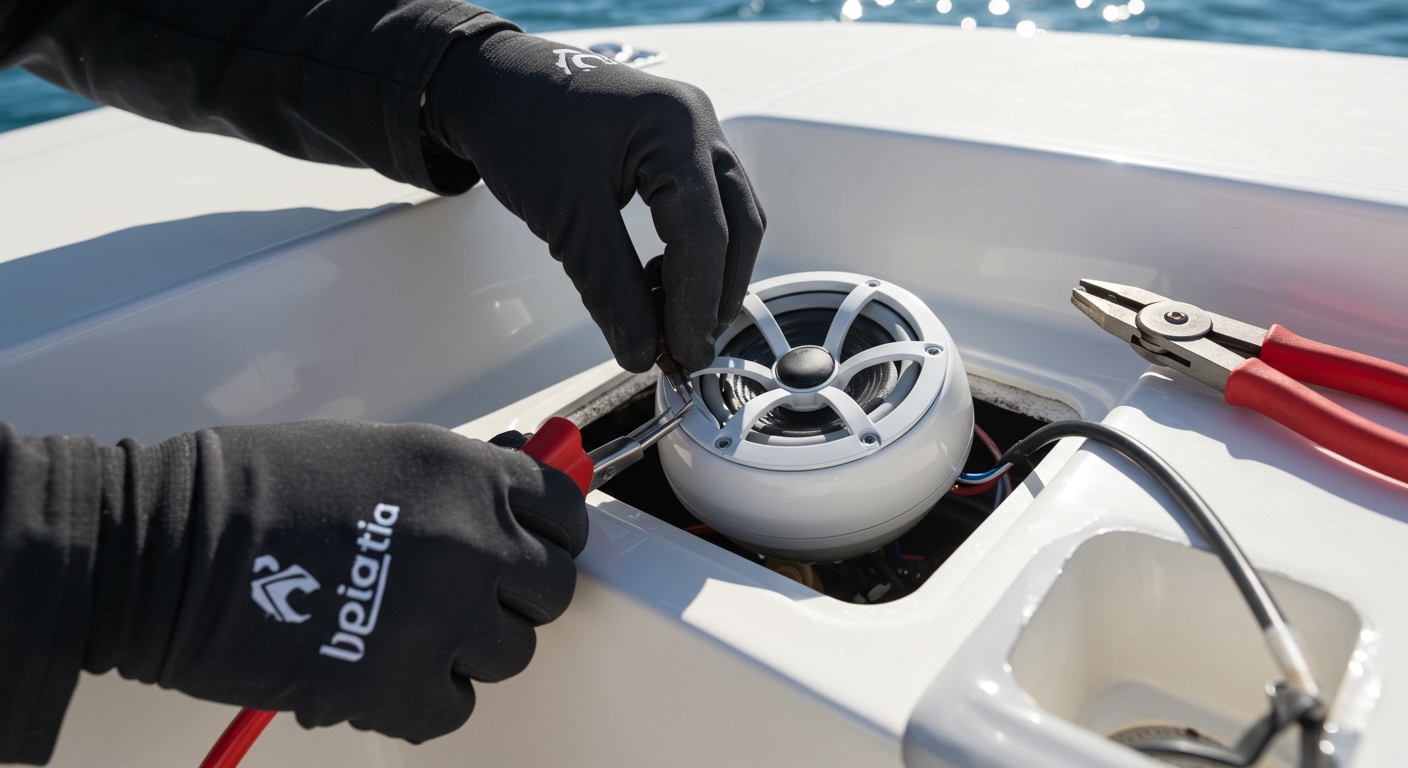
🛠️ Essential Tools and Materials
Before learning how to install marine speakers, gather these specific items. Using standard automotive tools often leads to rust issues in saltwater environments.
| Tool/Material | Purpose | Expert Recommendation |
|---|---|---|
| Marine Speaker Wire | Conducts signal without corroding | 16AWG Tinned Copper |
| Jigsaw or Hole Saw | Cutting the mounting diameter | Fine-tooth blade for fiberglass |
| Heat Shrink Butt Connectors | Waterproofing wire joins | Adhesive-lined type |
| Marine Silicone | Seals the speaker flange | 3M 4200 or Clear Silicone |
| Stainless Screws | Prevents rust streaks | Grade 316 Stainless Steel |
| Painter’s Tape | Protects gelcoat from cracking | Blue or Green low-tack tape |
📏 Step 1: Planning and Location Selection
The first step in how to install marine speakers is finding the “sweet spot.” Unlike a car, a boat has limited flat surfaces and many hidden hazards.
Check for Depth and Obstructions
Measure the mounting depth of your new speakers (usually 2.5 to 5 inches). Reach behind the intended panel to ensure you aren’t about to cut into a fuel tank, hydraulic steering line, or main wiring harness.
Evaluate Structural Integrity
Fiberglass can vibrate or flex if it is too thin. If the area feels “flimsy,” you may need to add a starboard backing plate or plywood coated in resin to reinforce the mounting area. This ensures the mid-bass response remains tight and punchy.
✂️ Step 2: Cutting the Mounting Holes
Learning how to install marine speakers requires confidence with power tools. Fiberglass is unforgiving, so follow these “pro” steps to avoid gelcoat spider cracks.
- Apply Painter’s Tape: Cover the entire area where the speaker will sit with blue painter’s tape. This prevents the jigsaw baseplate from scratching the gelcoat.
- Trace the Template: Use the cardboard template included in the box. Center it and trace with a sharpie.
- Drill a Pilot Hole: Use a 3/8″ drill bit to create a starting point inside the circle for your jigsaw blade.
- Cut Slowly: Use a high-speed, fine-tooth blade. Let the tool do the work; pushing too hard can cause the fiberglass to splinter.
- Test Fit: Place the speaker in the hole. If it’s tight, use a drum sander or file to shave the edges until it drops in flush.
🔌 Step 3: How to Wire Marine Speakers
This is the most critical technical phase. If you want to know how to wire marine speakers for longevity, you must ignore standard electrical tape and twist-ties.
Understanding Polarity
Every speaker has a positive (+) and negative (-) terminal.
Positive wire: Usually solid color (e.g., White).
Negative wire: Usually has a black stripe (e.g., White/Black).
If you swap these on one speaker, the two speakers will be “out of phase,” resulting in a total loss of bass.
Using Tinned Copper Wire
Standard copper wire acts like a wick for salt air. Within months, the copper turns black/green and loses conductivity. Tinned copper is coated in a thin layer of tin, making it virtually immune to the marine environment.
Securing Connections
- Strip 1/4 inch of insulation.
- Crimp using heat-shrink butt connectors.
- Apply heat with a heat gun until the internal adhesive oozes out, creating a vacuum seal.
💡 Step 4: How to Wire LED Marine Speakers
Many modern units, like Pyle marine speakers or Fusion models, include built-in RGB lighting. Knowing how to wire led marine speakers adds a professional aesthetic to your night cruises.
- Identify the LED Leads: You will typically see four extra wires: Black (12V+ Common), Red (Ground for Red), Green (Ground for Green), and Blue (Ground for Blue).
- Use an RGB Controller: Do not hook these directly to your battery. Use a Marine RGB Controller so you can change colors and turn them off when not in use.
- Common Power: Connect the Black wire to the positive output of your LED controller.
- Color Channels: Connect the R, G, and B wires to the corresponding channels on the controller.
- Fuse Protection: Always install a 3-amp or 5-amp fuse on the main power lead to the LED controller.
🔊 Step 5: How to Install Marine Tower Speakers
Wakeboard towers require a different approach. Knowing how to install marine tower speakers involves managing weight and vibration.
Clamp Selection: Ensure the clamps match the diameter of your tower pipe (typically 1.75″ to 3″).
Internal Wiring: Most towers are hollow. Drill a small exit hole near the speaker and an entry hole at the base of the tower. Use rubber grommets to prevent the metal from chafing the wire.
Safety Lanyards: Some high-end tower speakers include a safety cable. Always attach this so the speaker doesn’t fall on a passenger if the clamp fails.
🛻 How to Install Marine Speakers on Truck
Off-road enthusiasts often ask how to install marine speakers on truck builds. Marine speakers are perfect for Jeeps, ATVs, or trucks that see mud and rain.
- Door Fitment: Most marine speakers are “oversized” 6.5-inch units. You may need mounting adapter rings to fit them into factory truck door locations.
- Baffle Protection: Use silicone speaker baffles behind the speaker. This protects the rear of the speaker from water running down inside the window seal.
- Amplification: Marine speakers often have higher power requirements than factory truck speakers. Consider adding a small Class D Marine Amp under the seat to drive them properly.
🚀 Key Takeaways: TL;DR
If you are in a hurry, here is the essential guide to how to hook up marine speakers:
- Select Location: Find a flat surface with at least 3-4 inches of mounting depth.
- Cut & Prep: Use the provided template to mark and cut the hole using a jigsaw or hole saw.
- Run Wiring: Use 16-gauge tinned marine wire from the speaker to the head unit.
- Connect: Match positive (+) to positive and negative (-) to negative to maintain acoustic phase.
- Secure: Pilot-drill holes and fasten with stainless steel screws.
🛠️ Essential Tools and Materials
Before learning how to install marine speakers, gather these specific items. Using standard automotive tools often leads to rust issues in saltwater environments.
| Tool/Material | Purpose | Expert Recommendation |
|---|---|---|
| Marine Speaker Wire | Conducts signal without corroding | 16AWG Tinned Copper |
| Jigsaw or Hole Saw | Cutting the mounting diameter | Fine-tooth blade for fiberglass |
| Heat Shrink Butt Connectors | Waterproofing wire joins | Adhesive-lined type |
| Marine Silicone | Seals the speaker flange | 3M 4200 or Clear Silicone |
| Stainless Screws | Prevents rust streaks | Grade 316 Stainless Steel |
| Painter’s Tape | Protects gelcoat from cracking | Blue or Green low-tack tape |
📏 Step 1: Planning and Location Selection
The first step in how to install marine speakers is finding the “sweet spot.” Unlike a car, a boat has limited flat surfaces and many hidden hazards.
Check for Depth and Obstructions
Measure the mounting depth of your new speakers (usually 2.5 to 5 inches). Reach behind the intended panel to ensure you aren’t about to cut into a fuel tank, hydraulic steering line, or main wiring harness.
Evaluate Structural Integrity
Fiberglass can vibrate or flex if it is too thin. If the area feels “flimsy,” you may need to add a starboard backing plate or plywood coated in resin to reinforce the mounting area. This ensures the mid-bass response remains tight and punchy.
✂️ Step 2: Cutting the Mounting Holes
Learning how to install marine speakers requires confidence with power tools. Fiberglass is unforgiving, so follow these “pro” steps to avoid gelcoat spider cracks.
- Apply Painter’s Tape: Cover the entire area where the speaker will sit with blue painter’s tape. This prevents the jigsaw baseplate from scratching the gelcoat.
- Trace the Template: Use the cardboard template included in the box. Center it and trace with a sharpie.
- Drill a Pilot Hole: Use a 3/8″ drill bit to create a starting point inside the circle for your jigsaw blade.
- Cut Slowly: Use a high-speed, fine-tooth blade. Let the tool do the work; pushing too hard can cause the fiberglass to splinter.
- Test Fit: Place the speaker in the hole. If it’s tight, use a drum sander or file to shave the edges until it drops in flush.
🔌 Step 3: How to Wire Marine Speakers
This is the most critical technical phase. If you want to know how to wire marine speakers for longevity, you must ignore standard electrical tape and twist-ties.
Understanding Polarity
Every speaker has a positive (+) and negative (-) terminal.
Positive wire: Usually solid color (e.g., White).
Negative wire: Usually has a black stripe (e.g., White/Black).
If you swap these on one speaker, the two speakers will be “out of phase,” resulting in a total loss of bass.
Using Tinned Copper Wire
Standard copper wire acts like a wick for salt air. Within months, the copper turns black/green and loses conductivity. Tinned copper is coated in a thin layer of tin, making it virtually immune to the marine environment.
Securing Connections
- Strip 1/4 inch of insulation.
- Crimp using heat-shrink butt connectors.
- Apply heat with a heat gun until the internal adhesive oozes out, creating a vacuum seal.
💡 Step 4: How to Wire LED Marine Speakers
Many modern units, like Pyle marine speakers or Fusion models, include built-in RGB lighting. Knowing how to wire led marine speakers adds a professional aesthetic to your night cruises.
- Identify the LED Leads: You will typically see four extra wires: Black (12V+ Common), Red (Ground for Red), Green (Ground for Green), and Blue (Ground for Blue).
- Use an RGB Controller: Do not hook these directly to your battery. Use a Marine RGB Controller so you can change colors and turn them off when not in use.
- Common Power: Connect the Black wire to the positive output of your LED controller.
- Color Channels: Connect the R, G, and B wires to the corresponding channels on the controller.
- Fuse Protection: Always install a 3-amp or 5-amp fuse on the main power lead to the LED controller.
🔊 Step 5: How to Install Marine Tower Speakers
Wakeboard towers require a different approach. Knowing how to install marine tower speakers involves managing weight and vibration.
Clamp Selection: Ensure the clamps match the diameter of your tower pipe (typically 1.75″ to 3″).
Internal Wiring: Most towers are hollow. Drill a small exit hole near the speaker and an entry hole at the base of the tower. Use rubber grommets to prevent the metal from chafing the wire.
Safety Lanyards: Some high-end tower speakers include a safety cable. Always attach this so the speaker doesn’t fall on a passenger if the clamp fails.
🛻 How to Install Marine Speakers on Truck
Off-road enthusiasts often ask how to install marine speakers on truck builds. Marine speakers are perfect for Jeeps, ATVs, or trucks that see mud and rain.
- Door Fitment: Most marine speakers are “oversized” 6.5-inch units. You may need mounting adapter rings to fit them into factory truck door locations.
- Baffle Protection: Use silicone speaker baffles behind the speaker. This protects the rear of the speaker from water running down inside the window seal.
- Amplification: Marine speakers often have higher power requirements than factory truck speakers. Consider adding a small Class D Marine Amp under the seat to drive them properly.
🔄 How to Replace Marine Speakers
If you are upgrading an old system, here is how to replace marine speakers efficiently:
- Remove Old Screws: If they are rusted, apply PB Blaster and let it sit for 10 minutes. Use a manual screwdriver to avoid stripping the heads.
- Inspect Old Wiring: Look for “green rot” in the wires. If the wire is brittle or discolored, pull new marine-grade wire through the hull.
- Patching Holes: If the new speaker is smaller than the old one, you will need to create a trim ring out of King Starboard to cover the gap.
- Re-Seal: Never reuse old silicone. Scrape the surface clean with a plastic razor before applying a fresh bead.
⚠️ Common Mistakes to Avoid
Using Zinc Screws: These will rust within weeks. Only use Grade 316 Stainless.
Over-tightening: Fiberglass is brittle. Over-tightening screws can cause “gelcoat crazing.”
Ignoring the Fuse: Every power wire (Head unit, Amp, LEDs) must have an inline fuse near the battery.
- Lack of Drip Loops: When routing wires, let the wire hang lower than the entry point before going up. This prevents water from “wicking” directly into the speaker terminals.
🙋 Frequently Asked Questions (FAQs)
Can I use regular car speakers on my boat?
No. Standard car speakers use paper cones and untreated steel baskets. They will rust and the cones will disintegrate within one season of exposure to humidity and UV rays. Marine speakers use polypropylene cones and plastic/stainless frames.
How do I know if my boat has a “common ground” system?
Older boats might, but you should never use the hull or engine block as a ground for audio. Always run a dedicated negative wire back to the negative bus bar or battery to prevent engine noise (alternator whine) in your speakers.
What is the best way to install Pyle marine speakers?
When learning how to install pyle marine speakers, pay close attention to the mounting depth. Pyle units often have larger magnets. Ensure you use the included foam gasket to create a watertight seal against the fiberglass.
Do I need an amplifier for marine speakers?
While a head unit can power them, marine environments are noisy (wind, engine, water). A Marine Amplifier provides the “headroom” needed to hear clear music at cruising speeds without distorting the signal.
🏁 Conclusion
Mastering how to hook up marine speakers is about more than just making noise; it’s about protecting your investment against the harshest environment on earth. By using tinned copper wire, stainless hardware, and marine-grade sealants, you ensure your sound system lasts for years of sun and salt.
Whether you are figuring out how to install marine tower speakers for wakeboarding or simply how to replace marine speakers on an older pontoon, the key is patience and the right materials. Ready to upgrade your vessel? Start by measuring your mounting space today and choose a high-quality, IP-rated speaker set.









