

Understanding What Company Makes JBL Speakers Today
If you are wondering what company makes jbl speakers, the answer is Harman International Industries, a wholly-owned subsidiary of Samsung Electronics. Since its acquisition in 2017, Samsung has overseen the global production, though the soul of the engineering remains at JBL’s historic roots in the United States.
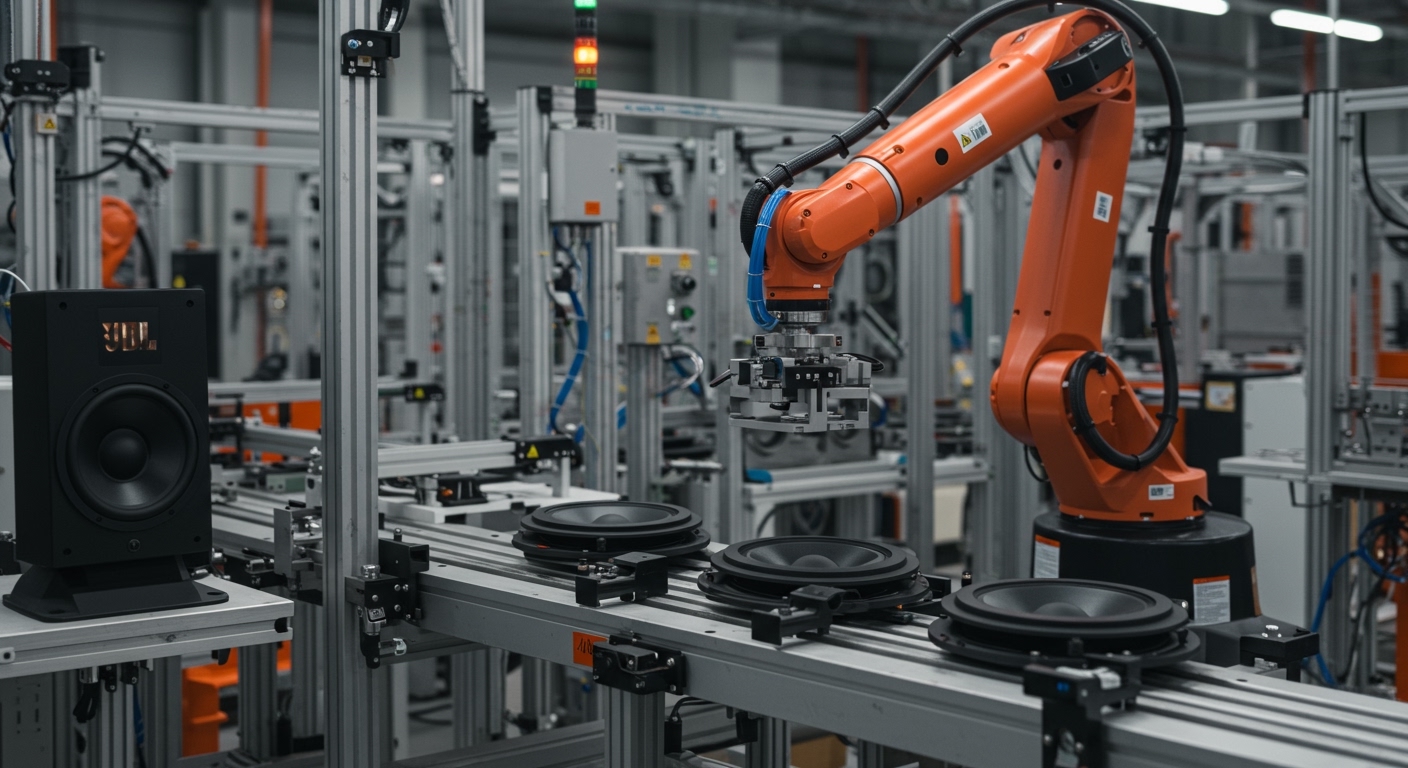
🚀 Key Takeaways: JBL Manufacturing at a Glance
Parent Company: Harman International (owned by Samsung Electronics).
Primary Engineering Hub: Northridge, California, USA.
Manufacturing Locations: China, Mexico, Hungary, Brazil, and the USA (for high-end Pro gear).
Core Technology: Patented Differential Drive transducers and Slipstream port designs.
Production Scale: Millions of units annually, ranging from the JBL Flip to massive Line Array stadium systems.
Step 1: Research, Development, and Acoustic Engineering
The process of who makes jbl speakers begins long before a single screw is turned. Unlike many brands that simply rebadge generic designs, JBL (James B. Lansing) performs nearly all its fundamental research in-house.
Conceptualizing the Sound Profile
Engineers in Northridge, California, use advanced software to simulate acoustic environments. They focus on the “JBL Signature Sound,” which emphasizes a powerful low-end and crystal-clear high frequencies.
Prototyping and Laser Interferometry
Before mass production, Harman engineers create prototypes. They use Laser Interferometry to observe how speaker cones vibrate in real-time. This ensures that the transducer does not deform under high pressure, preventing distortion.
Understanding What Company Makes JBL Speakers Today
If you are wondering what company makes jbl speakers, the answer is Harman International Industries, a wholly-owned subsidiary of Samsung Electronics. Since its acquisition in 2017, Samsung has overseen the global production, though the soul of the engineering remains at JBL’s historic roots in the United States.
🚀 Key Takeaways: JBL Manufacturing at a Glance
Parent Company: Harman International (owned by Samsung Electronics).
Primary Engineering Hub: Northridge, California, USA.
Manufacturing Locations: China, Mexico, Hungary, Brazil, and the USA (for high-end Pro gear).
Core Technology: Patented Differential Drive transducers and Slipstream port designs.
Production Scale: Millions of units annually, ranging from the JBL Flip to massive Line Array stadium systems.
Step 1: Research, Development, and Acoustic Engineering
The process of who makes jbl speakers begins long before a single screw is turned. Unlike many brands that simply rebadge generic designs, JBL (James B. Lansing) performs nearly all its fundamental research in-house.
Conceptualizing the Sound Profile
Engineers in Northridge, California, use advanced software to simulate acoustic environments. They focus on the “JBL Signature Sound,” which emphasizes a powerful low-end and crystal-clear high frequencies.
Prototyping and Laser Interferometry
Before mass production, Harman engineers create prototypes. They use Laser Interferometry to observe how speaker cones vibrate in real-time. This ensures that the transducer does not deform under high pressure, preventing distortion.
Step 2: Sourcing and Preparing Raw Materials
To understand who manufactures jbl speakers to such high standards, one must look at their material science. The durability of a JBL Boombox or a JBL Professional monitor depends on high-grade components.
Essential Material Components
| Component | Common Materials Used | Purpose |
|---|---|---|
| Speaker Cones | Polypropylene, Paper Composite, Kevlar | Provides rigidity and lightweight movement. |
| Magnets | Neodymium, Ferrite | Drives the voice coil with high magnetic flux. |
| Voice Coils | Copper-clad Aluminum wire | Conducts electricity to move the cone. |
| Enclosures | ABS Plastic, Birch Plywood, MDF | Houses components and manages resonance. |
| Surrounds | Nitrile Butadiene Rubber (NBR) | Allows the cone to move freely while staying centered. |
Step 3: Transducer and Voice Coil Assembly
This is the “heart” of the manufacturing process. Where are jbl bluetooth speakers made often dictates the level of automation used in this step.
Winding the Voice Coil
The voice coil is a thin wire wrapped around a bobbin. JBL often uses flat-wire ribbon technology. This allows more wire to fit into the magnetic gap, increasing efficiency and power handling.
Pressing the Diaphragm
The cone (diaphragm) is pressed into its specific shape. For JBL Bluetooth speakers, these are often waterproofed using specialized coatings during the molding process. This is why which company makes jbl speakers matters—Harman has proprietary chemical formulas for environmental resistance.
Step 4: Enclosure Fabrication and Tuning
The “box” or “shell” is just as important as the driver. It determines the speaker’s resonant frequency and durability.
Injection Molding for Portable Series
For models like the JBL Charge or JBL Flip, high-impact ABS plastic is injected into precision molds. These shells are then wrapped in a durable fabric mesh that provides the iconic JBL look and feel.
Woodworking for Professional Series
If you look at where is jbl speakers from in the professional world, many high-end cinema and concert speakers are still made with Baltic Birch plywood. These enclosures are CNC-machined for perfect joints and coated in DuraFlex, a rugged, weather-resistant finish.
Step 5: Electronic Integration (PCBA and Crossovers)
Modern JBL speakers are “smart.” They require sophisticated Printed Circuit Board Assemblies (PCBA) to handle Bluetooth 5.3, DSP (Digital Signal Processing), and battery management.
Installing the Amplifier and DSP
Harman integrates Class-D amplifiers into almost all portable JBL units. These amps are incredibly efficient, converting very little energy into heat, which is vital for battery life. The DSP is tuned to ensure the speaker doesn’t “bottom out” at high volumes.
Battery Integration
For JBL bluetooth speakers, high-density Lithium-ion cells are installed. These are shielded to prevent interference with the magnetic drivers and are tested for thermal stability.
Step 6: Rigorous Quality Control and Testing
Who made jbl speakers famous? Their reputation for being “bulletproof.” This comes from extreme testing protocols.
- Anechoic Chamber Testing: Every new design is tested in a room with zero echoes to measure its true frequency response.
- Power Testing: Speakers are often run at full volume for 100 hours straight to ensure they won’t fail during a party or concert.
- Environmental Stress: JBL “tortures” its portable speakers in salt spray chambers, UV light rooms, and underwater tanks (for IP67 ratings).
- Drop Testing: Units are dropped from various heights onto concrete to simulate real-world accidents.
Where Exactly Are JBL Speakers Made?
Many consumers ask what country makes jbl speakers. The answer is global, but here is the breakdown of the primary manufacturing hubs used by Harman/Samsung:
Global Manufacturing Footprint
China (Panyu & Shenzhen): This is where are jbl bluetooth speakers made for the mass market (Flip, Charge, Clip, Go). These facilities are highly automated.
Mexico (Tijuana & Querétaro): Primarily focuses on JBL Automotive systems for brands like Toyota and Ford, as well as some professional audio assembly.
Hungary (Pécs): A major hub for Harman professional electronics and high-end European distribution.
USA (Northridge, CA): While mass production moved overseas, the Custom Shop and Luxury Audio (like the JBL Everest or K2) are often “Made in the USA” with global parts.
Brazil (Manaus): Manufactures speakers specifically for the South American market to bypass heavy import taxes.
Expert Insights: Why the Manufacturer Matters
In my experience auditing audio hardware, the transition of JBL to Samsung ownership has actually improved manufacturing consistency. While some purists miss the “Made in Oregon” or “Made in California” era of the 1970s, the modern Samsung supply chain offers:
Superior Battery Tech: Leveraging Samsung SDI expertise.
Advanced Connectivity: Utilizing Harman’s leadership in automotive wireless tech.
Cost Efficiency: Allowing high-end acoustic tech to trickle down into affordable $50 speakers.
Pro Tips for Buyers
Check the Label: If you want “Made in USA” JBL, look at the Synthesis or Professional lines.
Verify Authenticity: Because who manufactures jbl speakers is so well-known, counterfeiters are everywhere. Always buy from authorized retailers like Crutchfield, Amazon (Official Store), or Best Buy.
Firmware Matters: Use the JBL Portable App. Since Samsung took over, software updates have significantly improved the “PartyBoost” features.
Common Mistakes to Avoid
Assuming all JBL is made in one place: Don’t be surprised if your JBL Bar says “Made in China” while your JBL Studio monitors say “Engineered in USA, Assembled in China.”
Ignoring IP Ratings: Just because a speaker is “made by JBL” doesn’t mean it’s waterproof. Check for the IP67 or IPX7 certification on the box.
- Underpowering Passive Speakers: If you buy JBL Pro passive speakers, ensure your amp matches the Harman recommended wattage to avoid clipping.
FAQs About JBL Manufacturing
What company makes JBL speakers now?
JBL is a brand owned by Harman International Industries. Since March 2017, Harman has been a subsidiary of Samsung Electronics. Therefore, Samsung is the ultimate parent company.
What country makes JBL speakers?
Most consumer JBL products, including Bluetooth speakers and headphones, are made in China. However, they also have significant manufacturing plants in Mexico, Hungary, and Brazil, with high-end engineering based in the USA.
Are JBL speakers made by Samsung?
While Samsung owns the brand, they do not usually brand the speakers as “Samsung.” They allow Harman to operate JBL as an independent entity, though they share research and supply chain resources.
Who made JBL speakers originally?
JBL was founded by James Bullough Lansing in 1946. He was a pioneering audio engineer who also helped found Altec Lansing.
Where are JBL professional speakers made?
Many JBL Professional products are engineered in Northridge, California. Depending on the model, assembly may take place in the USA, Mexico, or China.
Conclusion: The Future of JBL Manufacturing
Understanding what company makes jbl speakers reveals a story of American acoustic heritage meeting South Korean tech giant efficiency. Whether it is a tiny JBL Go 3 or a massive stadium array, the manufacturing process remains rooted in the rigorous standards set by Harman International.
By combining California-based engineering with global manufacturing in China and Mexico, JBL continues to dominate the audio market. If you are looking for a blend of durability, “fun” sound signatures, and cutting-edge Bluetooth tech, JBL’s current manufacturing ecosystem is arguably the best in the world.
Ready to experience the sound? Always ensure you are buying genuine Harman products by checking for the official JBL holographic seal on the packaging!









