To achieve the most immersive “bubble of sound,” where should atmos speakers be placed depends on your specific layout, but the gold standard is directly overhead in the ceiling. For a standard 5.1.2 system, place two speakers slightly in front of your seating position at a 65 to 100-degree angle relative to the floor.
Key Takeaways: Quick Setup Guide
Ideal Height: Aim for a ceiling height between 8 to 12 feet for optimal sound dispersion.
Speaker Count: A .2 setup (two overheads) is the entry point, while a .4 setup (four overheads) provides a seamless front-to-back transition.
Angle is King: Use a protractor or a smartphone app to ensure speakers are at the correct Dolby-recommended angles (usually 45° or 55° from the listener).
Symmetry: Maintain equal distance between the left and right overhead channels and the Main Listening Position (MLP).
Understanding the Dolby Atmos Layouts
Before drilling holes, you must decide which configuration fits your room. Dolby Atmos adds a “height” layer to traditional surround sound, typically denoted by a third digit (e.g., 5.1.2).
The 5.1.2 Configuration
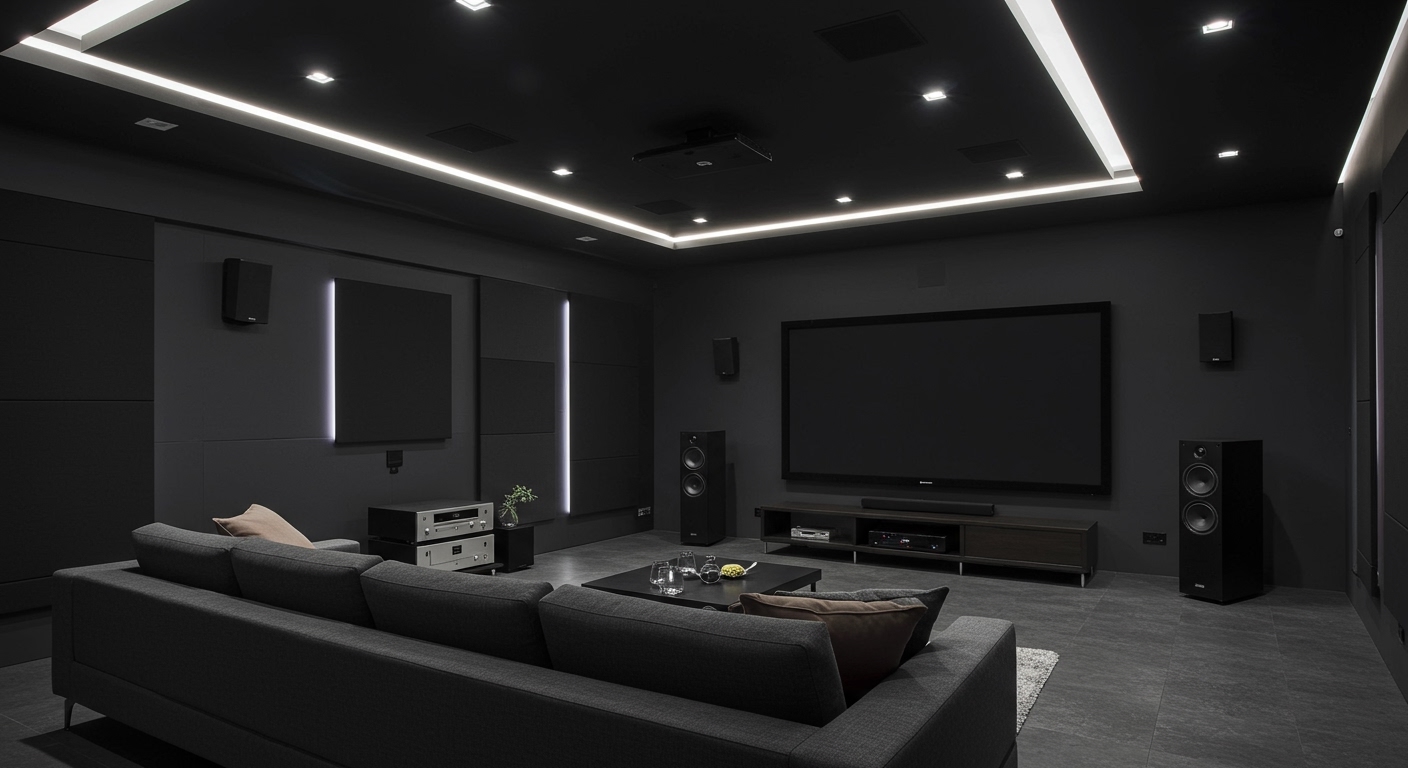
This is the most common entry-level setup. It uses your existing five speakers and one subwoofer, adding two overhead speakers. These should be placed in line with your front left and right speakers, slightly forward of your head.
The 5.1.4 and 7.1.4 Configuration
For a truly cinematic experience, four height speakers are recommended. In a 5.1.4 setup, you place two speakers in front of the seating area and two behind it. This allows sound objects to move realistically from the front of the room to the back.
Essential Tools for Precision Placement
Installing Dolby Atmos speakers requires more than just a ladder. Accurate measurement ensures the “overhead” effect doesn’t just sound like a wall speaker placed too high.
| Tool | Purpose | Expert Recommendation |
|---|---|---|
| Laser Measure | Finding the exact MLP (Main Listening Position) | Bosch GLM 20 for accuracy |
| Protractor App | Calculating the 45-degree or 55-degree angles | Any smartphone “Inclinometer” app |
| Painter’s Tape | Marking locations on the ceiling before cutting | Use blue tape to avoid ceiling damage |
| SPL Meter | Level matching all speakers post-installation | NIOSH SLM app or a dedicated decibel meter |
Step 1: Identify Your Main Listening Position (MLP)
Everything in a Dolby Atmos setup revolves around where your ears are. Sit in your favorite chair and mark the “sweet spot.”
- Measure the distance from the floor to your ears while seated.
- Mark the center point on the floor directly beneath your head.
- Project that point up to the ceiling using a laser pointer or plumb bob. This is your “Ground Zero” for all height measurements.
Step 2: Calculate the Ideal Angles
Knowing where to place atmos ceiling speakers requires basic geometry. Dolby provides specific angular ranges to ensure the sound reaches you at the right time.
For 2-Speaker Setups (.2)
Placement: Place the speakers at a 65-100 degree angle from the listener.
In Practice: If you prefer a more forward soundstage, lean toward 65 degrees. For a more “top-down” feel, aim for 80-90 degrees.
For 4-Speaker Setups (.4)
Front Heights: Position these at a 30-55 degree angle in front of the MLP.
Rear Heights: Position these at a 125-150 degree angle behind the MLP.
Expert Tip: In my experience, a symmetrical 45-degree and 135-degree setup provides the most balanced “panning” for flying objects in movies like Top Gun: Maverick.
Step 3: Align with Front Speakers
A common mistake is placing overhead speakers too wide or too narrow. Where should i place my ceiling speakers for dolby atmos to ensure a cohesive soundstage?
- Look at your Front Left and Front Right speakers.
- Draw an imaginary line from those speakers back to the rear of the room.
- Your Atmos speakers should be installed along these lines (roughly 0.5 to 0.7 times the width of your total front stage).
- This alignment ensures that a sound moving from the floor to the ceiling stays in the same vertical plane.
Understanding the Dolby Atmos Layouts
Before drilling holes, you must decide which configuration fits your room. Dolby Atmos adds a “height” layer to traditional surround sound, typically denoted by a third digit (e.g., 5.1.2).
The 5.1.2 Configuration
This is the most common entry-level setup. It uses your existing five speakers and one subwoofer, adding two overhead speakers. These should be placed in line with your front left and right speakers, slightly forward of your head.
The 5.1.4 and 7.1.4 Configuration
For a truly cinematic experience, four height speakers are recommended. In a 5.1.4 setup, you place two speakers in front of the seating area and two behind it. This allows sound objects to move realistically from the front of the room to the back.
Essential Tools for Precision Placement
Installing Dolby Atmos speakers requires more than just a ladder. Accurate measurement ensures the “overhead” effect doesn’t just sound like a wall speaker placed too high.
| Tool | Purpose | Expert Recommendation |
|---|---|---|
| Laser Measure | Finding the exact MLP (Main Listening Position) | Bosch GLM 20 for accuracy |
| Protractor App | Calculating the 45-degree or 55-degree angles | Any smartphone “Inclinometer” app |
| Painter’s Tape | Marking locations on the ceiling before cutting | Use blue tape to avoid ceiling damage |
| SPL Meter | Level matching all speakers post-installation | NIOSH SLM app or a dedicated decibel meter |
Step 1: Identify Your Main Listening Position (MLP)
Everything in a Dolby Atmos setup revolves around where your ears are. Sit in your favorite chair and mark the “sweet spot.”
- Measure the distance from the floor to your ears while seated.
- Mark the center point on the floor directly beneath your head.
- Project that point up to the ceiling using a laser pointer or plumb bob. This is your “Ground Zero” for all height measurements.
Step 2: Calculate the Ideal Angles
Knowing where to place atmos ceiling speakers requires basic geometry. Dolby provides specific angular ranges to ensure the sound reaches you at the right time.
For 2-Speaker Setups (.2)
Placement: Place the speakers at a 65-100 degree angle from the listener.
In Practice: If you prefer a more forward soundstage, lean toward 65 degrees. For a more “top-down” feel, aim for 80-90 degrees.
For 4-Speaker Setups (.4)
Front Heights: Position these at a 30-55 degree angle in front of the MLP.
Rear Heights: Position these at a 125-150 degree angle behind the MLP.
Expert Tip: In my experience, a symmetrical 45-degree and 135-degree setup provides the most balanced “panning” for flying objects in movies like Top Gun: Maverick.
Step 3: Align with Front Speakers
A common mistake is placing overhead speakers too wide or too narrow. Where should i place my ceiling speakers for dolby atmos to ensure a cohesive soundstage?
- Look at your Front Left and Front Right speakers.
- Draw an imaginary line from those speakers back to the rear of the room.
- Your Atmos speakers should be installed along these lines (roughly 0.5 to 0.7 times the width of your total front stage).
- This alignment ensures that a sound moving from the floor to the ceiling stays in the same vertical plane.
Step 4: Choose Between In-Ceiling and Up-Firing
Not everyone can cut holes in their ceiling. If you are renting or have concrete ceilings, you have two main alternatives.
In-Ceiling Speakers: These offer the best performance. Use speakers with aimable tweeters so you can point the high frequencies directly at the MLP.
Atmos Modules (Up-firing): These sit on top of your existing speakers and bounce sound off the ceiling. For these to work, your ceiling must be flat and made of a reflective material like drywall or plaster.
On-Ceiling (Surface Mount): If you have a basement with exposed joists, mounting bookshelf speakers directly to the beams is a fantastic, high-performance “pro” move.
Expert Tips for Perfect Atmos Calibration
Once you have decided where to put atmos speakers, the software setup is just as important as the physical placement.
Timbre Matching: Try to use the same brand for your overheads as your main speakers. This ensures that a helicopter moving across the room doesn’t change its “sound character” as it moves from one speaker to another.
Crossover Settings: Most Atmos ceiling speakers are smaller than floor-standers. Set your receiver’s crossover to 80Hz or 100Hz to let your subwoofer handle the heavy lifting.
Room Treatment: High-frequency sounds from Atmos speakers reflect easily. Place acoustic panels at the first reflection points on your side walls to keep the overhead sound “tight” and localized.
Common Mistakes to Avoid
Placing speakers in corners: This causes “bass loading” and makes the Atmos effects sound muddy.
Ignoring the “Voice of God”: In a .2 setup, don’t place the speakers directly above your head (90 degrees) if you only have two; they often sound better slightly forward.
Setting them too loud: The height channel is meant for ambient “atmospheric” sound and specific objects. If they are too loud, they distract from the dialogue and front action.
Frequently Asked Questions (FAQs)
Where should Dolby Atmos speakers be placed in a small room?
In smaller rooms, stick to a 5.1.2 configuration. Attempting a 5.1.4 setup in a cramped space can lead to “hot spots” where the sound is too close to your head, breaking the immersion. Focus on getting the two overheads perfectly centered between the TV and your seat.
Can I use bookshelf speakers as Atmos speakers?
Yes, you can mount bookshelf speakers to the ceiling using swivel brackets. This is often preferred by audiophiles because high-quality bookshelf speakers usually outperform budget in-ceiling models. Ensure they are securely anchored to a joist.
How high should my ceiling be for Atmos?
The ideal ceiling height is 8 to 12 feet. If your ceiling is higher than 14 feet, the sound may dissipate before it reaches you. If it is lower than 7 feet, the speakers will be too close to your head, making the sound source too obvious rather than an “atmospheric” effect.
Where to place Dolby Atmos ceiling speakers if I have a ceiling fan?
Ceiling fans are the enemy of Atmos. They cause “phase shifting” as the blades chop through the sound waves. If you have a fan, try to place your speakers at the wider end of the Dolby-recommended angle range to create a clear line of sight to the listener.
Conclusion
Mastering where to place speakers for dolby atmos is the difference between a “loud” room and a “cinematic” room. By following the Dolby angular guidelines, ensuring lateral alignment with your front speakers, and choosing the right hardware for your ceiling type, you create a seamless 3D audio environment.
Ready to upgrade your home theater? Start by marking your Main Listening Position today and use the angle guide above to find your perfect speaker locations. For more advanced calibration tips, check out our guide on Room Correction Software.
**