

How to Check Sound Quality of Speakers: A Step-by-Step Guide
Feeling that mix of excitement and anxiety after unboxing a new set of speakers is something I know well. You’ve spent your hard-earned money, but how can you be sure they sound as good as the reviews claimed? To how to check sound quality of speakers, you must listen critically for five key elements: clarity, mid-range accuracy, bass response, stereo imaging, and dynamics, using a high-quality audio source. It’s not about just playing your favorite song; it’s about knowing what to listen for.
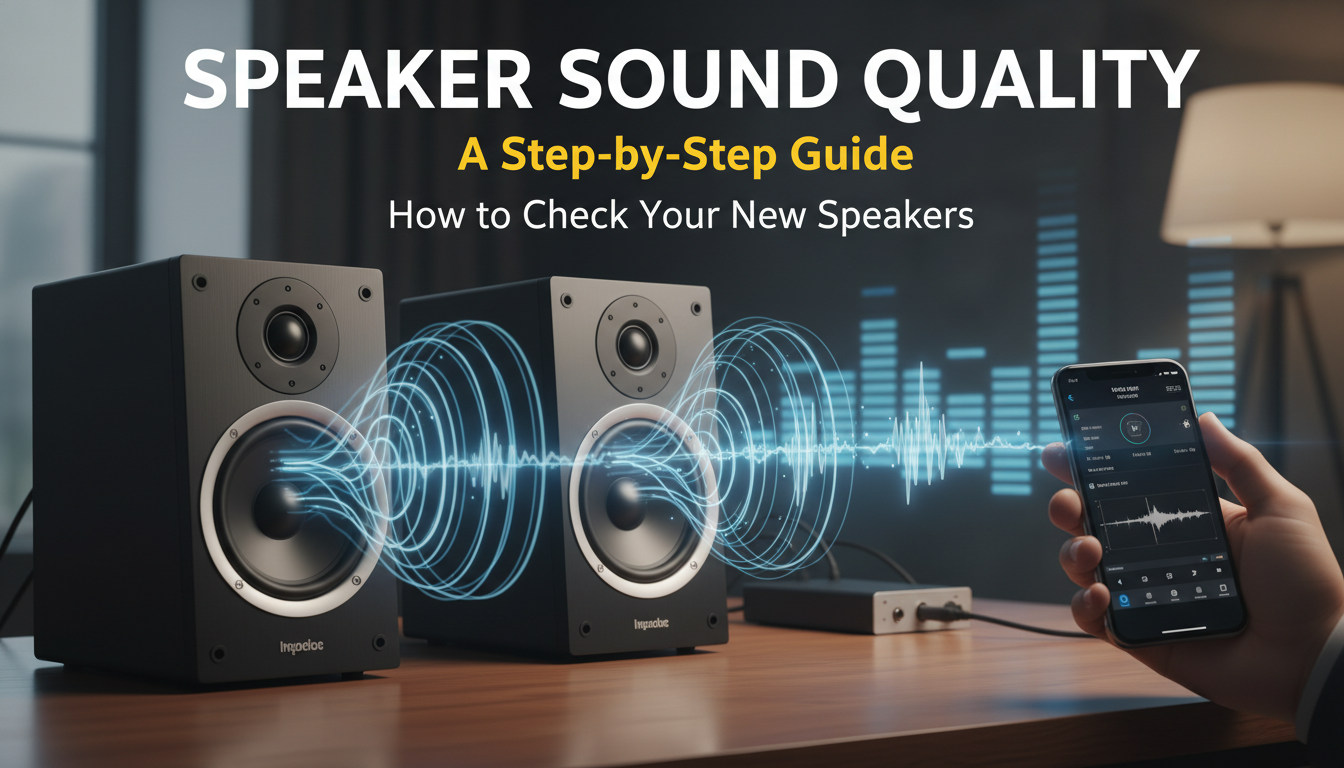
This guide will walk you through the exact steps I use to test any speaker, from a high-end bookshelf pair to a portable Bluetooth unit. We’ll skip the confusing jargon and focus on practical tests you can do right now to truly understand your speaker’s performance.
Key Takeaways: Quick Speaker Sound Quality Check
- Use High-Quality Audio: Test with lossless files (FLAC, WAV) or high-fidelity streaming (Tidal, Qobuz), not compressed MP3s or standard Spotify.
- Listen for the Full Spectrum: Evaluate the highs (cymbals), mids (vocals, guitar), and lows (bass, drums) independently.
- Check for Distortion: Play bass-heavy tracks and turn up the volume moderately. The bass should be tight and clear, not muddy or rattling.
- Evaluate the “Soundstage”: Close your eyes. Can you pinpoint where each instrument is? A wide and accurate soundstage makes music feel immersive.
- Use Diverse Genres: Test with a variety of music—from classical and jazz to rock and electronic—to see how the speakers handle different demands.
The Foundation: How to Prepare for Your Speaker Sound Quality Test
Before you even press play, setting the stage correctly is crucial. I’ve seen a fantastic pair of speakers sound mediocre simply because of a poor setup. Don’t make that mistake.
Your Audio Source Matters Most
Using a low-quality, compressed MP3 file to test a high-quality speaker is like trying to judge a 4K TV by watching a VHS tape. Compression algorithms strip out audio data to save space, and you’ll miss the very details you’re trying to hear.
- Go Lossless: Always use lossless audio formats like FLAC, WAV, or ALAC. These files are perfect replicas of the original studio recording.
- Use Hi-Fi Streaming: If you stream, use a service that offers a high-fidelity tier. Tidal Masters and Qobuz Studio are excellent choices for this.
- Avoid Bluetooth (If Possible): For the initial critical test, connect directly with a cable. Standard Bluetooth compresses audio, which can mask the true quality of the speaker. If you must use it, ensure you’re using a high-quality codec like aptX HD or LDAC.
Create the Right Listening Environment
Your room is an unsung hero (or villain) in your sound system. Hard surfaces like windows and bare floors reflect sound, while soft surfaces like carpets and curtains absorb it.
- The Equilateral Triangle: Position your speakers and your listening chair in an equilateral triangle. The distance between the two speakers should be the same as the distance from each speaker to your ears.
- Minimize Reflections: If you’re in a room with a lot of echo, try to place the speakers away from walls and corners. This reduces bass “boominess.”
- Eliminate Background Noise: Turn off fans, air conditioners, and any other sources of ambient noise for your critical listening session.
The 5-Step Listening Test: How to Know the Sound Quality of Speakers
Once your setup is optimized, it’s time to listen. I recommend using a playlist of 3-5 songs you know intimately. This familiarity will help you spot nuances and flaws more easily.
Step 1: Evaluate Clarity and Detail (The Highs / Treble)
The high-frequency range is where you hear the “sparkle” and “air” in a recording. This includes sounds like cymbals, hi-hats, string instruments, and the “s” sounds in vocals (sibilance).
- What to Listen For: Cymbals should have a clear, metallic shimmer and decay naturally. They should sound crisp, not harsh, tinny, or like shattering glass.
- My Go-To Test Track: I often use Steely Dan’s “Aja.” The intricate cymbal work by Steve Gadd is a fantastic test. On poor speakers, it can sound like a splashy mess, but on good ones, you can hear every delicate tap.
- Actionable Test: Listen to a well-recorded acoustic track. Can you hear the subtle sound of the guitarist’s fingers sliding on the strings? That’s the kind of detail you’re looking for.
Step 2: Assess the Mid-Range (The Heart of the Music)
The mid-range is arguably the most important frequency band. It’s where vocals, guitars, and pianos live. If the mid-range is wrong, the entire performance will sound unnatural.
- What to Listen For: Vocals should sound rich, present, and natural, as if the person is in the room with you. They shouldn’t sound “boxy” (like they’re singing from a cardboard box) or “thin.”
- My Go-To Test Track: Queen’s “Bohemian Rhapsody” is a mid-range masterpiece. With its complex layers of vocals, piano, and guitar solos, it will quickly reveal if a speaker can handle complexity without sounding congested or “muddy.”
- Actionable Test: Play a song with a powerful male or female vocalist. Does their voice have weight and emotion, or does it sound distant and hollow?
Step 3: Check the Bass Response (The Lows)
Good bass is not about being the loudest; it’s about being tight, controlled, and detailed. Many speakers can produce a “boom,” but few can reproduce the texture of a bass guitar string or the impact of a kick drum.
- What to Listen For: Bass notes should start and stop cleanly. You want to hear the distinct notes, not a one-note, droning hum. At higher volumes, the bass should remain clear and not distort or cause the speaker cabinet to rattle.
- My Go-To Test Track: For pure low-end extension, I use Massive Attack’s “Angel.” The deep, pulsating bassline at the beginning is a challenge for any speaker. It should be felt as much as it’s heard, without overwhelming the rest of the track.
- Actionable Test: Play a track with a fast, rhythmic bassline. Can you follow each individual note clearly, or do they all blur together?
Step 4: Analyze the Soundstage and Stereo Imaging
This is where things get truly immersive. The soundstage is the three-dimensional space the music appears to occupy. Imaging is the ability to pinpoint the location of individual instruments within that space.
- What to Listen For: Close your eyes. Does the music sound like it’s trapped inside the two speaker boxes, or does it extend beyond them—to the sides, in front, and behind? You should be able to “see” the vocalist in the center, the drummer behind them, and the guitars on either side.
- My Go-To Test Track: The intro to Pink Floyd’s “Money” is a classic for this. The cash register sounds pan from the far left to the far right. On a system with good imaging, the sound will travel smoothly between the speakers, not just jump from one to the other.
- Actionable Test: Listen to a live recording. A good set of speakers will reproduce the ambiance of the venue, making you feel like you’re in the audience.
Step 5: Test Dynamics
Dynamics refer to the difference between the quietest and loudest parts of a song. A speaker with good dynamic range can convey the power and emotion of a performance, from a soft whisper to a thundering crescendo.
- What to Listen For: The speaker should handle sudden changes in volume effortlessly without sounding strained or compressed. Quiet passages should remain clear and audible, while loud sections should be impactful without becoming distorted.
How to Check Sound Quality of Speakers: A Step-by-Step Guide
Feeling that mix of excitement and anxiety after unboxing a new set of speakers is something I know well. You’ve spent your hard-earned money, but how can you be sure they sound as good as the reviews claimed? To how to check sound quality of speakers, you must listen critically for five key elements: clarity, mid-range accuracy, bass response, stereo imaging, and dynamics, using a high-quality audio source. It’s not about just playing your favorite song; it’s about knowing what to listen for.
This guide will walk you through the exact steps I use to test any speaker, from a high-end bookshelf pair to a portable Bluetooth unit. We’ll skip the confusing jargon and focus on practical tests you can do right now to truly understand your speaker’s performance.
Key Takeaways: Quick Speaker Sound Quality Check
- Use High-Quality Audio: Test with lossless files (FLAC, WAV) or high-fidelity streaming (Tidal, Qobuz), not compressed MP3s or standard Spotify.
- Listen for the Full Spectrum: Evaluate the highs (cymbals), mids (vocals, guitar), and lows (bass, drums) independently.
- Check for Distortion: Play bass-heavy tracks and turn up the volume moderately. The bass should be tight and clear, not muddy or rattling.
- Evaluate the “Soundstage”: Close your eyes. Can you pinpoint where each instrument is? A wide and accurate soundstage makes music feel immersive.
- Use Diverse Genres: Test with a variety of music—from classical and jazz to rock and electronic—to see how the speakers handle different demands.
The Foundation: How to Prepare for Your Speaker Sound Quality Test
Before you even press play, setting the stage correctly is crucial. I’ve seen a fantastic pair of speakers sound mediocre simply because of a poor setup. Don’t make that mistake.
Your Audio Source Matters Most
Using a low-quality, compressed MP3 file to test a high-quality speaker is like trying to judge a 4K TV by watching a VHS tape. Compression algorithms strip out audio data to save space, and you’ll miss the very details you’re trying to hear.
- Go Lossless: Always use lossless audio formats like FLAC, WAV, or ALAC. These files are perfect replicas of the original studio recording.
- Use Hi-Fi Streaming: If you stream, use a service that offers a high-fidelity tier. Tidal Masters and Qobuz Studio are excellent choices for this.
- Avoid Bluetooth (If Possible): For the initial critical test, connect directly with a cable. Standard Bluetooth compresses audio, which can mask the true quality of the speaker. If you must use it, ensure you’re using a high-quality codec like aptX HD or LDAC.
Create the Right Listening Environment
Your room is an unsung hero (or villain) in your sound system. Hard surfaces like windows and bare floors reflect sound, while soft surfaces like carpets and curtains absorb it.
- The Equilateral Triangle: Position your speakers and your listening chair in an equilateral triangle. The distance between the two speakers should be the same as the distance from each speaker to your ears.
- Minimize Reflections: If you’re in a room with a lot of echo, try to place the speakers away from walls and corners. This reduces bass “boominess.”
- Eliminate Background Noise: Turn off fans, air conditioners, and any other sources of ambient noise for your critical listening session.
The 5-Step Listening Test: How to Know the Sound Quality of Speakers
Once your setup is optimized, it’s time to listen. I recommend using a playlist of 3-5 songs you know intimately. This familiarity will help you spot nuances and flaws more easily.
Step 1: Evaluate Clarity and Detail (The Highs / Treble)
The high-frequency range is where you hear the “sparkle” and “air” in a recording. This includes sounds like cymbals, hi-hats, string instruments, and the “s” sounds in vocals (sibilance).
- What to Listen For: Cymbals should have a clear, metallic shimmer and decay naturally. They should sound crisp, not harsh, tinny, or like shattering glass.
- My Go-To Test Track: I often use Steely Dan’s “Aja.” The intricate cymbal work by Steve Gadd is a fantastic test. On poor speakers, it can sound like a splashy mess, but on good ones, you can hear every delicate tap.
- Actionable Test: Listen to a well-recorded acoustic track. Can you hear the subtle sound of the guitarist’s fingers sliding on the strings? That’s the kind of detail you’re looking for.
Step 2: Assess the Mid-Range (The Heart of the Music)
The mid-range is arguably the most important frequency band. It’s where vocals, guitars, and pianos live. If the mid-range is wrong, the entire performance will sound unnatural.
- What to Listen For: Vocals should sound rich, present, and natural, as if the person is in the room with you. They shouldn’t sound “boxy” (like they’re singing from a cardboard box) or “thin.”
- My Go-To Test Track: Queen’s “Bohemian Rhapsody” is a mid-range masterpiece. With its complex layers of vocals, piano, and guitar solos, it will quickly reveal if a speaker can handle complexity without sounding congested or “muddy.”
- Actionable Test: Play a song with a powerful male or female vocalist. Does their voice have weight and emotion, or does it sound distant and hollow?
Step 3: Check the Bass Response (The Lows)
Good bass is not about being the loudest; it’s about being tight, controlled, and detailed. Many speakers can produce a “boom,” but few can reproduce the texture of a bass guitar string or the impact of a kick drum.
- What to Listen For: Bass notes should start and stop cleanly. You want to hear the distinct notes, not a one-note, droning hum. At higher volumes, the bass should remain clear and not distort or cause the speaker cabinet to rattle.
- My Go-To Test Track: For pure low-end extension, I use Massive Attack’s “Angel.” The deep, pulsating bassline at the beginning is a challenge for any speaker. It should be felt as much as it’s heard, without overwhelming the rest of the track.
- Actionable Test: Play a track with a fast, rhythmic bassline. Can you follow each individual note clearly, or do they all blur together?
Step 4: Analyze the Soundstage and Stereo Imaging
This is where things get truly immersive. The soundstage is the three-dimensional space the music appears to occupy. Imaging is the ability to pinpoint the location of individual instruments within that space.
- What to Listen For: Close your eyes. Does the music sound like it’s trapped inside the two speaker boxes, or does it extend beyond them—to the sides, in front, and behind? You should be able to “see” the vocalist in the center, the drummer behind them, and the guitars on either side.
- My Go-To Test Track: The intro to Pink Floyd’s “Money” is a classic for this. The cash register sounds pan from the far left to the far right. On a system with good imaging, the sound will travel smoothly between the speakers, not just jump from one to the other.
- Actionable Test: Listen to a live recording. A good set of speakers will reproduce the ambiance of the venue, making you feel like you’re in the audience.
Step 5: Test Dynamics
Dynamics refer to the difference between the quietest and loudest parts of a song. A speaker with good dynamic range can convey the power and emotion of a performance, from a soft whisper to a thundering crescendo.
- What to Listen For: The speaker should handle sudden changes in volume effortlessly without sounding strained or compressed. Quiet passages should remain clear and audible, while loud sections should be impactful without becoming distorted.
How to Measure Sound Quality of Speakers Beyond Just Listening
While your ears are the ultimate judge, objective tools can help you identify specific issues. This is a more advanced way to how to measure sound quality of speakers.
Using a Frequency Sweep Test
A frequency sweep is an audio file that plays a tone that glides from the lowest frequencies (around 20Hz) to the highest (20,000Hz).
- Find a Test: Search on YouTube for “speaker frequency response test.”
- Listen Carefully: As the tone sweeps upward









