

Getting Started: How to Convert Car Speakers Into Home Speakers
Have you recently upgraded your car’s sound system and now have a pair of perfectly good speakers collecting dust in the garage? It feels wasteful to just throw them out. The great news is you don’t have to. With a few key components and a bit of DIY spirit, you can convert those car speakers into a fantastic home speaker system. This process involves providing the right kind of power, amplification, and a proper enclosure to make them sing. As someone who has built several of these systems for my workshop and patio, I can tell you the results are surprisingly high-quality and incredibly rewarding.
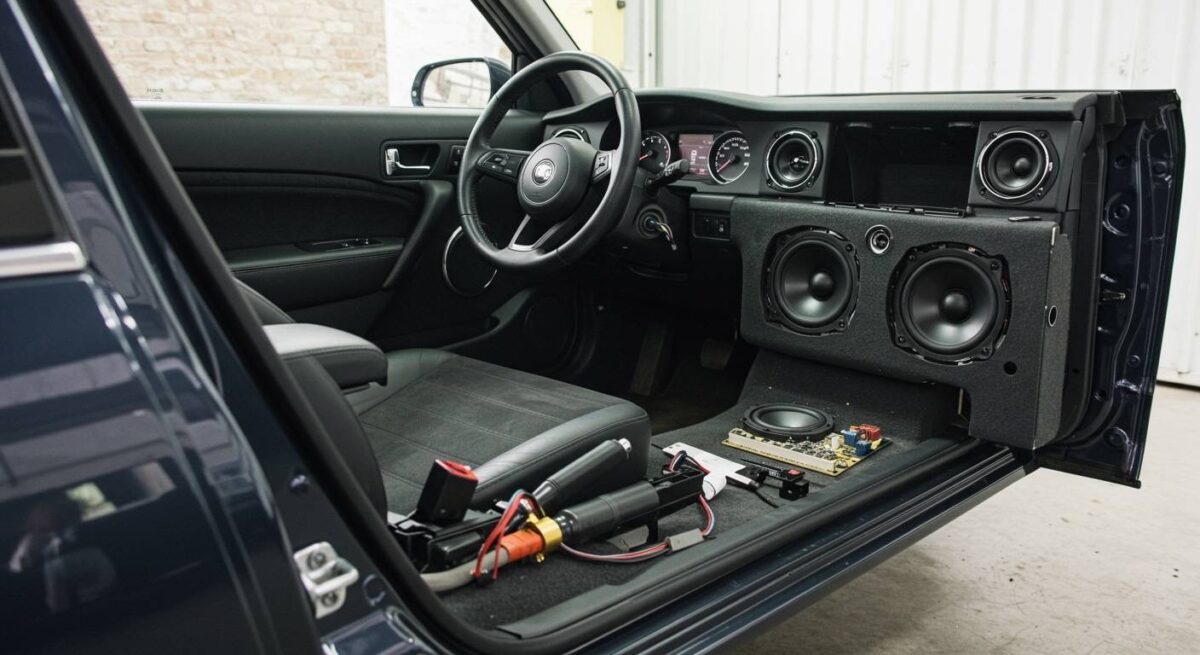
Key Takeaways: The 5-Minute Guide
- Power is Paramount: Car speakers run on 12V DC power, not the AC power from your wall. You’ll need a dedicated 12V DC power supply, like a repurposed computer PSU or a commercial power adapter, to mimic a car’s electrical system.
- Amplification is Non-Negotiable: Car speakers are “passive,” meaning they need an external amplifier to work. You can use the original car amplifier or, more simply, a compact and efficient “mini” home amplifier.
- An Enclosure is Essential: A speaker just sitting on a table will sound thin and lifeless. Building or buying a speaker box (enclosure) is critical for producing rich, full sound, especially bass.
- Impedance Matters: Most car speakers are 4-ohm, while most home stereo receivers are designed for 8-ohm speakers. Connecting 4-ohm speakers directly to a standard home receiver can cause it to overheat and fail.
Why You Should Turn Car Speakers into Home Speakers
Repurposing old gear is not just a fun project; it’s a smart one. When I built my first workshop sound system from a pair of old Infinity Kappa component speakers, I was shocked at how clear and powerful it sounded for a fraction of the cost of a new system.
The Advantages
- Cost-Effective: The most expensive part of a speaker system is often the drivers themselves. Since you already have them, you’re saving a significant amount of money. Your main costs will be a small amplifier and some MDF for the enclosure.
- High-Quality Audio: Car audio manufacturers often produce incredibly durable and high-performance speakers designed to overcome road noise. When used in a quiet home environment, their clarity can be truly impressive.
- Eco-Friendly Upcycling: You’re giving electronic equipment a second life, keeping it out of a landfill. It’s a satisfying way to reduce waste.
- Customization: You have complete control over the final product. You can build the enclosures to perfectly match your room’s decor, size constraints, and acoustic goals.
The Potential Challenges
- DIY Skills Required: This project involves basic wiring and potentially some simple woodworking. It’s a great learning experience, but it’s not quite plug-and-play.
- Acoustic Design: Car speakers are engineered for the unique, small, and oddly shaped environment of a vehicle cabin. Getting them to sound their best in an open room requires a properly designed enclosure.
Understanding the Core Technical Hurdles
Before we start building, it’s crucial to understand why you can’t just wire car speakers to your home stereo. The differences are fundamental, and bridging them is the key to this project’s success.
Power: 12V DC vs. 120V AC**
The single biggest difference is the power source.
- Your Home: Wall outlets supply high-voltage Alternating Current (AC), typically 120V in North America.
- Your Car: A car’s electrical system runs on low-voltage Direct Current (DC), nominally 12V, supplied by the battery and alternator.
To make car speakers work at home, you need a device that converts 120V AC from your wall into a stable 12V DC.
Amplification: Passive vs. Active**
Car speakers are passive components. They are just the speaker driver (the cone, magnet, etc.) and require an external amplifier to receive a powered signal. You cannot plug them directly into a phone or computer’s headphone jack and expect to hear anything more than a faint whisper.
Impedance: 4 Ohms vs. 8 Ohms**
Impedance, measured in ohms (Ω), is the electrical resistance of a speaker.
- Car Speakers: Are almost universally 4-ohm. This low impedance is designed to draw more power from a car’s limited 12V system.
- Home Speakers: Are typically 8-ohm. Home receivers and amplifiers are designed to safely drive this higher-impedance load.
Connecting a 4-ohm car speaker to an 8-ohm home receiver forces the receiver to work twice as hard, generating excessive heat and potentially causing its protection circuits to trip or, worse, leading to permanent damage. This is why a separate, impedance-matched amplifier is so important.
The Enclosure: The Missing Piece**
In your car, the door panel or rear deck acts as a large baffle or enclosure for the speaker. This is critical because it separates the sound waves coming from the front of the speaker cone from the waves coming from the back. Without this separation, they cancel each other out, especially at low frequencies, resulting in a complete lack of bass.
Your Project Shopping List: Essential Components & Tools
Here is a detailed breakdown of everything you’ll need to gather before you begin.
Core Electronic Components
*









