

What Are Good Studio Speakers and Why Do They Matter?
Good studio speakers, also known as studio monitors, are loudspeakers specifically designed for professional audio production. Their primary purpose is to provide an accurate, uncolored, and flat frequency response, allowing you to hear your music exactly as it was recorded. This is crucial because if your speakers are artificially boosting the bass, your mix will sound thin and weak on other systems.
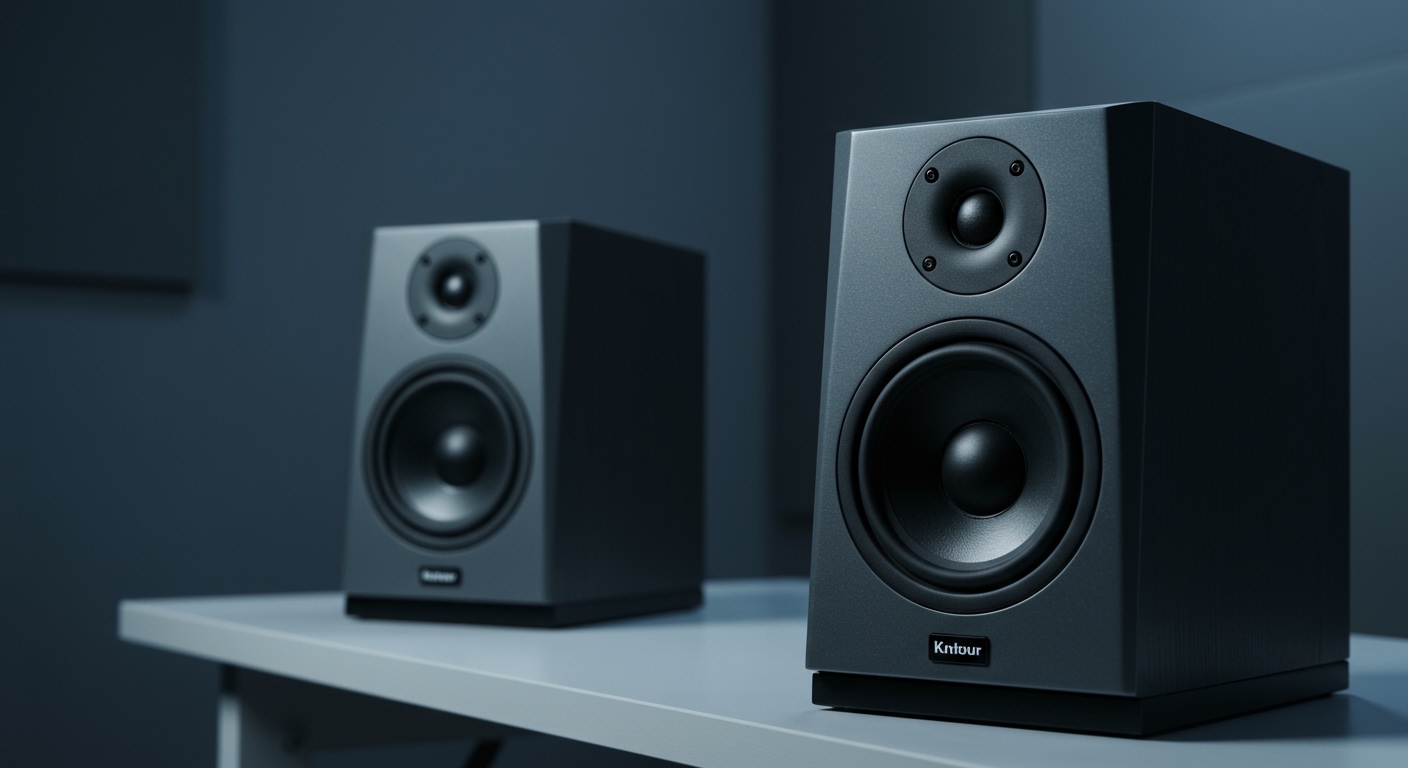
From my years in the studio, I can tell you the single biggest leap in mix quality comes from investing in a reliable pair of monitors. They are your sonic microscope, revealing flaws, clashes, and details that regular consumer speakers are designed to hide. Without them, you’re essentially mixing blindfolded, leading to tracks that don’t “translate” well to cars, earbuds, or club systems. Understanding what quality are studio speakers is the first step toward professional-sounding results.
Key Takeaways: Your Quick Guide to Studio Speakers
- Purpose: Studio speakers provide an accurate, “flat” sound so you can make precise mixing decisions. They don’t color the sound like consumer Hi-Fi speakers.
- Key Features: Look for Frequency Response, Driver Size (woofer), Power Rating (Watts), and Connectivity (XLR, TRS, RCA).
- Room Size Matters: Smaller rooms (under 150 sq ft) work best with 3-5 inch woofers. Medium to large rooms need 6-8 inch woofers for accurate bass representation.
- Placement is Critical: Proper positioning—forming an equilateral triangle with your head and using isolation pads—is just as important as the speakers themselves.
- Budget: Expect to spend at least $150-$300 for a decent entry-level pair. Professional-grade monitors can cost thousands.
Studio Speakers vs. Hi-Fi Speakers: The Critical Difference
Many beginners ask me, “Can’t I just use my home stereo speakers?” The answer is a firm no, and understanding why is fundamental. The design philosophy behind these two types of speakers is completely opposite.
The Goal of Hi-Fi Speakers
Consumer or Hi-Fi speakers are designed for enjoyment. They are engineered to make music sound better than it might actually be.
- “Scooped” EQ Curve: They often have a “smiley face” EQ curve, meaning they boost the low-end (bass) and the high-end (treble) to create a more exciting and impressive listening experience.
- Coloration: They add their own sonic character or “color” to the sound. This is great for casual listening but disastrous for mixing.
- Forgiving Nature: They are designed to smooth over imperfections in a recording, making almost anything sound pleasant.
The Goal of Studio Speakers (Monitors)
In contrast, what is studio monitor speakers all about? It’s about brutal honesty. Their job is to be a neutral, analytical tool.
- Flat Frequency Response: The holy grail for a studio monitor is a flat frequency response. This means it reproduces all frequencies—from the lowest bass to the highest treble—at an equal volume level.
- Translation: Because you’re hearing an uncolored version of your audio, the decisions you make (like cutting a specific bass frequency or boosting a vocal) will translate accurately to other playback systems. This is the key to a professional mix.
As a producer, you need a reliable reference point. Using Hi-Fi speakers to mix is like painting a picture while wearing sunglasses—you can’t trust the colors you’re seeing. Studio monitors remove those sunglasses.
Key Features to Look for in Good Studio Speakers
When you start shopping, you’ll be hit with a lot of technical jargon. Let’s break down the specifications that actually matter so you can make an informed choice.
Frequency Response
This is perhaps the most important specification. It tells you the range of frequencies the speaker can accurately reproduce.
- What to look for: A wide range, such as 50Hz – 20kHz. The first number (50Hz) indicates how low the bass can go, and the second (20kHz) indicates the highest treble.
- The “±” Number: You’ll often see a spec like “50Hz – 20kHz (±3dB)”. This “deviation” number tells you how flat the response is. A smaller number (like ±1.5dB) is better, indicating a more accurate speaker.
Driver Size (Woofer and Tweeter)
Studio monitors typically have two drivers: a woofer for low/mid frequencies and a tweeter for high frequencies.
- Woofer Size: Measured in inches, this is the main factor determining bass response. Common sizes are 3″, 5″, 6.5″, and 8″. A larger woofer can reproduce lower bass frequencies more accurately without strain.
- Tweeter Type: Most tweeters are “soft dome” (silk, fabric) or “metal dome” (aluminum, titanium). Soft domes are often described as smoother, while metal domes can be more detailed but sometimes harsher. I personally prefer soft domes for long mixing sessions to avoid ear fatigue.
Active vs. Passive Monitors
This is a crucial distinction that determines your setup needs.
- Active Monitors: These have a built-in amplifier. They are the standard for home and project studios because they are an all-in-one solution. You just plug them into a power source and your audio interface. 99% of beginners should choose active monitors.
- Passive Monitors: These require a separate, external power amplifier. They are more common in high-end professional studios where engineers want to mix and match components for a specific sound. They are more complex and expensive to set up.
Power Rating (Watts)
The power rating, measured in watts, indicates the amplifier’s power. More power doesn’t necessarily mean “louder”; it means more headroom.
- Headroom: Adequate power prevents the amplifier from distorting when handling loud, dynamic peaks in your music (like a kick drum hit). This results in a cleaner, more accurate sound, even at lower volumes.
- Bi-Amping: Many active monitors are “bi-amped,” meaning there’s a separate amplifier for the woofer and the tweeter. This is a superior design that leads to a more efficient and precise sound.
Connectivity
Check the back of the monitor to see what inputs it offers.
- Balanced Inputs (XLR, TRS): These are the professional standard. They are much better at rejecting noise and interference from other electronic devices, which is a common problem in home studios.
- Unbalanced Inputs (RCA): These are common on consumer gear. While they work, they are more susceptible to picking up hum and buzz. Always use balanced connections if your audio interface supports them.
How to Choose the Right Studio Speakers for Your Room
The biggest mistake I see new producers make is buying huge 8-inch monitors for a tiny bedroom studio. Your speakers must be matched to your room size for them to work correctly.
Small Rooms (Under 150 sq. ft. / 14 sq. m)
In a small, untreated room, large speakers will create overwhelming bass problems. The long sound waves of low frequencies will bounce around, creating “standing waves” that give you a completely inaccurate picture of your low-end.
- Recommended Woofer Size: 3 to 5 inches.
- Why it works: Smaller speakers excite the room’s bass modes less, leading to a more controlled and trustworthy low-end. You can always check the deep sub-bass on a good pair of headphones like the Beyerdynamic DT 770 Pro.
- Popular Models: PreSonus Eris E3.5, KRK Rokit 5, Yamaha HS5.
Medium Rooms (150 – 250 sq. ft. / 14 – 23 sq. m)
If you have a bit more space, you can step up to a larger monitor that will provide a more extended bass response.
- Recommended Woofer Size: 6 to 7 inches.
- Why it works: This size offers a great balance of full-range sound without being too overpowering for a typical project studio.
- Popular Models: Adam Audio T7V, Yamaha HS7, Focal Alpha 65 Evo.
Large Rooms (Over 250 sq. ft. / 23 sq. m)
In a large, well-treated room, you need speakers that can move enough air to fill the space without straining.
- Recommended Woofer Size: 8 inches or larger.
- Why it works: 8-inch monitors can often reproduce bass low enough that you may not even need a separate subwoofer. They provide the power and full-range extension needed for critical mixing in a professional environment.
- Popular Models: Yamaha HS8, Neumann KH 120 A (paired with a sub), Adam Audio A77H.
A Step-by-Step Guide to Setting Up Your Studio Speakers
Buying what are good studio speakers is only half the battle. Proper placement and a little acoustic treatment can make a $300 pair of monitors sound better than a $2000 pair that’s set up incorrectly.
Step 1: Positioning – The Equilateral Triangle
This is the most critical rule of monitor placement. Your head and the two speakers should form a perfect equilateral triangle.
- Placement: Position your speakers on either side of your computer screen.
- Distance: The distance between the two speakers should be the same as the distance from each speaker to your listening position (your head).
- Toeing In: Angle, or “toe in,” the speakers so they are pointing directly at your ears. The tweeters should be at ear level.
Step 2: Isolation
Speakers create vibrations. If they’re sitting directly on your desk, the desk will resonate, smearing the sound and creating false bass frequencies.
- Solution: Use isolation pads or dedicated monitor stands. These are dense foam pads or metal stands that decouple the speaker from the surface, tightening up the bass and improving stereo imaging. This is a small investment with a huge sonic payoff.
Step 3: Dealing with Walls
Your room’s walls are your biggest enemy. Sound waves bounce off them, causing reflections that interfere with the direct sound from your speakers.
- Avoid Corners: Never place your desk and speakers in a corner. This acts like a megaphone for bass frequencies, creating a “bass trap” that will completely ruin your perception of the low end.
- Distance from Front Wall: Try to place your speakers at least a foot or two away from the wall behind them. Most monitors have a rear-facing bass port, and placing them too close to a wall will cause an artificial bass buildup.
- Symmetry: Ensure the left and right side walls are an equal distance from your listening position. An asymmetrical setup can skew your stereo image.
Step 4: Basic Acoustic Treatment
You don’t need to spend a fortune to dramatically improve your room’s acoustics. Focus on the “first reflection points.”
- The Mirror Trick: Sit in your listening position and have a friend slide a mirror along the left and right walls. Anywhere you can see the reflection of a speaker in the mirror is a first reflection point.
- Place Absorption: Place an acoustic panel (a foam or fiberglass panel) at these points on the side walls and on the ceiling. This will absorb those early reflections, drastically improving your clarity and stereo imaging.
How Much Are Good Studio Speakers? A Budget Breakdown
The question “how much is studio speakers” depends heavily on your goals. The good news is that technology has advanced so much that even budget-friendly options are incredibly capable.
Entry-Level: The Best Starter Speakers ($150 – $400 per pair)
This is the sweet spot for home producers and beginners. You can get a remarkably accurate pair of monitors that will serve you well for years.
- What you get: Typically 3.5 to 5-inch woofers, decent frequency response, and multiple input options.
- Limitations: The bass response might not be very deep, and they may not get extremely loud without some distortion.
- My Recommendation: The PreSonus Eris E5 XT offers incredible value. They are known for their flat response and acoustic tuning controls, a feature usually found on much more expensive speakers.
Mid-Range: The Project Studio Standard ($400 – $1,000 per pair)
This is where you start to see significant improvements in build quality, component selection, and overall accuracy. If you’re serious about music production, this is a worthy investment.
- What you get: 5 to 7-inch woofers, more powerful and cleaner amplification (often bi-amped), and a more extended and accurate frequency response.
- My Recommendation: The Yamaha HS series (especially the HS5 and HS7)









