

What Is The Difference Between Monitor Speakers and Normal Speakers?
Struggling to understand why the music you create in your home studio sounds completely different in your car or on your friend’s stereo? This common frustration often boils down to one crucial misunderstanding: the difference between monitor speakers and the normal speakers you use for everyday listening. The core distinction is that monitor speakers are designed for analytical, critical listening with a flat, uncolored frequency response to reveal flaws in a mix, while normal (hi-fi) speakers are engineered to enhance the sound and make music more enjoyable and immersive for the listener.
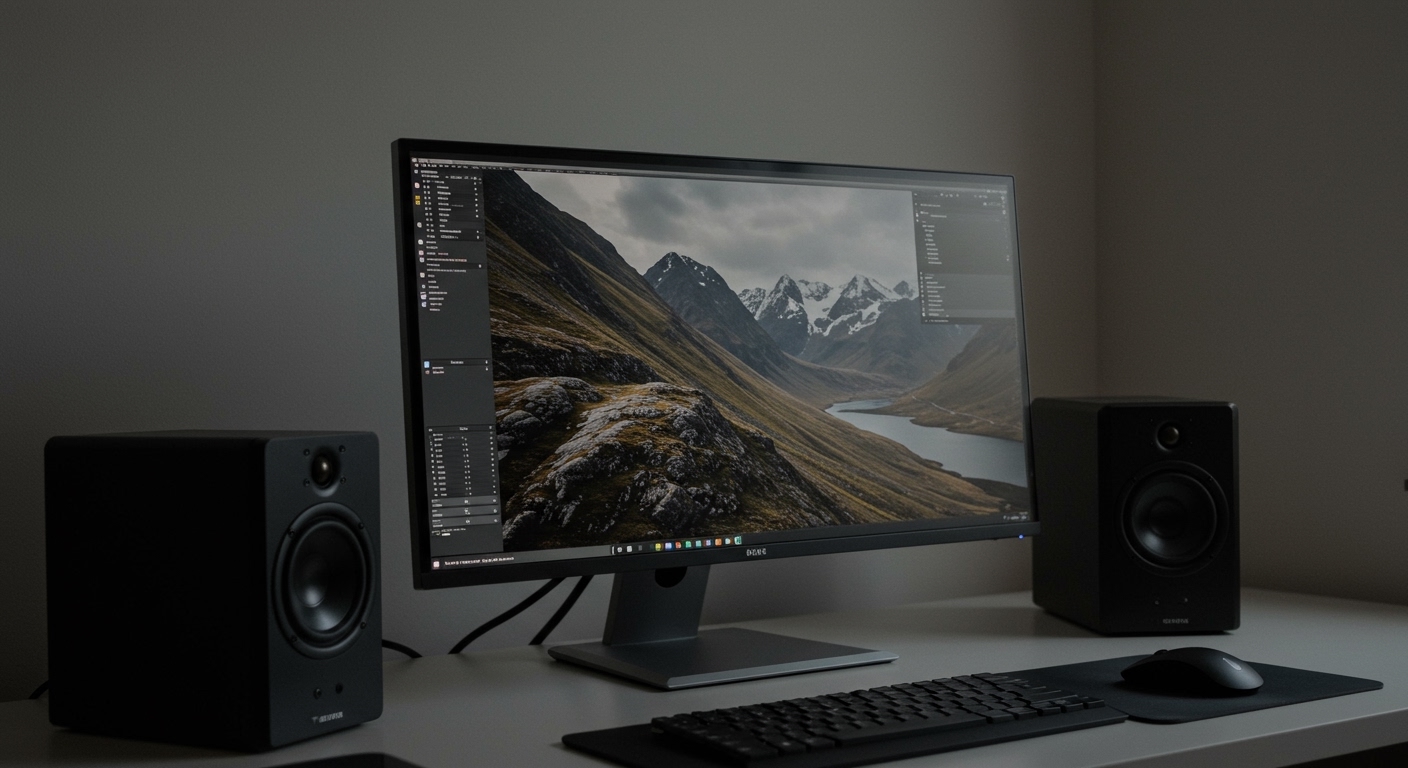
Think of it like this: monitor speakers are like a perfectly calibrated, unforgiving mirror for your audio, showing you every detail, good and bad. Normal speakers are like a flattering, soft-focus portrait, designed to make the subject look its best. Understanding this fundamental difference is the first step toward making better music and choosing the right gear for your needs.
Key Takeaways: Monitors vs. Normal Speakers
- Primary Purpose: Monitors are for creating audio (mixing, mastering, production). Normal speakers are for consuming audio (listening to music, watching movies).
- Sound Signature: Monitors aim for a flat frequency response, meaning they don’t boost or cut any frequencies. This provides an accurate, neutral sound. Normal speakers have a “colored” or “scooped” sound, often boosting bass and treble to make music sound more exciting.
- Listening Position: Monitors are typically “near-field,” designed to be listened to from a short distance (3-5 feet) to minimize room reflections. Normal speakers are often “far-field,” designed to fill an entire room with sound.
- Power: Most studio monitors are active, meaning the amplifier is built directly into the speaker cabinet. Most home hi-fi speakers are passive, requiring a separate, external amplifier or receiver.
Understanding Studio Monitors: The Audio Microscope
Studio monitors, often just called “monitors,” are the bedrock of any recording studio, from a bedroom setup to Abbey Road. Their one and only job is to reproduce sound as accurately and transparently as possible. They are not designed to sound “good”; they are designed to sound honest.
When I’m mixing a track, I need to hear every single detail. Is the kick drum clashing with the bass guitar? Is the vocalist’s “s” sound too harsh (sibilant)? Are there subtle clicks or pops I missed during recording? A regular speaker might hide these flaws, but a good monitor, like the Yamaha HS8s I’ve used for years, will put them front and center. This honesty is critical for making mixing decisions that translate well to any other speaker system.
Key Characteristics of Monitor Speakers
- Flat Frequency Response: This is the most important trait. A graph of a monitor’s frequency response should be as close to a flat, horizontal line as possible. This ensures that what you hear is a true representation of the audio source, without any artificial enhancement.
- Low Distortion: High-quality components are used to ensure the speaker itself doesn’t add unwanted noise or distortion, even at higher volumes. This maintains the purity of the signal.
- Near-Field Design: Most studio monitors are designed for near-field listening. This means you set them up in an equilateral triangle with your listening position, typically just a few feet away. This setup minimizes the impact of your room’s acoustics, allowing you to hear the direct sound from the speaker rather than reflected sound bouncing off walls.
- Active Crossovers & Bi-Amplification: The majority of modern studio monitors are active. This means they have their own built-in amplifiers, one for the woofer (low frequencies) and one for the tweeter (high frequencies). An electronic crossover inside the speaker splits the frequencies precisely, sending the right signals to the right driver. This is far more efficient and accurate than the passive crossovers found in most home speakers.
Understanding Normal Speakers: The Entertainment Centerpiece
Normal speakers, also known as consumer speakers or hi-fi (high-fidelity) speakers, have a completely different goal. Their purpose is to make your music, movies, and games sound as enjoyable, impressive, and immersive as possible. They are designed for pure listening pleasure, not for critical analysis.
These speakers achieve this by intentionally “coloring” the sound. Manufacturers know that most people perceive boosted bass and sparkling treble as more exciting and “powerful.” This often results in a “V-shaped” or “smiley face” EQ curve, where the low and high frequencies are emphasized, and the mid-range (where vocals and many core instruments sit) is slightly recessed.
When I kick back on my couch to just listen to a new album, I’m not using my studio monitors. I’m using a pair of Klipsch RP-600M bookshelf speakers. They bring a life and energy to the music that’s fantastic for casual listening but would be disastrous for making critical mixing decisions because they aren’t showing me the true picture of the audio.
Key Characteristics of Normal Speakers
- Colored Sound Signature: As mentioned, these speakers are tuned to sound pleasing. This isn’t a bad thing; it’s by design. The goal is to flatter the source material.
- Wide Soundstage: Hi-fi speakers are often designed to create a wide, deep “soundstage.” This is an illusion of space, making it feel like the band is performing in a large room right in front of you. This is great for immersion but can mask issues with stereo imaging in a mix.
- Far-Field Design: They are built to fill a room with sound and sound good from various listening positions and distances, not just a single “sweet spot.”
- Passive Design: The vast majority of consumer speakers are passive. They don’t have built-in amps and require you to connect them to an external A/V receiver or stereo amplifier using speaker wire. This allows for more system flexibility but adds another component to the signal chain.
The Core Differences: What Is The Difference Between Monitors and Speakers?
Let’s break down the fundamental distinctions in a more detailed, head-to-head comparison. Grasping these concepts is key to understanding why using the wrong tool for the job can lead to so much frustration.
Frequency Response: Flat vs. Colored (The Biggest Difference)
This is the most critical distinction.
- Monitor Speakers (Flat): Imagine a ruler. It gives you an exact, un-editorialized measurement. A monitor speaker’s flat frequency response is the audio equivalent of that ruler. It doesn’t add or subtract anything. A bass note at 60 Hz is reproduced at the same relative volume as a cymbal at 10 kHz. This neutrality is essential for a mix engineer to make accurate EQ and compression decisions.
- Normal Speakers (Colored): Imagine a funhouse mirror. It reflects an image, but it’s intentionally distorted to be more entertaining. Normal speakers do this with sound. They might boost the “thump” of the bass around 80-120 Hz and add “air” or “sparkle” to the treble above 12 kHz. If you create a mix on these speakers, you might think your track has plenty of bass. But when you play it on a system without that bass boost (like a car stereo or laptop speakers), it will suddenly sound thin and weak.
Purpose & Intended Use: Creation vs. Consumption
The “why” behind their design dictates every other attribute.
- Monitor Speakers (Creation): These are a professional tool for audio engineers, music producers, and video editors. Their purpose is to deconstruct sound for analysis. You use them to identify problems and make precise adjustments.
- Normal Speakers (Consumption): These are a consumer electronics product designed for entertainment. Their purpose is to present a finished audio product in the most engaging way possible. You use them to sit back and enjoy the show.
Design & Construction: Active vs. Passive, Listening Position
The physical build and intended setup are radically different.
- Power: As we’ve covered, most monitors are active (powered), offering a more efficient and precisely tuned system where the amplifier is perfectly matched to the speaker drivers. Most hi-fi speakers are passive (unpowered), requiring an external amplifier.
- Listening Position: Monitors demand a precise, near-field listening position (the “sweet spot”) to function correctly. Normal speakers are more forgiving, designed for far-field listening and to sound generally good throughout a room.
A Quick Comparison Table: Monitor Speakers vs. Normal Speakers
| Feature | Studio Monitor Speakers | Normal (Hi-Fi) Speakers |
|---|---|---|
| Primary Goal | Accuracy & Transparency (Analytical) | Enjoyment & Immersion (Flattering) |
| Frequency Response | Flat (uncolored) | Colored (V-shaped/enhanced) |
| Best For | Music production, mixing, mastering, editing | Casual music listening, movies, gaming |
| Typical Power | Active (built-in amplifier) | Passive (requires external amplifier) |
| Listening Distance | Near-field (3-5 feet away) | Far-field (room-filling) |
| Soundstage | Precise and detailed imaging | Wide and immersive |
| User | Creator / Engineer | Consumer / Listener |
| Example Products | KRK Rokit 5, Yamaha HS Series, Adam Audio T7V | Klipsch RP-600M, KEF Q150, Bowers & Wilkins 606 |
Practical Application: When To Use Which Speaker
Now that we know what’s the difference between speakers and monitors, let’s talk about the practical side. Can you break the rules? Sometimes, but it’s important to know the consequences.
Can You Use Monitor Speakers for Normal Listening?
Yes, you absolutely can, but you might not like what you hear.
Because monitor speakers are so honest, they will ruthlessly expose poorly mixed or mastered music. A track that sounds powerful and cohesive on consumer speakers might sound harsh, thin, or muddy on a pair of studio monitors. You’ll hear the compression artifacts from a low-quality MP3 file and the sibilance in a poorly recorded vocal.
For me, listening to my favorite classic rock albums on my studio monitors can sometimes be fatiguing. The mixing styles of the 60s and 70s can sound dated and unbalanced on a hyper-accurate system. However, for well-produced modern music, especially in genres like jazz or classical, listening on monitors can be a revelation, revealing layers of detail you’ve never heard before.
- Pro: You hear the music exactly as the artist and engineer intended in the studio.
- Con: They can be unforgiving and less “fun” for casual









